
Lawn Care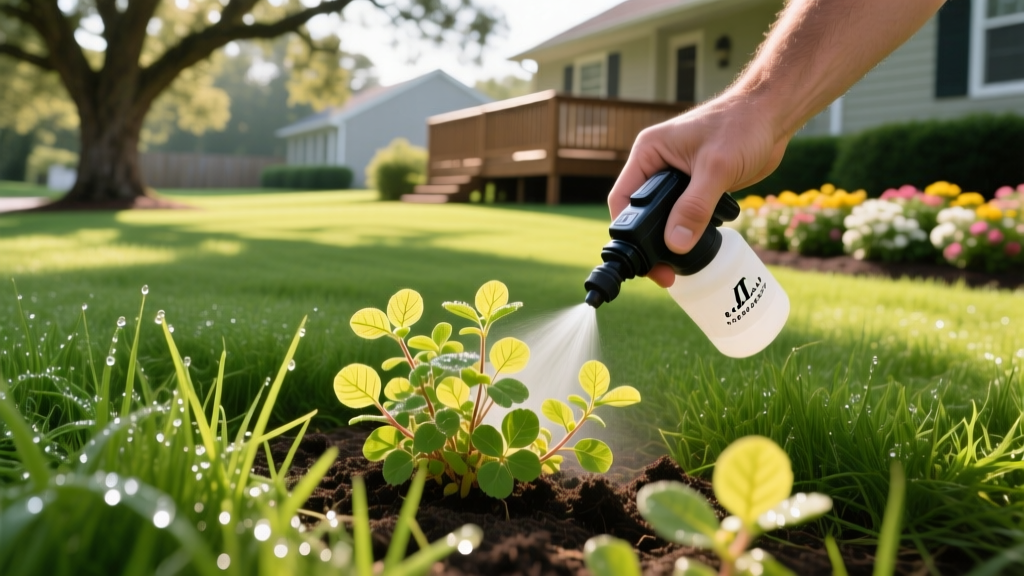
Killing Dollar Weed: Spot-Treatment Guide for Southern Lawns
The Biology of the Invader: Why Dollar Weed Thrives
Dollar weed (Hydrocotyle umbellata) is a hydrophilic, stoloniferous broadleaf weed that plagues warm-season lawns across the southern United States. Unlike many weeds that exploit dry, neglected turf, dollar weed is an indicator species for excessive soil moisture and compaction. According to the University of Florida IFAS Extension, this weed requires consistently wet soil conditions to germinate and spread its subterranean stolon network.
Before attempting chemical eradication, you must understand its growth habit. Dollar weed reproduces via seeds, tubers, and creeping stolons that root at the nodes. When you pull the visible round leaf, you are often leaving behind a massive underground rhizome network that will simply push up new leaves within 7 to 10 days. Effective control requires a dual approach: altering the soil hydrology and utilizing systemic post-emergent herbicides that translocate down into the root system.
Identification Warning: Dollar Weed vs. Dichondra
Homeowners frequently misidentify dichondra as dollar weed. Look at the petiole (leaf stem). On dollar weed, the petiole attaches to the exact center of the leaf, resembling an umbrella. On dichondra, the petiole attaches to the edge of the leaf. This distinction is critical, as dichondra is highly susceptible to certain herbicides that dollar weed can tolerate.
Homeowners frequently misidentify dichondra as dollar weed. Look at the petiole (leaf stem). On dollar weed, the petiole attaches to the exact center of the leaf, resembling an umbrella. On dichondra, the petiole attaches to the edge of the leaf. This distinction is critical, as dichondra is highly susceptible to certain herbicides that dollar weed can tolerate.
Pre-Treatment Cultural Adjustments (The Non-Negotiables)
Chemical spot-treatment will fail long-term if the environment remains favorable. Clemson University HGIC emphasizes that reducing soil moisture is the primary cultural control mechanism. Implement these adjustments before mixing your herbicide:
- Irrigation Auditing: Dollar weed thrives when the top 2 inches of soil remain saturated for more than 12 hours a day. Reduce your irrigation frequency. Water deeply but infrequently (e.g., 0.5 inches twice a week rather than 0.15 inches daily).
- Core Aeration: Compacted clay soils prevent water percolation, creating the boggy surface conditions dollar weed loves. Perform core aeration in early summer to break up the thatch and soil interface.
- Canopy Management: Prune lower branches of surrounding trees and shrubs. Dollar weed tolerates shade far better than Bermuda or Zoysia grass; increasing sunlight penetration helps the turf outcompete the weed.
2026 Spot-Treatment Chemical Matrix
Selecting the correct active ingredient depends entirely on your specific warm-season grass type. Using the wrong chemistry will result in severe phytotoxicity. Below is a comparative matrix of professional-grade and premium consumer formulations currently dominating the market.
| Active Ingredient | Brand Example | Safe Grasses | Mix Rate (per Gallon) | Est. Cost / 1k sq ft |
|---|---|---|---|---|
| Thiencarbazone + Iodosulfuron + Dicamba | Celsius WG | Bermuda, Zoysia, Centipede, St. Augustine | 0.113 oz (3.2g) | $1.20 - $1.50 |
| Sulfentrazone + Quinclorac | Blindside | Bermuda, Zoysia, Fescue, KBG | 0.75 oz | $0.90 - $1.10 |
| Atrazine | Image for Lawns | St. Augustine & Centipede ONLY | 4.0 oz | $0.30 - $0.50 |
| 2,4-D + Quinclorac + Dicamba | Ortho WeedClear | Bermuda, Zoysia, Fescue | Ready-to-Use | $2.00 - $3.00 |
Critical Phytotoxicity Warning: Never apply Atrazine to Bermuda or Zoysia grass. It will cause severe bleaching and potential death of the turf. Reserve Atrazine strictly for St. Augustine and Centipede lawns.
The Precision Spot-Spray Protocol
Broadcast spraying entire lawns for dollar weed is economically inefficient and environmentally irresponsible. Spot-treating isolated patches requires precise calibration. Follow this exact protocol for optimal translocation to the root system.
Step 1: Calibration and the W-A-L-E-S Mixing Order
Use a dedicated 1-gallon or 2-gallon pump sprayer. One gallon of mixed solution covers approximately 1,000 square feet when walking at a steady pace. Because professional herbicides like Celsius WG are Water Dispersible Granules (WG), you must follow the proper mixing sequence to prevent clumping:
- W (Wettable Powders / Granules): Add the Celsius WG to the sprayer filled halfway with water. Agitate vigorously until fully dissolved.
- A (Agitate): Continue stirring.
- L (Liquid Flowables): Add any liquid herbicides (if tank-mixing).
- E (Emulsifiable Concentrates): Add EC formulations.
- S (Surfactant): Add a Non-Ionic Surfactant (NIS) at a 0.25% v/v rate. This equates to roughly 1/2 teaspoon per gallon. The NIS breaks the surface tension of the waxy dollar weed leaf, allowing the chemical to penetrate the cuticle.
Step 2: Application Timing and Technique
Apply the solution when daytime temperatures are between 65°F and 85°F. Avoid spraying if rain is forecast within 24 hours. Do not mow the lawn for 48 hours before or after application; you need maximum leaf surface area to absorb the systemic herbicide. Spray the dollar weed patches until the leaves are visibly wet, but avoid heavy runoff that pools on the soil surface.
Step 3: The 28-Day Follow-Up
Systemic herbicides do not provide instant gratification. At day 7, the dollar weed leaves will begin to curl and yellow. By day 14, necrosis will be evident. Wait a full 28 days to evaluate the stolon network. If new, miniature leaves emerge from the soil, execute a second spot-treatment application at the exact same rate.
Troubleshooting Treatment Failures
If your dollar weed persists despite chemical intervention, diagnose the failure using these common edge cases:
- Symptom: Leaves turn yellow but the weed returns in 3 weeks.
Root Cause: You sprayed without a surfactant, or the soil pH is highly alkaline (above 7.5), which can tie up certain active ingredients like 2,4-D. Test your soil pH and apply elemental sulfur if necessary to lower it to the 6.0-6.5 range. - Symptom: Surrounding turf shows severe stunting or bleaching.
Root Cause: Sprayer overlap. When spot-treating, homeowners often walk back and forth over the same patch, delivering 3x the labeled dose. Use a dye marker (like Blue Dye) in your tank mix to visually track exactly where you have sprayed. - Symptom: Complete failure of the herbicide during mid-summer.
Root Cause: Heat stress. When temperatures exceed 90°F, warm-season grasses close their stomata to conserve water, and weeds do the same. The herbicide sits on the leaf surface and degrades under UV light before it can be absorbed. Shift applications to early morning or wait for a cooler weather front.
Long-Term Hydrological Management
Ultimately, killing dollar weed with herbicides is a temporary bandage if the soil remains a bog. To permanently eradicate the weed from your landscape architecture, you must address the drainage. For chronically wet zones, consider installing French drains or regrading the soil to achieve a minimum 2% slope away from the turf area. Topdressing your lawn with 1/4 inch of coarse sand or compost annually will gradually improve soil percolation, creating an environment where warm-season grasses thrive and hydrophilic weeds suffocate.

