
Lawn Care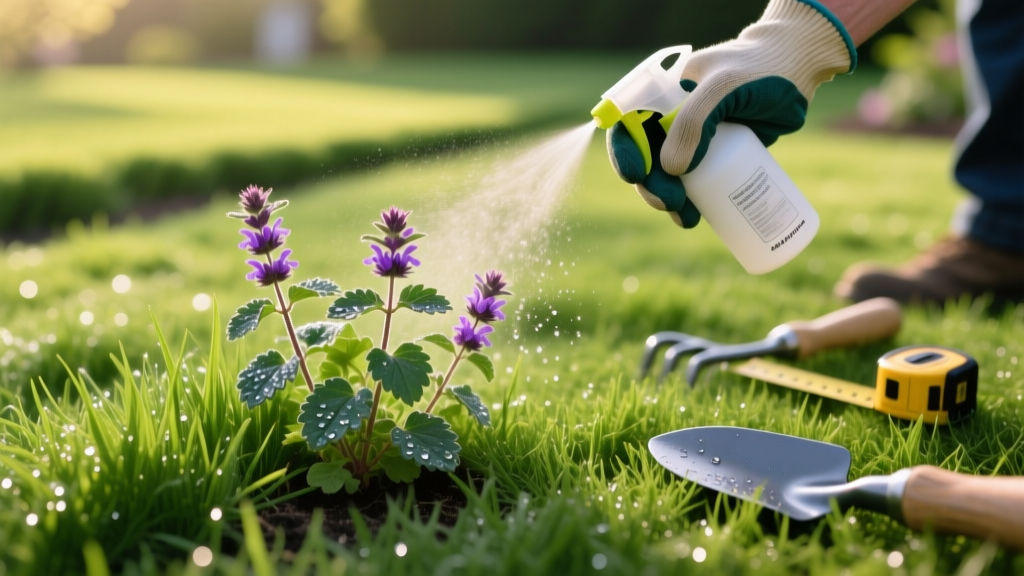
Spot-Treatment Guide: Killing Henbit Weed in Cool-Season Lawns
Henbit (Lamium amplexicaule) is a prolific winter annual broadleaf weed that exploits thin, dormant turf in cool-season lawns. Germinating in early autumn, it establishes a deep taproot over the winter and explodes into vibrant purple-flowered patches by early spring. While broadcast spraying is a common but inefficient approach, targeted spot-treatment is the most cost-effective and environmentally sound method for killing henbit weed before it drops thousands of seeds. This guide provides exact herbicide chemistries, mixing ratios, and application protocols to eradicate henbit without damaging your surrounding turf.
The Biology of Henbit: Why Timing Dictates Success
To effectively eliminate henbit, you must understand its lifecycle. Unlike summer annuals like crabgrass, henbit germinates when soil temperatures drop below 70°F in late summer and early fall. It grows slowly as a low-lying rosette throughout the winter, then bolts upward and flowers in March and April.
Identification Tip: Henbit is frequently confused with purple deadnettle (Lamium purpureum). Both have square stems and purple flowers, but henbit features upper leaves that clasp directly around the stem without a petiole (leaf stalk), whereas purple deadnettle has distinct petioles. According to NC State TurfFiles, both weeds respond identically to the herbicide protocols outlined below, so precise differentiation is not strictly necessary for chemical control.
The primary failure point in killing henbit weed is treating it too late in the spring. Once the plant begins flowering, it develops a thick, waxy cuticle on its leaves that repels water-based herbicides. Furthermore, the plant's energy shifts from vegetative growth to seed production, meaning systemic herbicides fail to translocate to the roots. Spot-treating in the fall or early winter, when the plant is in the rosette stage, yields a 95% or higher kill rate with standard chemistries.
Pre-Emergent Protocols: Stopping Henbit Before It Starts
If your lawn has a history of severe henbit infestations, post-emergent spot-treatment is a reactive battle. A proactive pre-emergent barrier is the ultimate solution. Pre-emergents work by inhibiting cell division in the germinating seed's radicle (first root), killing the weed before it breaches the soil surface.
Chemical Options and Application Rates
- Prodiamine (e.g., Barricade 65 WDG): Apply at a rate of 0.4 to 0.85 oz per 1,000 square feet. This provides a 4 to 6-month residual barrier. Timing is critical: apply in late August to early September, ensuring the product is watered in with 0.5 inches of irrigation within 48 hours.
- Dithiopyr (e.g., Dimension 2EW): Apply at 0.5 to 0.75 fl oz per 1,000 square feet in mid-September. Dithiopyr has the unique advantage of possessing early post-emergent activity, meaning it can still kill henbit seedlings that have already germinated but have not yet developed five leaves.
Post-Emergent Spot Treatment: The Herbicide Matrix
When henbit is already visible, spot-treatment with a 1-gallon or 2-gallon pump sprayer is the most efficient method. The choice of active ingredient depends entirely on the size and maturity of the weed.
| Active Ingredient (Group) | Best Used For | Mixing Rate (per Gallon) | Speed of Control |
|---|---|---|---|
| 2,4-D + Dicamba + MCPP (Group 4) | Young, fall rosettes | 1.5 fl oz (e.g., Trimec Classic) | 7–14 days |
| Carfentrazone (Group 14) | Mature, spring-flowering plants | 0.03 fl oz (e.g., Quicksilver) | 24–48 hours (Burn-down) |
| Triclopyr + Fluoroxypyr (Group 4) | Cool-weather spot treatments | 2.0 fl oz (e.g., Turflon Ester Ultra) | 10–14 days |
The Spring Flowering Problem: Why You Need a PPO Inhibitor
If you are killing henbit weed in March or April when the purple flowers are fully bloomed, standard auxin mimics (Group 4 herbicides like 2,4-D) will often fail. The plant's vascular system is focused on pushing energy upward to the flowers, not pulling liquids down to the roots. To overcome this, you must tank-mix a Group 14 PPO inhibitor like carfentrazone. Carfentrazone destroys the weed's cell membranes upon contact, causing rapid desiccation and necrosis. It essentially burns the top growth off within 24 hours, bypassing the need for systemic translocation.
Step-by-Step Spot Spraying Technique
Proper application technique is just as critical as the chemical itself. Henbit leaves are covered in fine, reflective hairs that can cause water droplets to bead up and roll off.
- Calibrate Your Sprayer: Use a 1-gallon poly pump sprayer equipped with a flat-fan nozzle (such as the TeeJet XR11002VS). Adjust the pressure to 20-30 PSI to produce medium-coarse droplets that minimize drift.
- Add a Non-Ionic Surfactant (NIS): This is non-negotiable for henbit. Add 0.25% v/v of a high-quality NIS (approximately 1/2 teaspoon per gallon of water). The surfactant breaks the surface tension of the water, allowing the herbicide to spread evenly across the hairy leaves and penetrate the waxy cuticle.
- Mix the Solution: Fill the sprayer halfway with water, add the surfactant, then add the herbicide. Agitate gently, then fill the rest of the water to prevent excessive foaming.
- Apply to Wet, Not Runoff: Spray the henbit until the leaves are uniformly wet and glistening, but stop before the liquid begins to drip onto the soil. Dripping wastes chemical and increases the risk of turf injury.
- Observe Weather Constraints: Do not spray if rain is expected within 4 hours. Avoid spraying when temperatures are below 45°F (herbicide uptake halts) or above 85°F (risk of volatilization and turf burn).
Warning on Turf Safety: When using products containing carfentrazone or high concentrations of 2,4-D on cool-season lawns (like Kentucky Bluegrass or Tall Fescue), temporary yellowing or stunting of the surrounding grass may occur. This is a known phytotoxic response that typically resolves within 14 days as the turf metabolizes the chemical. Never spot-treat St. Augustine or Centipede grass with standard 2,4-D mixes; use Atrazine or Penoxsulam instead.
Cultural Controls: Closing the Canopy
Chemical eradication is only half the battle. Henbit is a pioneer species that thrives in open, sunlit soil. According to Penn State Extension, a dense turf canopy is the most effective long-term biological control against winter annual weeds.
- Fall Overseeding: Core aerate your lawn in early September and overseed with a shade-tolerant, aggressive cool-season blend (such as a mix of 80% Tall Fescue and 20% Kentucky Bluegrass). Apply starter fertilizer at the time of seeding.
- Mowing Height: Raise your mower deck to 3.5 or 4.0 inches for the final two mows of the autumn season. Taller grass blades cast deeper shadows on the soil surface, depriving henbit seeds of the photoblastic light triggers they need to germinate.
- Strategic Nitrogen: Avoid heavy nitrogen applications in late spring, which primarily fuels top growth. Instead, focus your nitrogen budget on late fall (November) "winterizer" applications. This promotes deep root growth and early spring green-up, allowing your turf to outcompete germinating weeds.
By combining precise fall pre-emergent barriers, targeted post-emergent spot-treatments utilizing surfactants and PPO inhibitors, and aggressive canopy management, you can permanently break the lifecycle of henbit in your lawn.

