
Lawn Care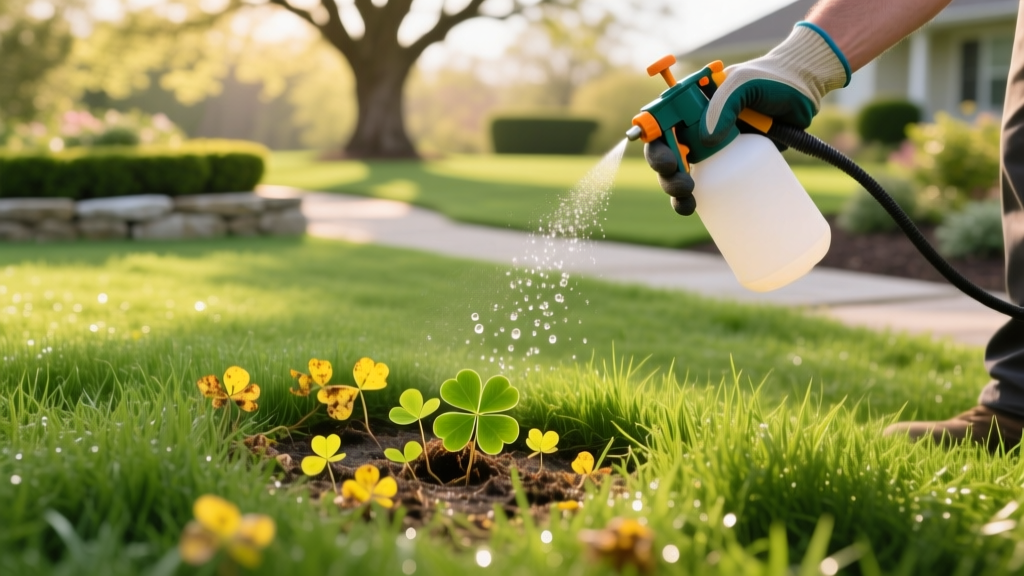
Killing Clover in Lawns: Expert Spot-Treatment & Herbicide Guide
Clover is one of the most persistent broadleaf weeds in residential turf. While a thin scattering of white clover (Trifolium repens) can actually benefit soil health by fixing atmospheric nitrogen, aggressive patches will rapidly outcompete your turfgrass for water, sunlight, and root space. Because clover spreads via both seeds and creeping stolons, simply mowing over it will not eradicate the problem.
This guide provides a precise, actionable framework for killing clover in lawns using targeted spot-treatments, professional-grade herbicide chemistry, and cultural soil corrections.
Why Clover Invades: The Soil Health Connection
Clover is an indicator plant. Its presence almost always signals a specific soil deficiency: low nitrogen. Unlike turfgrass, clover has a symbiotic relationship with Rhizobium bacteria in its root nodules, allowing it to pull nitrogen directly from the air. When your soil lacks available nitrogen, your grass starves and thins out, while the clover thrives and fills the void.
Expert Insight: Before spending money on herbicides, test your soil. If your nitrogen levels are critically low, killing the clover will only leave you with bare dirt that will quickly be recolonized by new weeds. Herbicide application must be paired with a nitrogen-rich fertilization program.
Identifying Your Clover (and Its Imposters)
Accurate identification dictates your chemical strategy. Homeowners frequently misidentify look-alikes, leading to failed treatments. Use this matrix to confirm the weed you are targeting.
| Weed Species | Leaf Structure | Flower Color | Herbicide Susceptibility |
|---|---|---|---|
| White Clover | 3 oval leaflets with white 'chevron' V-marks | White to pale pink | Moderate (Requires Triclopyr) |
| Black Medic | 3 teardrop-shaped leaflets, central stem longer | Small yellow clusters | High (Responds to 2,4-D) |
| Oxalis (Yellow Wood Sorrel) | 3 heart-shaped leaflets, folds down at night | Bright yellow, 5 petals | Low (Requires Fluroxypyr/Triclopyr) |
Chemical Spot-Treatment: The Heavy Hitters
When killing clover in lawns, standard consumer-grade 'weed and feed' granules are largely ineffective against established patches. You need a liquid spot-treatment utilizing specific active ingredients. According to University of California IPM guidelines, post-emergent broadleaf herbicides containing Triclopyr or a combination of 2,4-D, MCPP, and Dicamba yield the highest control rates.
The Secret Weapon: Non-Ionic Surfactants
Clover leaves possess a highly hydrophobic (water-repellent) waxy cuticle. If you spray a water-based herbicide directly onto clover without a surfactant, the liquid will bead up and roll off onto the soil, wasting the chemical and risking root damage to surrounding grass.
- The Fix: Add a non-ionic surfactant (e.g., Southern Ag Surfactant or Hi-Yield Spreader Sticker) to your tank mix.
- Rate: 1 teaspoon (approx. 5ml) of surfactant per gallon of mixed herbicide.
- Result: The surfactant breaks the surface tension, allowing the herbicide to spread evenly across the leaf and penetrate the cuticle.
Top Herbicide Recommendations for Clover
Here are the specific formulations that work best for residential spot-treatments:
- Bonide Chickweed, Clover & Oxalis Killer: A ready-to-spray or concentrate option containing Triclopyr. Ideal for small lawns. Cost: ~$18-$25 per bottle. Mix rate for concentrate: 2.5 oz per gallon of water.
- SpeedZone Broadleaf Herbicide (Professional Grade): Contains 2,4-D, MCPP, Dicamba, and Carfentrazone. Carfentrazone provides a rapid 'burn-down' effect, showing results in 24 hours. Cost: ~$130/gallon, but the mix rate is only 1.5 oz per gallon, making it highly cost-effective for large properties over multiple seasons.
- Fertilome Weed Free Zone: Excellent for cool-season grasses, combining 2,4-D, MCPP, Dicamba, and Carfentrazone. Safe for Fescue, Kentucky Bluegrass, and Ryegrass.
Step-by-Step Spot-Spraying Protocol
Follow this exact sequence to maximize herbicide uptake and protect your surrounding turfgrass.
Warning: Never apply broadleaf herbicides when temperatures exceed 85°F (29°C). High heat causes the chemicals to volatilize (turn into a gas), which can drift and severely damage nearby ornamental shrubs, trees, and garden beds.
- Mow First: Mow your lawn to a height of 2.5 to 3 inches. Wait 48 hours before spraying. This allows the clover to produce fresh, highly absorbent leaf tissue.
- Mix the Solution: In a 1-gallon or 2-gallon pump sprayer, add half the required water, then the herbicide, then the surfactant, then the remaining water. Agitate well.
- Targeted Application: Adjust the sprayer nozzle to a pin-stream or low-pressure fan. Spray the clover leaves until they are visibly wet, but not dripping. Dripping wastes chemical and increases soil residual.
- The Waiting Period: Do not water the lawn, and ensure no rain is in the forecast for at least 48 hours. The herbicide needs this time to translocate from the leaves down to the deep taproot.
- Follow-Up: Clover is a perennial with deep roots. A single application rarely achieves 100% kill. Expect to apply a second spot-treatment 21 to 28 days after the first application to catch any regrowth.
Organic and Cultural Eradication Methods
If you prefer to avoid synthetic chemicals, or if you are managing a lawn where pets and children play constantly, organic and mechanical methods are viable, though they require more physical labor and time.
Mechanical Extraction
Pulling clover by hand is ineffective because the taproot snaps, leaving the crown in the soil to regenerate. Instead, use a specialized stand-up weeding tool. The Fiskars 3-Claw Stand-Up Weeder (approx. $38) features serrated stainless steel claws that grip the taproot deeply. Position the claws directly over the clover crown, step on the foot platform, and leverage the handle back. This extracts the entire root system with minimal soil disruption.
Cultural Suppression via Nitrogen Loading
As noted by Penn State Extension, increasing soil nitrogen is the most effective long-term cultural control for clover.
- Organic Route: Apply Milorganite (5-2-0) at a rate of 32 lbs per 2,500 sq ft in early spring and early fall. It provides slow-release nitrogen and iron, thickening the grass canopy to shade out clover seedlings.
- Synthetic Route: Use a high-nitrogen fertilizer like Lesco 30-0-3. Apply 1 lb of actual nitrogen per 1,000 sq ft every 6 to 8 weeks during the active growing season.
Post-Treatment Lawn Recovery
Once the clover dies and turns brown (usually 10-14 days post-spray), you will be left with bare patches in your turf. If left alone, these patches will invite crabgrass or new clover seeds.
Overseeding Protocol: Rake out the dead clover debris to expose the soil. Apply a premium grass seed blend matched to your region (e.g., Jonathan Green Black Beauty Ultra for cool-season, or Pennington Bermudagrass for warm-season). Top-dress with 1/4 inch of compost, keep the seed consistently moist for 14 days, and avoid applying any pre-emergent herbicides for at least 60 days, as they will prevent your new grass seed from germinating.
Frequently Asked Questions
Will horticultural vinegar kill clover?
Yes, 20% to 30% horticultural vinegar (acetic acid) will burn the foliage of clover. However, it is a non-selective contact herbicide. It will instantly burn and kill any turfgrass it touches, leaving you with dead brown spots. It also does not translocate to the roots, meaning the clover will likely regrow within two weeks. It is not recommended for lawn use.
Is microclover the same as white clover?
No. Microclover (Trifolium repens var. 'Pirouette' or 'Nano') is a specially bred cultivar with much smaller leaves, fewer flowers, and a lower growth habit. It is increasingly used in 2026 as a deliberate lawn mix component to reduce fertilizer needs and drought stress. Do not treat microclover as a weed if it was intentionally seeded into your turf blend.
How much does professional clover treatment cost?
Hiring a professional lawn care service to treat a standard 5,000 sq ft lawn for broadleaf weeds typically costs between $65 and $110 per application. For a DIY spot-treatment using professional-grade concentrates like SpeedZone, the cost per 5,000 sq ft is roughly $12 to $18, making DIY highly cost-effective if you already own a pump sprayer.

