
Lawn Care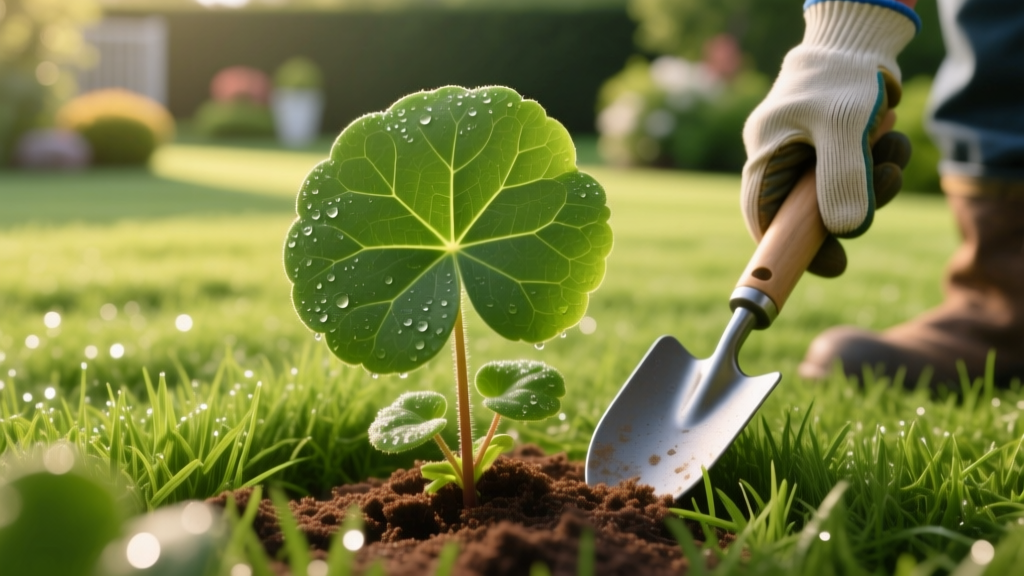
Large Round Leaf Weed: Identification and Spot Treatment
When homeowners spot aggressive broadleaves choking out their turf, they frequently search for the large round leaf weed taking over their yard. This descriptive term usually points to one of three distinct botanical invaders: Common Mallow (Malva neglecta), Broadleaf Plantain (Plantago major), or mature Dollarweed (Hydrocotyle umbellata). Each of these weeds features large, circular or oval foliage that forms dense rosettes, smothering desirable grass and disrupting lawn uniformity.
Blanket spraying your entire lawn is rarely necessary and often damages surrounding turf. Instead, targeted spot-treatment protocols offer precise eradication while preserving your grass. This guide breaks down exact identification markers, professional-grade chemical mixing ratios, and organic alternatives to eliminate these specific broadleaf invaders.
Identifying the Culprit: Which Large Round Leaf Weed Do You Have?
Accurate identification dictates your treatment strategy. While all three weeds produce large, rounded foliage, their root structures and leaf textures require different approaches. Consult the NC State Turffiles database for regional variations, but use this matrix for immediate field identification.
| Weed Species | Leaf Shape & Texture | Average Leaf Diameter | Root System | Key Field Identifier |
|---|---|---|---|---|
| Common Mallow | Perfectly round, fuzzy, crinkled edges | 1.5 to 3 inches | Shallow, fibrous taproot | Pale pink/white flowers in leaf axils; sticky seed pods ('cheeseweed') |
| Broadleaf Plantain | Oval/round, smooth, prominent parallel ribs | 2 to 5 inches | Deep, thick, fibrous taproot | Long, rat-tail seed spikes shooting up from the center rosette |
| Dollarweed | Perfectly round, smooth, scalloped edges | 1 to 4 inches | Rhizomes and tubers | Leaf stem attaches to the center of the leaf (umbrella-like) |
The Biology of Broadleaf Invaders
Understanding why these weeds thrive is critical for long-term control. According to the USDA Plants Database, Common Mallow thrives in compacted, low-fertility soils where turfgrass struggles to compete. Broadleaf Plantain, conversely, is an indicator of heavy clay and severe soil compaction. Both species produce a waxy cuticle on their leaves—a biological defense mechanism that causes standard liquid herbicides to bead up and roll off onto the soil.
Dollarweed requires a different cultural approach, as it is an indicator of excessive moisture and poor drainage. Attempting to chemically eradicate Dollarweed without fixing irrigation leaks or grading issues will result in rapid reinfection from its underground tubers.
Chemical Spot-Treatment Protocols
For rapid eradication of Mallow and Plantain, systemic and ester-based herbicides are required. Amine-based herbicides (often found in cheap big-box store sprays) struggle to penetrate the waxy cuticle of mature Mallow leaves.
Professional-Grade Ester Formulation (Fast Burn-Down)
- Product: SpeedZone Broadleaf Herbicide for Turf (Active ingredients: Carfentrazone-ethyl 0.57%, 2,4-D 21.25%, MCPP-p 5.45%, Dicamba 1.77%).
- Cost: Approximately $145 per gallon (2026 pricing).
- Mix Rate: 1.5 fluid ounces per 1,000 square feet, diluted in 1.5 to 2 gallons of water.
- Application: Spot-spray directly onto the rosette until the leaves are wet, but not dripping. Expect visible leaf curl and necrosis within 24 to 48 hours.
Consumer-Grade Systemic Formulation (Slower, Deep Root Kill)
- Product: Ortho WeedClear Lawn Weed Killer (Active ingredients: 2,4-D, Quinclorac, Dicamba).
- Cost: $22 for a 32 oz ready-to-spray hose-end bottle.
- Application: Best for smaller infestations. Apply when daytime temperatures are strictly between 65°F and 85°F to prevent vapor drift that can damage nearby ornamental shrubs.
Pro-Tip: The Surfactant Multiplier
Because the large round leaf weed species (especially Mallow) feature fuzzy or waxy surfaces, you must add a Non-Ionic Surfactant (NIS) to your tank mix. Add 0.25% v/v (roughly 1/2 teaspoon per gallon of water) of a product like DyneAmic or a generic agricultural NIS. This breaks the surface tension, forcing the herbicide into the plant tissue rather than letting it evaporate off the leaf.
Organic and Non-Chemical Eradication
If you maintain an organic lawn or are treating weeds near edible garden beds, synthetic auxin herbicides (2,4-D, Dicamba) are off-limits. Use these targeted organic protocols instead.
Warning: Organic contact herbicides are non-selective. They will burn your turfgrass just as aggressively as the weed. Use a cardboard shield or a specialized bell-sprayer nozzle to confine the spray strictly to the broadleaf weed.
Horticultural Acetic Acid (Vinegar)
Standard 5% kitchen vinegar is ineffective against mature broadleaves. You need 20% to 30% horticultural acetic acid (Cost: ~$45 per gallon). Spray on a hot, sunny day when temperatures exceed 80°F. The heat accelerates the desiccation process, melting the waxy cuticle and collapsing the plant cells within hours. Note that this only burns the top growth; Mallow may require a second application 10 days later to exhaust the root reserves.
Mechanical Extraction
For Broadleaf Plantain, hand-pulling is highly effective if done correctly. You cannot simply yank the leaves. Use a dandelion digger or a soil knife (like the Hori Hori) to penetrate the soil 4 to 6 inches deep directly beside the crown. Leverage the tool to pop the entire thick taproot out. If the taproot snaps, the plant will regenerate within three weeks.
Post-Treatment Lawn Recovery
Eradicating the weed leaves a bare spot that will quickly be colonized by crabgrass or spurge if left untreated. According to Penn State Extension, immediate turf recovery is the ultimate weed prevention strategy.
- Scarify the Soil: Once the weed has died and been removed, use a hand rake to scratch the top 1/4 inch of soil in the bare patch.
- Overseed: Apply a matching grass seed at a rate of 4 to 6 seeds per square inch. For cool-season lawns, use a turf-type tall fescue blend.
- Top-Dress and Water: Cover the seed with 1/8 inch of compost or peat moss. Water lightly twice a day for 14 days to ensure germination before the next weed seed blows in.
Frequently Asked Questions
Why does the large round leaf weed keep coming back after I pull it?
If you are dealing with Broadleaf Plantain, you are likely leaving the bottom two inches of the taproot in the soil. If you are dealing with Dollarweed, you are leaving behind underground rhizomes and tubers. Chemical treatment is often required to translocate the kill signal down into the root system.
Can I use a weed-and-feed product to kill these weeds?
Weed-and-feed granular products are highly inefficient for spot-treating large, established broadleaves. The herbicide granules must stick to the wet leaves of the weed to be absorbed. On large, waxy, or fuzzy leaves, the granules simply bounce off and fall into the soil, where they are rendered useless. Liquid spot-spraying is vastly superior.
Is Common Mallow edible?
Yes, Malva neglecta is entirely edible and highly nutritious, often used in foraging as a spinach substitute. However, if you have treated your lawn with synthetic herbicides like 2,4-D or Carfentrazone, you must not consume any weeds or plants from that area for at least one full growing season.

