
Lawn Care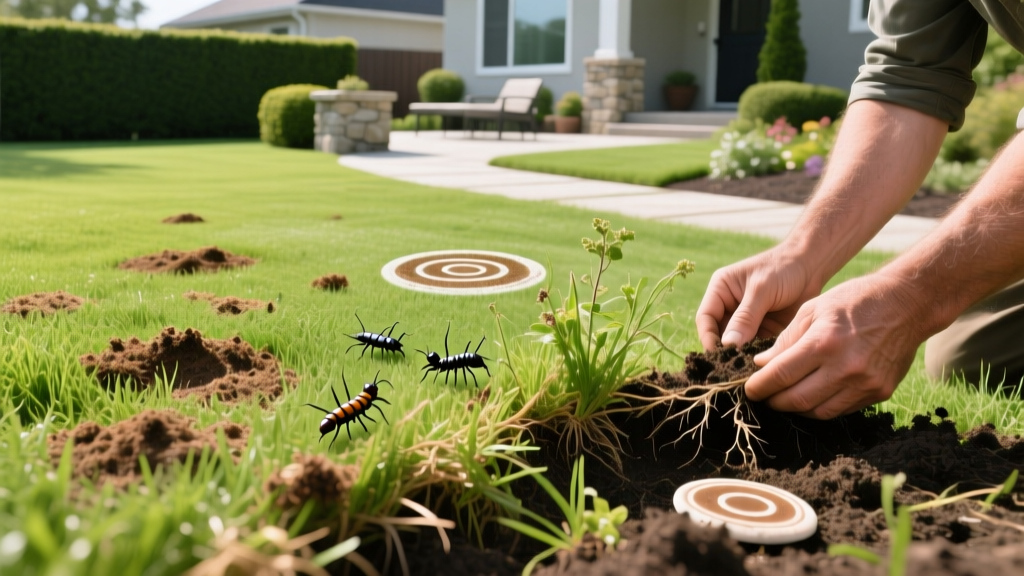
Why Is My Lawn Dying? Symptom Diagnosis and Emergency Rescue Fixes
When turfgrass transitions from vibrant green to brittle brown, homeowners often panic and immediately increase irrigation or apply random fertilizers. This reactive approach frequently accelerates turf decline. A lawn dying in localized patches or across the entire yard is a symptom of a specific biological or environmental failure. Accurate diagnosis requires isolating the root cause before deploying targeted rescue treatments.
The 60-Second Tug Test: Is Your Lawn Dead or Dormant?
Before purchasing chemical treatments, determine if the turf is actually dead or simply dormant. Cool-season grasses (Kentucky Bluegrass, Tall Fescue) naturally enter dormancy during prolonged summer heat exceeding 85°F, while warm-season grasses (Bermuda, Zoysia) go dormant after the first hard frost.
Perform the Crown Tug Test: Grasp a handful of brown grass near the soil line and pull upward.
- Dormant (Rescueable): The grass resists pulling. Inspect the crown (the base of the plant where roots meet shoots). If the crown is firm, white, or pale green, the plant is alive and conserving water.
- Dead (Requires Renovation): The grass pulls up effortlessly with minimal root resistance. The crown is brown, brittle, and shriveled. No chemical or watering regimen will revive dead tissue; this area requires core aeration and overseeding.
Symptom-to-Cause Diagnostic Matrix
Use this matrix to cross-reference your lawn's visual symptoms with the most likely underlying culprits. According to the University of Minnesota Extension, misidentifying environmental stress as a pest issue is the most common cause of secondary turf damage.
| Visual Symptom | Pattern & Spread | Peak Season | Primary Culprit | Immediate Diagnostic Action |
|---|---|---|---|---|
| Irregular brown patches, 1-5 ft wide | Expands outward daily; smoke-ring border visible in morning dew | Early to Mid-Summer (High humidity, night temps >68°F) | Brown Patch Fungus (Rhizoctonia solani) | Inspect individual grass blades for tan lesions with dark borders. |
| Spongy turf, peels back like carpet | Random scattered patches; high bird or skunk activity | Late Summer to Early Fall | White Grub Infestation | Peel back 1 sq ft of sod; count C-shaped white larvae in the top 2 inches of soil. |
| Straw-colored, silver-dollar-sized spots | Coalesces into large blighted areas; cobweb-like mycelium at dawn | Late Spring / Early Fall (Moderate temps, heavy dew) | Dollar Spot (Clarireedia jacksonii) | Check for hourglass-shaped lesions on leaf blades. |
| Localized dry, brown rings or arcs | Often around trees, driveways, or south-facing slopes | Mid-Summer (Drought stress periods) | Hydrophobic Soil / Localized Dry Spot (LDS) | Push a 6-inch screwdriver into the soil. If it won't penetrate, soil is compacted/hydrophobic. |
Emergency Rescue Protocols by Root Cause
⚠️ CRITICAL WARNING: Chemical Mixing
Never apply broadleaf herbicides (like 2,4-D) and systemic fungicides within 14 days of each other. The solvent carriers in herbicides can push fungicides too deeply into the soil profile, rendering them ineffective against foliar diseases and potentially causing phytotoxicity to the turf crown.
1. Grub & Insect Infestation Rescue
If your tug test reveals spongy turf that rolls back like a carpet, and you find more than 5-7 white grubs per square foot, you have a destructive infestation. By late summer, preventative products are useless; you must deploy a fast-acting curative insecticide.
The Curative Fix: Apply Trichlorfon (commonly sold as Dylox).
Unlike preventative chemicals that take weeks to build up in the root zone, Trichlorfon kills active grubs within 24 to 48 hours.
Application Rate: 3 lbs per 1,000 sq ft.
Cost: Approximately $38-$45 per 30 lb bag (covers ~3,000 sq ft).
The Catch: Trichlorfon degrades rapidly in water with a high pH (above 7.0). You must water the product in immediately after application with exactly 0.5 inches of irrigation to move it into the root zone before it breaks down.
2. Fungal Disease Triage (Brown Patch & Dollar Spot)
Fungal pathogens thrive when three conditions align: a susceptible host, a virulent pathogen, and a favorable environment (prolonged leaf wetness). The Clemson University Home & Garden Information Center emphasizes that altering the environment (improving drainage, pruning tree canopies for airflow) is just as critical as chemical intervention.
The Chemical Fix: For active Brown Patch or Dollar Spot, contact fungicides (like Chlorothalonil) will only protect new growth. You need a systemic fungicide to halt the infection inside the plant tissue.
- Propiconazole (FRAC Code 3): Excellent curative action for Dollar Spot and Rust. Cost: ~$45 for a 16 oz bottle of generic Banner Maxx equivalent.
- Azoxystrobin (FRAC Code 11): The gold standard for Brown Patch and Pythium Blight. Cost: ~$60-$85 for a 32 oz bottle of Heritage SC equivalent.
💡 Pro Tip: Rotate FRAC Codes
Fungi rapidly develop resistance to single-mode-of-action chemicals. Always alternate between FRAC Code 3 (DMI fungicides) and FRAC Code 11 (QoI fungicides) every 21 to 28 days during peak summer disease pressure.
3. Hydrophobic Soil & Localized Dry Spot (LDS)
If an area turns brown despite receiving the same irrigation as the surrounding green turf, the soil has likely become hydrophobic. Organic acids from decaying thatch coat soil particles, repelling water and creating localized dry spots. Simply watering more will only cause runoff.
The Rescue Fix: Apply a soil penetrant surfactant, such as Aqua-Aid or Cascade Plus. These wetting agents break the surface tension of water, allowing it to penetrate the waxy, hydrophobic soil crust.
Application: Mix 3-6 oz of liquid surfactant per 1,000 sq ft in a backpack sprayer. Apply to the dry spots, then immediately irrigate with 0.25 inches of water. Results (visible re-wetting of the soil profile) are typically seen within 48 hours. Follow up with deep-tine aeration to physically fracture the compacted subsurface layer.
Post-Rescue Recovery: The 30-Day Rehab Schedule
Once the primary pathogen or pest is neutralized, the lawn requires a structured rehabilitation protocol to rebuild root mass and canopy density.
- Days 1-7 (Stabilization): Maintain soil moisture at 60% field capacity. Avoid nitrogen-heavy fertilizers, which force weak, succulent top-growth that is highly susceptible to secondary fungal attacks. Apply a slow-release, potassium-rich fertilizer (e.g., 0-0-22 SOP) to strengthen cell walls and improve drought tolerance.
- Days 8-14 (Root Rebuilding): Transition to deep, infrequent watering. Apply 1 inch of water every 3-4 days rather than 0.25 inches daily. This forces the surviving roots to grow deeper into the soil profile to chase the moisture gradient.
- Days 15-30 (Canopy Fill): If the tug test confirmed dead patches larger than a dinner plate, perform spot-seeding. Rake the dead thatch down to bare soil, apply a starter fertilizer (high in phosphorus, like 18-24-12), and sow seed matching your existing turf cultivar. Keep the seedbed continuously moist for 14 days until germination is complete.
Frequently Asked Questions
Can dog urine cause my lawn to die in specific spots?
Yes. Dog urine contains high concentrations of urea (nitrogen) and salts. The nitrogen overload essentially burns the grass crown, creating a dead brown center surrounded by a dark green ring of stimulated growth (where the nitrogen dose was low enough to act as a fertilizer). To fix this, immediately flush the area with 2 gallons of water after the pet urinates to dilute the salts below the root zone. Do not apply gypsum or lime; water dilution is the only scientifically proven mitigation.
My lawn is dying despite watering an hour every day. What is happening?
Daily, shallow watering promotes shallow root systems and keeps the thatch layer perpetually wet, creating an ideal breeding ground for fungal pathogens like Pythium Blight. Furthermore, shallow watering encourages weed germination (like crabgrass and nutsedge). Transition immediately to watering 1 to 1.5 inches per week, split into two or three deep sessions, allowing the top inch of soil to dry out between waterings.
How much does professional lawn rescue cost compared to DIY?
DIY rescue using consumer-grade chemicals (like Scotts GrubEx or BioAdvanced Fungus Control) typically costs $0.02 to $0.04 per square foot. Professional commercial-grade applications (using products like Acelepryn or Heritage) cost between $0.08 and $0.15 per square foot per visit. However, commercial products offer 30-50% longer residual control and higher active ingredient concentrations, often requiring fewer total applications over a season.

