
Lawn Care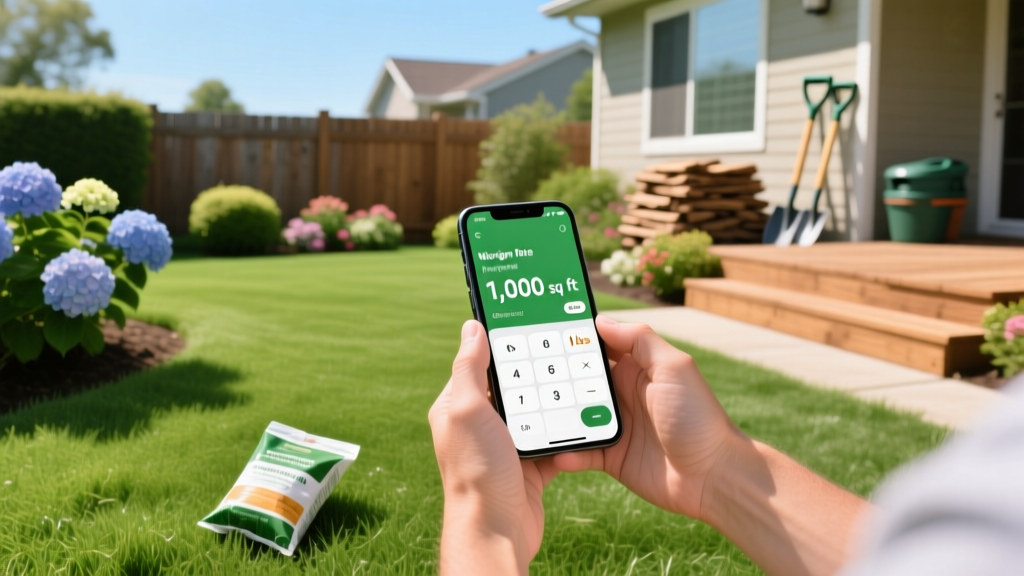
How to Use a Lawn Fertilizer Calculator for Exact Nitrogen Rates
Applying too much nitrogen burns turf, wastes money, and pollutes local waterways, while applying too little leaves your grass thin and vulnerable to weed invasion. Most homeowners rely on the generic coverage numbers printed on fertilizer bags, which often leads to over-application. A dedicated lawn fertilizer calculator removes the guesswork by aligning your specific turfgrass species, precise yard square footage, and the exact N-P-K ratio of your chosen product.
The Core Formula Behind Every Lawn Fertilizer Calculator
Every digital or manual lawn fertilizer calculator relies on a single foundational metric: pounds of actual nitrogen per 1,000 square feet. Fertilizer bags display three numbers (e.g., 24-0-6), representing the percentage by weight of Nitrogen (N), Phosphorus (P), and Potassium (K). The calculator's primary job is to translate your target nitrogen rate into the physical weight of the product you need to put in your spreader.
If a turfgrass scientist recommends 1 pound of nitrogen per 1,000 square feet for a fall application, you cannot simply apply 1 pound of a 24-0-6 fertilizer. That product is only 24% nitrogen. The calculator bridges this gap using a simple division formula.
Step-by-Step: Calculating Your Exact Product Weight
To manually verify the output of your lawn fertilizer calculator, follow this exact sequence:
- Determine Net Turf Area: Measure your total property, then subtract the square footage of your house, driveway, patios, and landscape beds. A 10,000 sq ft lot might only have 6,500 sq ft of actual grass.
- Identify the Target Nitrogen Rate: For a standard maintenance application, the target is typically 1.0 lb of N per 1,000 sq ft. For a heavy spring push on warm-season grasses, it might be 1.5 lbs.
- Divide 100 by the First N-P-K Number: If using a 20-5-10 fertilizer, divide 100 by 20. The result is 5. This means you need 5 pounds of this specific product to deliver exactly 1 pound of actual nitrogen.
- Calculate Total Product Needed: Multiply the result from Step 3 by your net turf area divided by 1,000. For a 6,500 sq ft lawn using 20-5-10: 5 lbs × 6.5 = 32.5 pounds of total product required for the entire yard.
Pro Tip: Always calibrate your broadcast spreader before applying. Set the spreader to the manufacturer's recommended setting for the specific fertilizer prill size, then test your walk speed over a 1,000 sq ft marked area to ensure you are dropping the exact calculated weight.
Annual Nitrogen Requirements by Turfgrass Species
Your lawn fertilizer calculator is only as accurate as the target rate you input. Different grass species have vastly different metabolic demands. Cool-season grasses generally require less total nitrogen than warm-season grasses, but the timing of the applications is critical.
| Turfgrass Species | Season Type | Annual Nitrogen Target (lbs N / 1,000 sq ft) | Peak Application Window |
|---|---|---|---|
| Kentucky Bluegrass | Cool-Season | 2.0 - 4.0 | Early Fall (September) |
| Tall Fescue | Cool-Season | 2.0 - 3.0 | Late Fall (November) |
| Bermudagrass | Warm-Season | 3.0 - 5.0 | Late Spring (May) |
| Zoysiagrass | Warm-Season | 1.5 - 3.0 | Early Summer (June) |
| Centipedegrass | Warm-Season | 0.5 - 1.5 | Early Summer (June) |
Why Your Soil Test Overrides the Calculator
A standard lawn fertilizer calculator assumes your soil has adequate levels of Phosphorus (P) and Potassium (K). However, blind application of high-phosphorus starter fertilizers on mature lawns is a leading cause of algae blooms in municipal water systems. According to the UMass Extension Soil and Plant Tissue Testing Laboratory, many residential soils already contain excessive phosphorus from decades of historical fertilizer use.
Before running your spring calculations, invest $25 to $40 in a professional soil test from a university extension lab. If your test results show 'Optimum' or 'Excessive' Phosphorus, adjust your calculator inputs to seek out zero-phosphorus fertilizers (e.g., 24-0-6 or 32-0-4). Applying a 10-10-10 fertilizer simply because it was on sale ignores the chemical reality of your soil profile.
Quick-Release vs. Slow-Release Nitrogen Math
Advanced fertilizer calculators also factor in the nitrogen release rate. Fertilizer labels must disclose the percentage of Water Insoluble Nitrogen (WIN) or slowly available nitrogen.
- Quick-Release (e.g., Urea, Ammonium Sulfate): Provides immediate green-up within 48 hours but carries a high risk of foliar burn if applied at rates exceeding 1.0 lb N per 1,000 sq ft without immediate watering.
- Slow-Release (e.g., Methylene Urea, Polymer-Coated Sulfur-Coated Urea): Feeds the turf gradually over 6 to 12 weeks. You can safely apply up to 1.5 lbs of slow-release N per 1,000 sq ft in a single pass without burning the grass.
For summer applications on cool-season grasses, the Purdue University Turfgrass Extension strongly recommends using products where at least 50% of the nitrogen is slow-release to prevent rapid, succulent growth that invites brown patch fungus.
Troubleshooting Common Calculator Errors
Even with perfect math, application errors can ruin your lawn. Watch out for these edge cases:
- The Spreader Overlap Tax: Broadcast spreaders throw fertilizer in an overlapping pattern. If you do not account for the 20% overlap required for even coverage, your calculator's total product weight will run out before you finish the lawn. Always buy 10% more product than the calculator dictates.
- Turning on the Concrete: Fertilizer burn on driveways and sidewalks occurs when homeowners leave the spreader gate open while turning around. Always close the gate, turn, and realign before reopening.
- Misjudging Prill Size: If you use a calculator to determine you need 4 lbs per 1,000 sq ft, but the physical prills of your chosen brand are unusually large, the spreader setting must be widened to maintain the correct flow rate.
Frequently Asked Questions
Can I use a lawn fertilizer calculator for liquid applications?
Yes, but the math shifts from weight to volume. Liquid fertilizers are measured in ounces per 1,000 square feet. You must check the product label for the specific gravity and nitrogen concentration by volume, which often differs from granular weight percentages.
How often should I recalculate my fertilizer rates?
You should recalculate every time you switch fertilizer brands or N-P-K ratios. If you use the exact same product (e.g., Scotts Turf Builder 32-0-4) for every application, your base calculation remains static, though you may adjust the target nitrogen rate down to 0.5 lbs per 1,000 sq ft for lighter summer maintenance feeds.

