
Lawn Care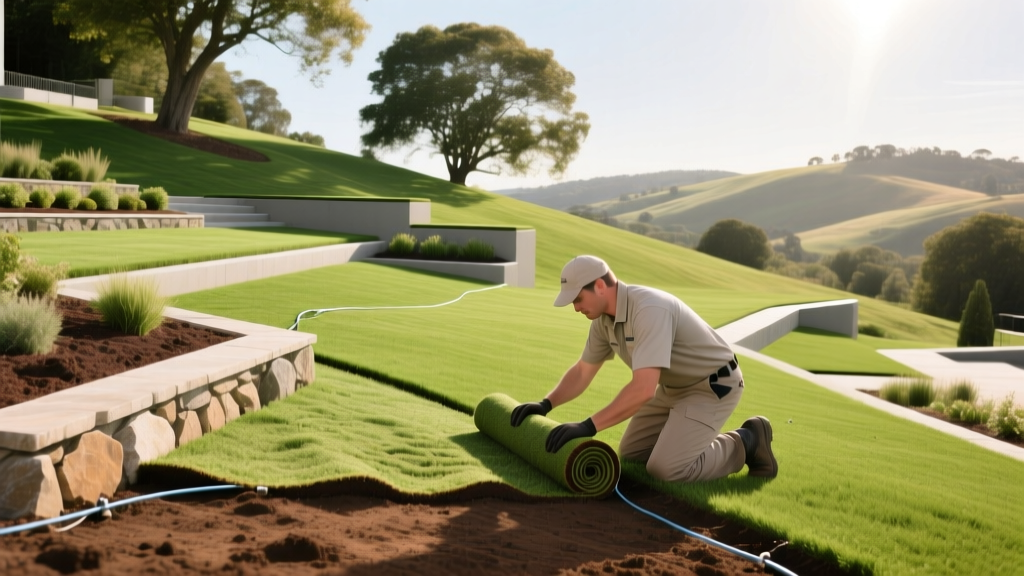
Lawn Installation Edwards Hill: Solving Slope & Soil Issues
Standard flatland turf protocols fail in the Edwards Hill topography. The region is defined by 15% to 35% gradients, heavy silty-clay loam deposits, and severe surface runoff during spring thaw and heavy summer convective storms. Attempting a conventional broadcast seed or standard sod installation on these slopes results in catastrophic seed washout, sod slippage, and localized turf asphyxiation from water pooling in clay depressions. Successful lawn installation in Edwards Hill requires treating the site as an engineered landscape rather than a standard residential yard.
Edwards Hill Site-Condition Profile
- Primary Soil Type: Silty-clay loam (Percolation rate: 0.1 to 0.4 inches/hour)
- Average Gradient: 18% to 32% (Moderate to steep slope)
- Primary Failure Modes: Shear erosion, clay compaction, rain-shadow drought stress
- USDA Hardiness Zone: Transition Zone (6b/7a)
Problem 1: Shear Erosion on 15-35% Gradients
On slopes exceeding a 15% grade, gravity and surface tension pull water down the incline faster than the clay soil can absorb it. According to USDA NRCS soil survey data, silty-clay loams on inclines are highly susceptible to sheet erosion before turf roots can establish. You must mechanically anchor the soil and the turf simultaneously.
The Anchoring Protocol for Sloped Sod
Do not rely on soil contact alone to hold sod on an Edwards Hill slope. You must use a mechanical pinning system combined with biodegradable friction matting.
- Apply GeoJute Netting: Roll out 400 g/m² woven jute netting directly over the prepared soil. Jute provides immediate surface friction, reducing water velocity by up to 60% while allowing seed or sod roots to penetrate.
- Lay the Sod: Install sod horizontally across the slope (parallel to the contour lines), never vertically. Stagger the joints like brickwork to prevent continuous water channels.
- Pin with 11-Gauge Steel Staples: Use 6-inch, 11-gauge U-shaped landscape staples. Drive one staple every 2 square feet. On slopes exceeding 25%, increase density to one staple per 1 square foot along the top edge and seams.
Warning: Never use plastic erosion control mesh on residential lawns. Plastic mesh does not degrade, tangles in mower blades, and creates a tripping hazard once the soil settles.
Hydroseeding vs. Sod on Steep Grades
If the slope exceeds 30%, sod becomes dangerously heavy and prone to sliding before roots knit. Hydroseeding with a specific tackifier blend is the superior choice for extreme Edwards Hill gradients.
| Method | Best For Slope Grade | Required Additives | 2026 Avg. Cost (per sq ft) |
|---|---|---|---|
| Sod (Pinned) | 15% - 25% | Jute netting, 11ga staples | $1.65 - $2.10 |
| Hydroseed | 20% - 40% | Polyacrylamide (PAM) tackifier | $0.18 - $0.26 |
| Broadcast Seed | 0% - 10% (Flat) | Straw mulch (not hay) | $0.05 - $0.09 |
Problem 2: Heavy Clay Compaction in Hillside Depressions
Edwards Hill topography creates natural swales and depressions where water pools. Because the native silty-clay loam has a percolation rate of less than half an inch per hour, these areas turn into anaerobic mud pits that suffocate turf roots. Rototilling in more topsoil or compost often creates a 'bathtub effect' where water gets trapped between the loose topsoil and the hard clay pan below.
The Chemical and Structural Amendment Strategy
Instead of deep tilling, use a combination of structural aggregates and liquid soil conditioners to permanently alter the clay matrix.
- Expanded Shale Top-Dressing: Apply 1.5 cubic yards of expanded shale per 1,000 square feet to low-lying clay areas. Core aerate with 3-inch hollow tines, then drag the shale into the holes. Expanded shale is permanently porous and will not break down like compost, providing permanent macro-pores for drainage.
- Liquid Aeration (Surfactants): Apply a liquid soil penetrant containing Ammonium Laureth Sulfate (ALS) or a humic acid blend (such as N-EXT Lawn Products Air-8) at 3 oz per 1,000 sq ft. This breaks the sodium bonds in heavy clay, allowing water to infiltrate rather than pool.
Problem 3: Turfgrass Selection for Microclimates
The Edwards Hill canopy creates distinct microclimates: south-facing slopes experience intense summer drought stress, while north-facing slopes and ravines suffer from heavy shade and prolonged morning dew, inviting fungal pathogens like Brown Patch (Rhizoctonia solani). NC State TurfFiles notes that standard Kentucky Bluegrass will fail in both extremes without intensive chemical intervention.
Recommended Cultivars for Edwards Hill
| Cultivar / Brand | Grass Type | Ideal Microclimate | Key Advantage |
|---|---|---|---|
| Barenbrug RTF | Rhizomatous Tall Fescue | Slopes, Erosion Zones | Spreads via rhizomes to knit soil together on inclines |
| Zeon Zoysia | Warm-Season Zoysia | South-Facing, Full Sun | Extreme drought tolerance; deep root mass in clay |
| Shade-Glove Fine Fescue | Creeping Red/Chewings | North-Facing, Ravines | Thrives in low-light, requires 50% less water |
Cost & Timeline Breakdown for Hillside Installation
Budgeting for an Edwards Hill installation requires accounting for the labor premium associated with slope work and specialized soil amendments. Below is the projected 2026 cost matrix for a standard 5,000 sq ft sloped backyard renovation.
5,000 Sq Ft Sloped Renovation Estimate
- Site Grading & Swale Engineering: $1,800 - $2,500 (Includes laser-leveling and French drain trenching)
- Clay Amendment (Expanded Shale + Liquid Aeration): $650 - $850
- Erosion Control (GeoJute & Staples): $400 - $550
- RTF Sod Material & Pinning Labor: $4,500 - $6,000
- Total Project Range: $7,350 - $9,900
Edge Case Troubleshooting: Post-Installation Washouts
Even with proper pinning, a sudden 2-inch rain event within 48 hours of installation can cause silt to wash up through the sod seams, creating dead zones. If this occurs:
- Do not attempt to lift and re-lay the sod; the root hairs will be destroyed.
- Use a stiff push broom to aggressively sweep the deposited silt off the turf blades and back down the slope.
- Apply a fast-acting polyacrylamide (PAM) granular soil binder at 2 lbs per 1,000 sq ft to immediately flocculate the remaining loose clay particles and halt further erosion.
- Delay the first mowing until the sod resists upward pull (typically 21-28 days on cool clay soils).
'Hillside turf management is 80% water management. If you solve the velocity of the water moving down the Edwards Hill gradient, the grass will take care of itself.'

