
Lawn Care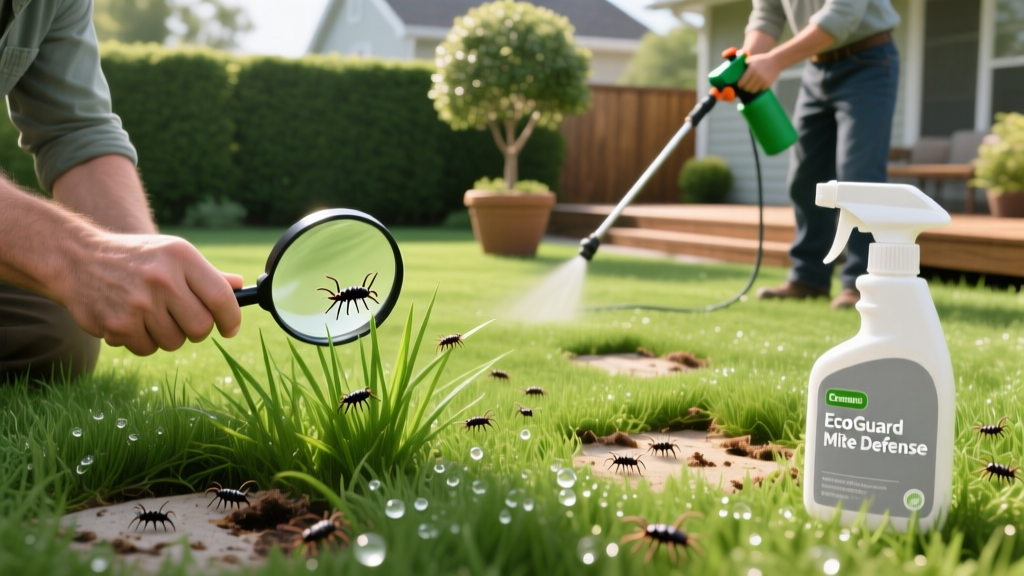
Lawn Mite Control: Step-by-Step Eradication and Prevention Guide
The Hidden Threat of Lawn Mites
Lawn mites are microscopic arachnids belonging primarily to the Tetranychidae (spider mites) and Eriophyidae (gall/erineum mites) families. Unlike surface-feeding insects, mites use specialized mouthparts to puncture individual turfgrass cells, extracting chlorophyll and cellular sap. The two most destructive species in North American turf are the Banks grass mite (Oligonychus pratensis), which attacks both cool- and warm-season grasses, and the Bermudagrass mite (Aceria cynodoniensis), which exclusively targets bermudagrass cultivars. Because they thrive in hot, dry, and dusty environments, their damage is frequently—and incorrectly—diagnosed as drought stress or localized dry spot. Effective eradication requires a precise, multi-phase approach combining accurate diagnostics, targeted translaminar miticides, and aggressive cultural modifications.
⚠️ Diagnostic Warning: Never apply broad-spectrum insecticides like carbaryl or imidacloprid for suspected mite damage. These chemicals eliminate the natural predatory insects (like lady beetles and predatory thrips) that keep mite populations in check, often triggering a massive secondary mite outbreak known as a 'resurgence.'
Phase 1: Accurate Lawn Mite Identification
Before purchasing chemicals, you must confirm the presence of mites. Visual symptoms alone are insufficient, as nematode damage and localized irrigation failures mimic mite stippling.
The White Paper Diagnostic Test
- Cut a piece of stiff white paper or use a white ceramic plate.
- Select a section of turf at the 'leading edge' of the damage—where the green grass meets the yellowing, stressed grass.
- Hold the paper directly beneath the grass canopy and vigorously shake the grass blades for 10 seconds.
- Inspect the paper. Lawn mites are roughly the size of a printed period (0.5mm). Look for tiny, slow-moving specks that are dark red, brown, or pale green.
- If you see movement, use a 10x jeweler's loupe to confirm the presence of eight legs, distinguishing them from six-legged insects like aphids or leafhoppers.
Species-Specific Symptom Profiles
- Banks Grass Mite: Causes fine, yellowish-white stippling on the upper leaf surface. In severe infestations, you will notice fine, silken webbing at the base of the grass blades and along the thatch line. The turf takes on a dull, grayish-green cast before turning completely brown.
- Bermudagrass Mite: Injects a toxic saliva that disrupts plant hormones, causing 'witches' broom'—a condition where the internodes shorten drastically, and the grass forms tight, tufted, yellow-green rosettes. The turf feels spongy and scalps easily when mowed.
Phase 2: Immediate Chemical Mitigation
Once confirmed, immediate chemical intervention is required to break the breeding cycle. Lawn mites can complete a life cycle in as few as 7 days during peak summer temperatures (85°F–95°F), meaning overlapping generations of eggs, nymphs, and adults are present simultaneously. You must use a miticide with translaminar properties or ovicidal (egg-killing) action.
Professional-Grade Miticide Comparison
| Active Ingredient | Common Brand | Mode of Action | Est. Cost (2026) | Mix Rate per 1,000 sq ft |
|---|---|---|---|---|
| Abamectin (0.15 EC) | Avid / Generic Abamectin | Translaminar, nerve/muscle poison | $140 / 32 oz | 0.02 - 0.05 fl oz |
| Spiromesifen | Forfeit / Envidor | Lipid biosynthesis inhibitor (ovicidal) | $185 / 33.8 oz | 0.1 - 0.2 fl oz |
| Bifenthrin (7.9%) | Bifen I/T / Talstar P | Contact pyrethroid (adults only) | $45 / 128 oz | 1.0 fl oz |
💡 Pro-Tip: The Surfactant Mandate
Mites hide deep in the thatch and on the underside of grass blades. When mixing Abamectin or Spiromesifen, always add a non-ionic surfactant at a rate of 0.25% v/v (roughly 1/3 teaspoon per gallon of water). This breaks the surface tension of the water, allowing the miticide to penetrate the thatch layer and coat the lower leaf canopy where mites congregate.
Mites hide deep in the thatch and on the underside of grass blades. When mixing Abamectin or Spiromesifen, always add a non-ionic surfactant at a rate of 0.25% v/v (roughly 1/3 teaspoon per gallon of water). This breaks the surface tension of the water, allowing the miticide to penetrate the thatch layer and coat the lower leaf canopy where mites congregate.
Step-by-Step Application Protocol
- Pre-Water: Irrigate the lawn with 0.25 inches of water 24 hours before application. Drought-stressed grass absorbs chemicals poorly, and mites migrate deeper into the soil profile when the thatch is bone dry.
- Mix the Tank: Fill your pump sprayer halfway with water, add the surfactant, then the miticide, then the remaining water. Agitate thoroughly.
- Spray Technique: Use a flat-fan nozzle (like a TeeJet 8002) calibrated to deliver 1.5 to 2.0 gallons of finished spray per 1,000 square feet. Spray slowly, ensuring the grass blades are thoroughly wetted but not to the point of heavy runoff.
- Post-Application Watering: Wait 2 hours to allow the translaminar chemical to absorb into the leaf tissue, then irrigate with 0.5 inches of water to wash any residual surface chemical down into the thatch layer where nymphs hide.
- Follow-Up: Reapply in 14 days to catch any newly hatched nymphs that survived the initial treatment as eggs.
Phase 3: Cultural Maintenance to Break the Life Cycle
Chemical control will fail long-term if the physical environment remains conducive to mite reproduction. Mites require dust, heat, and thick thatch to overwinter and multiply.
Aggressive Thatch Management
Lawn mites use the thatch layer as a thermal blanket and a physical shield from UV radiation and chemical sprays. According to turfgrass pathology standards, warm-season lawns should not exceed 0.5 inches of thatch. If your thatch exceeds this threshold, perform core aeration followed by verticutting (dethatching) in the early fall or late spring. Removing this physical barrier exposes mites to natural predators and environmental stressors.
Clipping Removal During Outbreaks
Under normal circumstances, mulching grass clippings is recommended for nutrient recycling. However, during an active mite infestation, you must bag and dispose of all clippings. A single grass clipping can harbor dozens of mite eggs. Mulching these clippings simply redistributes the breeding population across the lawn. Continue bagging for at least three mowing cycles following the final chemical application.
Phase 4: Long-Term Prevention Protocol
Preventing lawn mites requires manipulating the turf's nutritional profile and utilizing dormant-season treatments. For authoritative guidance on maintaining turf vigor to resist pests, refer to the Clemson University Home & Garden Information Center guidelines on bermudagrass maintenance calendars.
Dormant Oil Applications
Banks grass mites overwinter as fertilized females in the thatch and soil crevices, while other species overwinter as eggs on the base of grass stems. In late February or early March (when daytime temperatures are consistently between 40°F and 70°F and before spring green-up), apply a 2% to 4% solution of horticultural dormant oil. This physically smothers overwintering females and eggs by blocking their spiracles (breathing pores), drastically reducing the founding population for the spring.
Nitrogen Regulation
Excessive nitrogen fertilization spikes the concentration of free amino acids in turfgrass sap, which acts as a powerful attractant and growth accelerant for mites. Limit quick-release nitrogen (like urea) applications during the peak heat of July and August. Instead, rely on slow-release, sulfur-coated urea or organic nitrogen sources (like feather meal) that provide a steady, moderate nutrient release, keeping the grass resilient without making it overly succulent to piercing-sucking pests. For broader integrated pest management strategies, consult the University of California IPM Pest Notes on Spider Mites.
Frequently Asked Questions
Can lawn mites invade my house?
While clover mites (a different species) frequently migrate indoors in massive swarms during the spring, true turf-feeding lawn mites like the Banks grass mite and Bermudagrass mite cannot survive on indoor surfaces or human food. They will die within 24 hours if tracked inside on shoes or clothing.
Will Sevin (Carbaryl) kill lawn mites?
No. Carbaryl is highly toxic to bees and beneficial predatory insects but is largely ineffective against mites. Using Sevin on a mite-infested lawn will kill the natural enemies of the mites, resulting in an explosive population spike two weeks later.
How do I know if the treatment worked?
Do not expect the brown, stippled grass to turn green again; those specific leaf cells are dead. Success is measured by new growth. If the treatment was successful, the new grass blades emerging from the crown 7 to 10 days post-application will be solid green, free of stippling, and lack the tufted 'witches' broom' growth pattern.

