
Lawn Care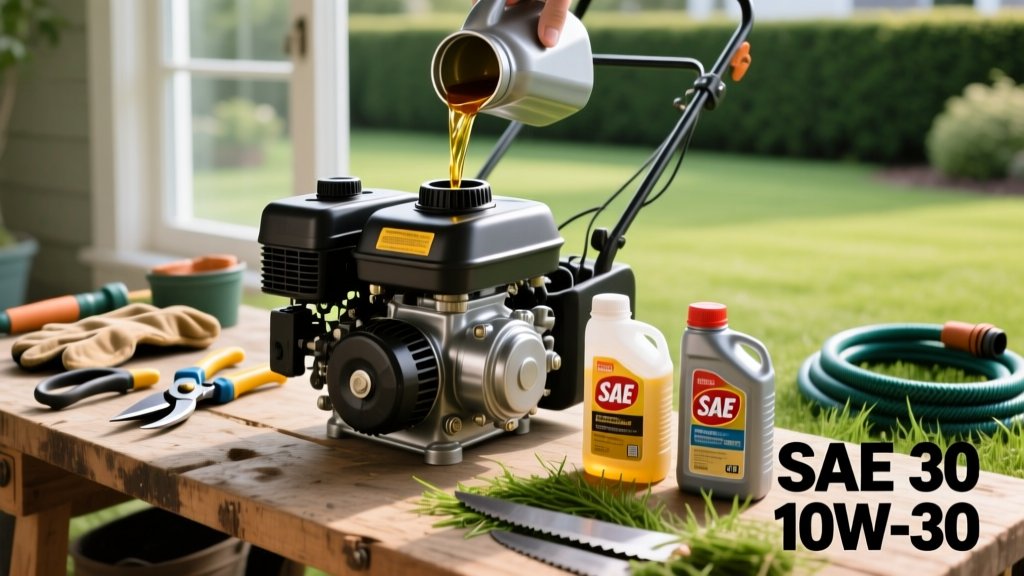
What Oil to Put in Lawn Mower Engines: SAE 30 vs 10W-30 Guide
Selecting the correct lubricant is the single most critical maintenance decision you make for your turf equipment. Using the wrong viscosity or API classification accelerates bearing wear, causes hydro-lock, and leads to catastrophic engine failure. When homeowners ask what oil to put in lawn mower engines, the answer depends entirely on the engine stroke type, ambient operating temperatures, and the chemical additive package required by splash-lubrication systems.
The Quick Answer: 4-Stroke vs. 2-Stroke
4-Stroke Engines (Most Walk-Behind & Riding Mowers): Use SAE 30 for consistent temperatures above 40°F (4°C), or 10W-30 for variable climates. Always choose an oil rated API SJ or higher, preferably formulated specifically for small engines to ensure adequate ZDDP (zinc) levels.
2-Stroke Engines (Older Mowers & String Trimmers): Never use straight motor oil. You must use a dedicated 2-stroke oil mixed with gasoline at the manufacturer's exact ratio (typically 40:1 or 50:1).
Decoding Viscosity: SAE 30 vs. 10W-30 vs. 5W-30
Viscosity dictates how the oil flows at specific temperatures. Small air-cooled engines operate at significantly higher internal temperatures than liquid-cooled automotive engines, often reaching 250°F to 300°F at the piston ring belt. This thermal stress requires an oil that resists thinning and shearing.
| Oil Grade | Temp Range | Best Application | Potential Drawbacks |
|---|---|---|---|
| SAE 30 | 40°F to 100°F+ | Standard summer mowing, heavy loads, older flathead engines. | Poor cold-start flow; causes starter motor strain below 40°F. |
| 10W-30 | 0°F to 100°F | Variable climates, early spring/fall mowing, modern OHV engines. | Multi-grade polymers can shear under extreme commercial heat. |
| 5W-30 (Synthetic) | -20°F to 100°F | Cold-weather starting, snow blowers, premium zero-turn mowers. | Higher cost; may increase oil consumption in worn, high-hour engines. |
| 15W-50 (Synthetic) | 50°F to 110°F+ | Commercial landscaping, extreme heat, heavy towing/hauling. | Too thick for cold starts; requires engine to be fully warmed. |
Temperature Thresholds and Cold-Start Failures
The 'W' in 10W-30 stands for Winter, indicating the oil's flow rate at cold temperatures. If you attempt to pull-start a mower at 35°F using straight SAE 30 oil, the lubricant will be too viscous to splash up from the crankcase sump to the camshaft and connecting rod bearings. This results in dry-start friction, which accounts for over 70% of small engine wear. Switching to a 10W-30 or 5W-30 synthetic ensures immediate lubrication upon startup.
API Service Classifications: Why ZDDP Matters
Not all 10W-30 oils are chemically identical. The American Petroleum Institute (API) classifies motor oils based on their additive packages. Modern automotive oils (API SP, introduced in 2020) are engineered to protect catalytic converters by strictly limiting phosphorus and zinc content.
Small lawn mower engines do not use catalytic converters. Instead, they rely heavily on ZDDP (Zinc Dialkyldithiophosphate) to protect flat-tappet camshafts and splash-lubricated bearings. According to API engine oil guidelines, as classifications advanced from SJ to SN and SP, ZDDP levels were progressively reduced. Therefore, using a modern, ultra-low-zinc automotive oil in an older Briggs & Stratton or Kohler engine can lead to premature camshaft lobe wear.
Expert Recommendation: Always purchase oil explicitly labeled 'Small Engine' or 'Lawn Mower' oil. These formulations maintain the higher ZDDP levels (typically 800-1000 ppm) required for air-cooled engines, even if they carry an API SJ, SL, or SM rating. For detailed manufacturer specifications, consult the Briggs & Stratton maintenance hub or your specific engine manual.
Synthetic vs. Conventional: Is the Premium Price Justified?
A standard 18-ounce bottle of conventional small engine oil costs roughly $6 to $8, while a full-synthetic equivalent costs $10 to $14. Because a walk-behind mower only requires one bottle per change, the annual cost difference is negligible, making synthetic the superior choice for most homeowners.
Full Synthetic Advantages
- Resists thermal breakdown at 300°F+ cylinder head temps.
- Prevents sludge buildup in the crankcase sump.
- Extends drain intervals from 50 hours to 100 hours.
- Superior cold-cranking performance for early spring.
Conventional Oil Use Cases
- Brand new engines (first 5-10 hours for initial ring seating).
- High-hour, worn engines with loose tolerances (reduces leaks).
- Strict budget constraints on large commercial fleets.
Step-by-Step: Checking and Changing Your Mower Oil
Proper oil level is just as critical as oil type. Overfilling causes the crankshaft to whip the oil into a foam, destroying its lubricating properties and forcing oil past the piston rings into the combustion chamber (blow-by).
- Warm the Engine: Run the mower for 5 minutes. Warm oil suspends contaminants and drains faster.
- Position and Drain: Place a pan beneath the plug. For push mowers without a drain plug, use an oil extraction pump or carefully tilt the mower to drain via the dipstick tube. Never tilt a mower with the carburetor facing down, or fuel will flood the air filter.
- Measure the Refill: Standard push mowers (e.g., Honda GCV160, Briggs 625 Series) hold exactly 15 to 18 ounces. Riding mowers typically hold 48 to 64 ounces. Pour in 75% of the required capacity first.
- Check the Dipstick: Wipe it clean, insert it without threading it in (unless specified by the manual), and read the level. Add the remaining oil in 2-ounce increments until it reaches the top hash mark.
Critical Warning: Never rely on the 'full' line on the oil bottle. Manufacturing variances and residual oil left in the crankcase mean the exact volume required will fluctuate. Always use the dipstick as the final authority.
Common Mistakes That Destroy Small Engines
- Using Automotive 0W-20: Modern eco-friendly car oils are far too thin for the wide bearing clearances in small engines, leading to catastrophic connecting rod failure under load.
- Mixing Viscosities: Topping off SAE 30 with leftover 10W-30 alters the shear stability of the oil. Stick to one grade per season.
- Ignoring the Oil Filter: Riding mowers and zero-turns equipped with spin-on oil filters must have the filter changed every time the oil is changed. A clogged filter bypasses dirty oil directly back into the engine.
Expert FAQ: Edge Cases and Exceptions
Can I use regular car oil in my lawn mower in an emergency?
Yes, but with caveats. If you are mid-mow and the engine is burning oil, topping it off with standard automotive 10W-30 (API SN or SP) is vastly preferable to running the engine dry. However, plan to drain and replace it with small-engine-specific oil at the end of the season to restore optimal ZDDP levels.
What if my mower burns oil and leaves blue smoke?
Blue smoke indicates oil is entering the combustion chamber. This is usually caused by an overfilled crankcase, a clogged breather tube, or worn piston rings. Before tearing down the engine, verify your oil level is not above the top dipstick mark, and check the air filter housing for pooled oil caused by tipping the mower on its side.
Do diesel-powered commercial mowers require different oil?
Yes. Commercial turf tractors with diesel engines (like the Kubota or Yanmar models used by golf courses) require heavy-duty diesel oil rated API CK-4 or CJ-4, typically in a 15W-40 viscosity. Never put standard gasoline engine oil in a diesel mower, as it lacks the necessary detergents to handle soot and sulfur.

