
Lawn Care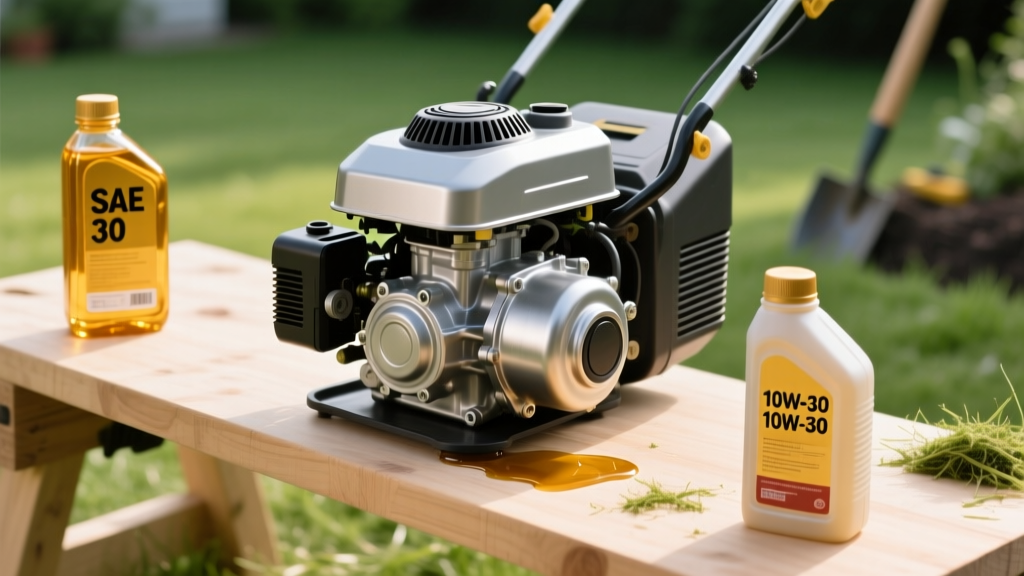
What Kinda Oil for Lawn Mower Engines? SAE 30 vs 10W-30 Explained
The Short Answer: What Kinda Oil for Lawn Mower Use?
If you are wondering what kinda oil for lawn mower engines is best, the short answer is SAE 30 for warm weather (40°F to 100°F) and 10W-30 for variable or cold climates (0°F to 100°F). However, grabbing a leftover jug of automotive oil from your garage can lead to premature engine wear, sludge buildup, and catastrophic failure in small air-cooled engines. Small engines operate at significantly higher internal temperatures and rely on different lubrication mechanics than your car, demanding specific viscosity profiles and additive packages.
This guide breaks down the exact chemistry, viscosity thresholds, and API classifications you need to select the right fluid for your walk-behind, zero-turn, or riding mower in 2026.
Decoding Small Engine Viscosity: SAE 30 vs. 10W-30
The Society of Automotive Engineers (SAE) grades oil by its flow characteristics at specific temperatures. Understanding these numbers is critical for preventing cold-start scoring and high-temperature breakdown.
SAE 30 (Single-Grade)
SAE 30 is a single-weight oil. It flows like a 30-weight oil at operating temperature (212°F / 100°C). Because it lacks viscosity-modifying polymers, it is highly resistant to shear breakdown—a common issue in the high-RPM, gear-driven sumps of small engines. However, it becomes thick and sluggish below 40°F, which can starve the cylinder walls of oil during startup and cause permanent scoring on the piston rings.
10W-30 (Multi-Grade)
10W-30 behaves like a thin 10-weight oil when cold (the 'W' stands for Winter, not Weight), allowing the starter motor to turn the engine over easily and pumping oil to the overhead valve train within seconds. Once the engine reaches operating temperature, it thickens to protect like a 30-weight oil. This is the most versatile choice for homeowners who experience distinct seasonal temperature shifts.
⚠️ Critical Warning: 2-Cycle vs. 4-Cycle Engines
Before purchasing oil, verify your engine type. If your mower requires a gas-oil mixture (common in older weed whackers and some push mowers), you have a 2-cycle engine. You must use TC-W3 or JASO FD certified 2-cycle oil mixed at a 50:1 ratio. Pouring straight 4-cycle SAE 30 into a 2-cycle gas tank will destroy the engine in under an hour. The guide below applies strictly to 4-cycle engines with a dedicated oil sump.
Before purchasing oil, verify your engine type. If your mower requires a gas-oil mixture (common in older weed whackers and some push mowers), you have a 2-cycle engine. You must use TC-W3 or JASO FD certified 2-cycle oil mixed at a 50:1 ratio. Pouring straight 4-cycle SAE 30 into a 2-cycle gas tank will destroy the engine in under an hour. The guide below applies strictly to 4-cycle engines with a dedicated oil sump.
Temperature Thresholds: When to Switch Viscosities
Air-cooled small engines run remarkably hot. While a car's liquid-cooled engine maintains a steady 195°F, the cylinder wall of a lawn mower engine can easily exceed 300°F under heavy summer loads. Using the wrong viscosity for your ambient temperature accelerates oil oxidation.
| Ambient Temp Range | Recommended Viscosity | Best Use Case |
|---|---|---|
| Below 32°F (0°C) | 5W-30 Synthetic | Snow blowers, extreme cold starts |
| 32°F to 100°F (0°C - 38°C) | 10W-30 Conventional/Synthetic | Spring/Fall mowing, variable climates |
| 40°F to 100°F+ (4°C - 38°C+) | SAE 30 Small Engine Oil | Peak summer mowing, heavy brush cutting |
| Above 95°F (35°C) Continuous | Vanguard 15W-50 Synthetic | Commercial zero-turns, extreme heat |
Automotive vs. Small Engine Oil: The ZDDP Factor
Many homeowners ask if they can use standard automotive 10W-30 in their mower. While it will keep the engine running, it is not optimal for long-term engine life. The difference lies in the anti-wear additive ZDDP (Zinc Dialkyldithiophosphate).
Modern automotive oils (API SP classification) have strictly limited zinc and phosphorus levels to protect the sensitive catalytic converters in cars. However, small engines do not have catalytic converters (or use much simpler emission systems) and often utilize flat-tappet camshafts and splash lubrication rather than high-pressure oil pumps. The high-shear environment of a mower gearbox requires higher levels of zinc to prevent metal-on-metal wear. Dedicated small engine oils, like those formulated by Briggs & Stratton or Kawasaki, contain elevated ZDDP levels specifically to protect these components. For a comprehensive look at small engine maintenance standards, refer to the University of Minnesota Extension's small engine care guidelines.
Understanding API Service Classifications
When inspecting oil bottles, look for the American Petroleum Institute (API) donut symbol. As of 2026, the current standard for gasoline engines is API SP. You may find older, cheaper oils labeled API SJ or SL on clearance shelves. While small engines are less sensitive to the low-speed pre-ignition (LSPI) protections that API SP was designed to address, API SP oils feature superior sludge prevention and timing chain wear protection. Always choose an oil that displays API SP, SN, or at minimum SM. For more on motor oil classifications, consult the API Engine Oil Licensing and Certification System.
Step-by-Step: Checking and Changing Your Mower Oil
Knowing what kinda oil for lawn mower use is only half the battle; proper changing technique prevents hydro-locking and smoking. Walk-behind mowers typically hold 15 to 24 ounces of oil, while riding mowers hold 48 to 64 ounces.
- Warm the Engine: Run the mower for 5 minutes. Warm oil suspends carbon particles and flows out completely. Turn off the engine and disconnect the spark plug wire.
- Drain the Sump: Place a catch pan underneath. Remove the drain plug (usually a 3/8-inch or 1/2-inch square drive) or use a siphon pump down the dipstick tube. Tilt the mower only with the carburetor facing UP to prevent oil from flooding the air filter and spark plug.
- Refill Slowly: Pour in the new SAE 30 or 10W-30 oil. Stop at the lower hash mark on the dipstick. Wait 60 seconds for the oil to settle in the crankcase, then check again.
- Avoid Overfilling: Overfilling by even 4 ounces can cause the crankshaft to whip the oil into a foam (aeration), leading to loss of lubrication, blown seals, and thick white smoke from the exhaust.
Cost Breakdown: Small Engine vs. Automotive Oil
- Dedicated Small Engine Oil (20 oz bottle): $7.99 - $11.99. Cost per ounce is higher, but perfectly sized for a single push-mower change with zero waste.
- Automotive 10W-30 (5-Quart Jug): $24.99 - $32.99. More cost-effective per ounce if you are maintaining a riding mower (requires ~48 oz) and multiple vehicles, but lacks the optimized ZDDP profile for flat-tappet small engines.
- Full Synthetic Small Engine Oil (e.g., AMSOIL, Honda GN4): $12.99 - $18.99 per quart. Recommended for commercial zero-turn mowers operating in 95°F+ heat to prevent viscosity shear.
Frequently Asked Questions
Can I use synthetic oil in an older lawn mower?
Yes. Synthetic oil will not damage older seals unless the engine is already actively leaking. Synthetic 5W-30 or 10W-30 provides vastly superior protection against thermal breakdown in air-cooled engines. However, if your mower has a history of severe sludge buildup, the superior detergents in synthetic oil might dislodge large chunks of carbon that could clog the oil pickup screen. In heavily neglected engines, run a conventional oil flush first.
Why is my mower blowing white smoke after an oil change?
White or blue smoke immediately after an oil change is almost always caused by overfilling the crankcase or tipping the mower the wrong way, allowing oil to enter the muffler and air intake. Remove the dipstick, check the level, and extract excess oil with a turkey baster or siphon. Run the engine for 10 minutes in a well-ventilated area to burn off oil that entered the exhaust system.
How often should I change the oil?
For standard residential walk-behind mowers, change the oil after the first 5 hours of use (the break-in period to remove manufacturing metal shavings), and then every 50 hours or once per mowing season. Riding mowers and zero-turns should be serviced every 100 hours or annually, alongside a replacement of the spin-on oil filter.

