
Lawn Care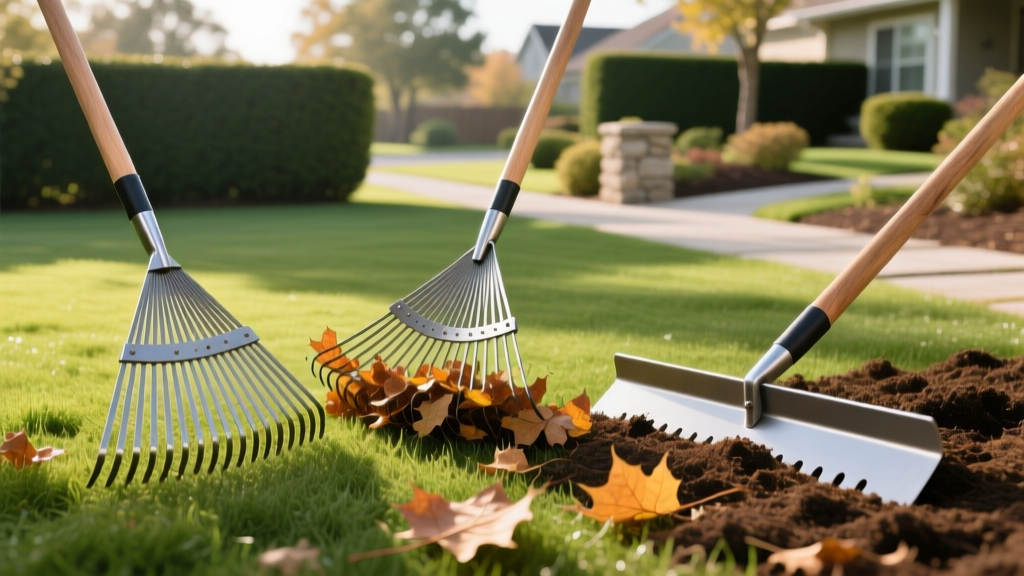
Choosing the Right Rake Types for Thatch, Leaves, and Grading
Most homeowners own exactly one rake—a flimsy poly-tine fan rake—and attempt to use it for every lawn task. This results in shattered tines, unremoved thatch, and severe lower back strain. Selecting the correct rake types for specific agronomic tasks is a matter of material science and turf geometry. A standard leaf rake cannot penetrate the turf canopy to remove thatch, and a heavy steel thatch rake will destroy delicate autumn leaves, driving them into the soil rather than lifting them.
This guide breaks down the metallurgy, tine spacing, and ergonomic designs of modern lawn rakes, providing a precise framework for equipment selection and long-term maintenance.
The Core Rake Types Matrix
Before purchasing, match the rake head geometry and tine material to your specific lawn care objective. The table below outlines the primary categories and their operational limits.
| Rake Type | Primary Use | Tine Material | Head Width | Avg. Price Range |
|---|---|---|---|---|
| Thatch / Dethatching | Removing dead organic layer | High-carbon steel | 14" - 16" | $25 - $55 |
| Fan / Leaf | Light debris and leaf cleanup | Polypropylene / Spring Steel | 24" - 30" | $18 - $40 |
| Bow / Garden | Soil leveling, gravel, heavy debris | Forged steel | 14" - 16" | $30 - $60 |
| Landscape / Leveling | Topdressing, sand distribution | Aluminum / Stainless Steel | 17" - 30" | $90 - $160 |
| Shrub / Hand | Tight spaces, under bushes | Spring steel / Bamboo | 8" - 12" | $12 - $25 |
Deep Dive: Thatch and Dethatching Rakes
Thatch is a tightly intermingled layer of living and dead stems and roots. According to Penn State Extension, a thatch layer exceeding 1/2 inch prevents water infiltration, harbors fungal pathogens like brown patch, and blocks fertilizer from reaching the root zone.
Tine Geometry and Spacing
Manual thatch rakes feature thick, curved steel tines designed to slice through the thatch layer and hook the dead material, pulling it to the surface. The critical metric is tine spacing:
- 1/2-inch spacing: Required for fine-bladed grasses like Bermuda, Zoysia, and Kentucky Bluegrass. Wider spacing will skip over the thin thatch layers in these dense turfs.
- 3/4-inch spacing: Ideal for coarse, bunch-type grasses like Tall Fescue, where wider gaps prevent the tines from clogging with thick organic matter.
For professional-grade manual dethatching, the Ames True Temper 15-Tine Thatch Rake remains the industry benchmark. Its 3mm thick high-carbon steel tines maintain their slicing edge without bending under the downward pressure required to penetrate compacted thatch.
⚠️ Turf Damage Warning: Never use a metal thatch rake on newly seeded lawns or dormant warm-season grasses. The aggressive curved tines will rip out shallow rhizomes and stolons, severely delaying spring green-up and causing permanent bare patches.
Fan and Leaf Rakes: Poly vs. Spring Steel
When clearing autumn leaves, the goal is maximum surface area coverage with minimal turf abrasion. Fan rakes achieve this through wide, flexible tines.
Material Degradation Factors
The choice between polypropylene and spring steel tines dictates the tool's lifespan and failure mode:
- Polypropylene Tines: Lightweight and rust-proof. However, poly tines suffer from UV degradation. Prolonged sun exposure causes the plastic to become brittle, leading to tine snap-off during aggressive raking. Furthermore, in sub-zero temperatures, poly tines lose all flexibility and will shatter if struck against frozen ground. The Bully Tools 92309 30-Inch Poly Leaf Rake uses a reinforced resin blend that delays UV brittleness by roughly two seasons compared to budget hardware store models.
- Spring Steel Tines: Offer superior flexibility and will bend rather than snap when hitting hidden rocks or roots. The failure mode here is tension loss; over time, the outer tines splay outward, reducing the effective sweeping width. To prevent rust, steel fan rakes require strict post-use cleaning.
Grading and Soil Leveling Rakes
For lawn renovation, topdressing, and leveling low spots, standard rakes are entirely ineffective. You need a dedicated leveling rake. These tools feature a flat, heavy bottom plate (usually aluminum or stainless steel) and a wide, flat top edge.
When spreading a 70/30 sand-to-topsoil mix to level a bumpy Fescue lawn, a 30-inch aluminum leveling rake (such as the Rocklin Levelawn) allows you to push the heavy mixture into depressions and pull the flat side to screed the surface perfectly level. Aluminum heads are preferred over steel for this application because wet topsoil and sand will rapidly corrode untreated steel, whereas aluminum naturally forms a protective oxide layer.
Ergonomics and Handle Selection
The handle material drastically alters shock absorption and user fatigue:
- Ash Wood: The gold standard for shock absorption. The cellular structure of ash wood dampens the high-frequency vibrations caused by steel tines striking rocks and roots. Requires annual oiling.
- Fiberglass: Highly durable and weather-resistant, but transfers significantly more impact shock to the user's wrists and elbows. Best for light-duty leaf raking, not heavy thatching.
- Steel: Found on budget bow rakes. Avoid for prolonged use; the lack of flex guarantees joint fatigue.
Equipment Maintenance and Storage Protocols
A $40 thatch rake will outlast a $15 model by a decade if subjected to proper end-of-season maintenance. Implement the following protocol before winter storage:
Annual Rake Maintenance Checklist
- Debris Removal: Use a stiff-bristled nylon brush to dislodge packed soil and organic matter from the tine base. Moisture trapped at the tine junction accelerates galvanic corrosion.
- Rust Treatment (Steel Tines): If carbon steel tines show surface oxidation, scrub with a wire wheel attachment on a cordless drill. Wipe down with a rag soaked in WD-40 Specialist Corrosion Inhibitor (not standard WD-40, which evaporates quickly).
- Wood Handle Conditioning: Lightly sand the bottom 36 inches of ash wood handles with 220-grit sandpaper. Apply two coats of boiled linseed oil using a clean cloth. This prevents the wood from drying out, cracking, and losing its grip on the metal ferrule.
- Ferrule Tightening: If the metal head feels loose on a wooden handle, drill a small pilot hole through the metal collar into the wood and drive a galvanized finishing nail to secure the joint permanently.
Decision Flowchart: Which Rake to Deploy
Use this rapid decision matrix on the job site to select the correct tool for the current lawn condition:
- Scenario A: Removing wet, matted oak leaves from a dormant lawn.
Solution: Wide poly fan rake (24"+). The wide, stiff tines will lift the heavy leaves without snagging the dormant grass crowns. - Scenario B: Preparing a lawn for fall overseeding by removing a 3/4" thatch layer.
Solution: 15-tine carbon steel thatch rake. Follow up with a stiff push broom to clear the loosened debris. - Scenario C: Spreading compost topdressing over a newly aerated lawn.
Solution: 30" aluminum leveling rake. Use the flat bottom edge to push compost into aeration cores. - Scenario D: Cleaning pine needles out of tight spaces between foundation shrubs.
Solution: 10" bamboo shrub rake. Bamboo tines are gentle on the bark of nearby shrubs and flexible enough to navigate tight root zones.
Proper tool selection eliminates the physical toll of lawn care and ensures the turf canopy is managed correctly. By matching the tine geometry and material to the specific agronomic task, you protect both your lawn's root system and your own biomechanics. For more on maintaining soil health after dethatching, consult the University of California IPM guidelines on lawn maintenance to ensure your post-raking fertilization and watering schedules align with the newly exposed soil profile.

