
Lawn Care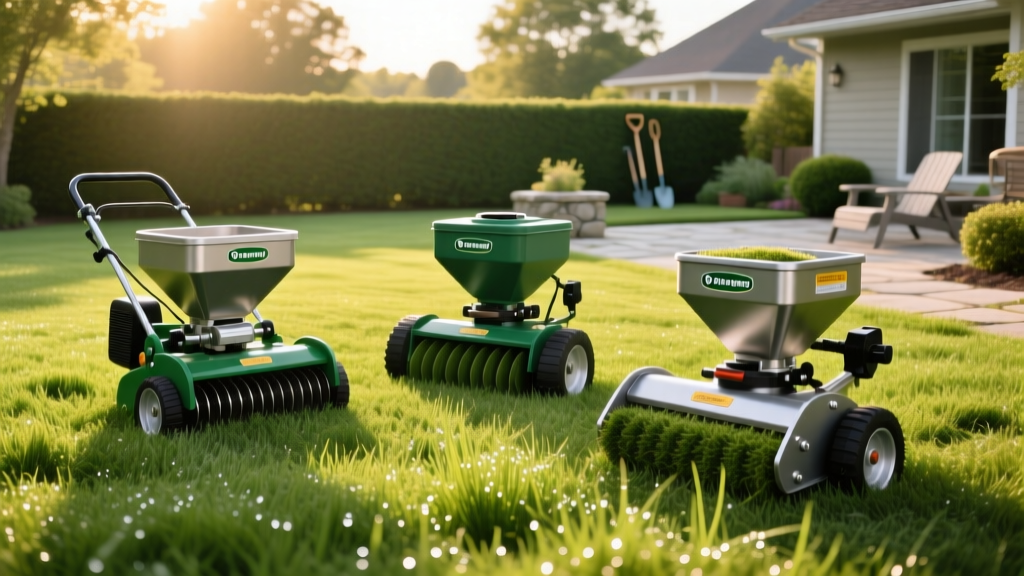
Best Lawn Seeder Types for Overseeding Lawns 2026
Why Seed-to-Soil Contact Dictates Overseeding Success
Throwing grass seed onto an existing lawn is a gamble with poor odds. For the 2026 overseeding season, turfgrass science continues to prove that seed-to-soil contact is the single most critical variable in germination rates. According to UMass Extension, seeds left on the surface dry out within hours and are easily consumed by birds. To achieve the 85%+ germination rates expected from premium tall fescue and Kentucky bluegrass blends, you must select the right lawn seeder for your specific turf density, soil compaction level, and budget.
This guide breaks down the mechanical differences between broadcast, drop, and slit seeders, providing exact calibration protocols and maintenance routines to prevent equipment failure mid-job.
The 4 Main Lawn Seeder Categories
1. Broadcast (Rotary) Spreaders
Broadcast seeders use a spinning horizontal disk to fling seed in a wide, semi-circular swath (typically 6 to 12 feet). They are the fastest option for large, open areas but lack precision near flower beds and driveways.
- Best For: Lawns over 5,000 sq ft with minimal obstacles; routine overseeding of healthy, thinning turf.
- Top Model: Scotts Turf Builder EdgeGuard Mini (approx. $55). The EdgeGuard gate physically blocks the right side of the spread pattern, preventing seed from landing on concrete.
- Drawback: Poor seed-to-soil contact. Must be paired with prior core aeration or heavy dethatching.
2. Drop Seeders
Drop seeders release seed directly downward through a series of holes along the bottom of the hopper. The swath width is limited to the wheelbase (usually 18 to 24 inches).
- Best For: Small to medium yards (under 4,000 sq ft) with tight borders, or applying expensive, low-rate seeds like bentgrass.
- Top Model: Agri-Fab 45-0543 18-Inch Push Drop Seeder (approx. $130). Features a rust-proof polyethylene hopper and enclosed gears.
- Drawback: Requires overlapping passes by exactly 2 inches; missing a gap leaves visible bare stripes in the lawn.
3. Slit (Slice) Seeders
Slit seeders are the gold standard for lawn renovation. They feature a reel of vertically spinning steel blades that cut 1/8-inch to 1/2-inch grooves into the soil, dropping seed directly into the trenches via rear-mounted tubes.
- Best For: Heavily compacted soil, severe lawn thinning, and total renovation without tilling. University of Maryland Extension highly recommends slit seeding for overcoming the thatch barrier in older lawns.
- Top Model: Ryan Ren-O-Thin Tine Seeder (Retail: $3,500+; Daily Rental: $140-$180). Features adjustable blade spacing and a heavy-duty chain drive.
- Drawback: Heavy (150+ lbs), difficult to maneuver on steep slopes, and requires a truck or trailer for transport.
4. Aerator/Seeder Combos
These units pull soil cores while simultaneously dropping seed into the aeration holes. While they save time, the seed distribution is clustered only in the aeration plugs, leaving the spaces between plugs unseeded.
Equipment Selection Matrix: Matching Seeder to Grass Type
| Grass Type | Lawn Condition | Recommended Seeder | Target Seeding Rate |
|---|---|---|---|
| Tall Fescue (Cool-Season) | Bare spots / Renovation | Slit Seeder (1/4' depth) | 6 - 8 lbs / 1,000 sq ft |
| Kentucky Bluegrass | Thinning / Routine | Drop Seeder or Broadcast | 2 - 3 lbs / 1,000 sq ft |
| Bermudagrass (Warm-Season) | Sprigging / Overseeding | Slit Seeder (1/8' depth) | 1 - 2 lbs / 1,000 sq ft |
| Perennial Ryegrass | Winter Overseeding | Broadcast Spreader | 5 - 10 lbs / 1,000 sq ft |
Calibration Protocol: The 100-Square-Foot Test
Guessing your spreader dial setting wastes expensive seed and causes uneven turf density. The micrometer dials on commercial seed bags are notoriously inaccurate across different brands. You must calibrate your lawn seeder using the 100-square-foot test.
Warning: Never calibrate over soil or grass. Seed coated with clay or fungicide will stick to damp soil, ruining your weight measurements. Always calibrate over a dry 10x10 foot tarp or a clean concrete driveway.
- Calculate the Target Weight: If your bag recommends 6 lbs per 1,000 sq ft, divide by 10. You need exactly 0.6 lbs (9.6 ounces) of seed to cover a 100 sq ft area (10 ft x 10 ft).
- Weigh the Seed: Place your empty collection bucket on a digital kitchen scale. Add slightly more than 9.6 ounces of seed to the seeder hopper.
- Run the Pattern: Push the seeder over your marked 10x10 area at your normal walking speed (approx. 3 mph).
- Measure the Remainder: Pour the leftover seed from the hopper into the bucket and weigh it. Subtract the leftover weight from your starting weight.
- Adjust: If you dispensed 11 ounces, close the dial by one notch. If you dispensed 7 ounces, open it by one notch. Repeat until you dispense exactly 9.6 ounces.
Mechanical Maintenance & Failure Prevention
Lawn seeders are subjected to abrasive fertilizers, moisture, and soil impact. Ignoring these three maintenance points will lead to mid-job breakdowns.
Hopper and Agitator Cleaning
Modern grass seeds are often coated in clay, fungicides, or hydro-gels (e.g., Scotts EZ Seed). If exposed to humidity, this coating turns into concrete inside the hopper. Never use a garden hose to clean your seeder. Instead, use a cordless leaf blower at 150 MPH to blast out the agitator bar and the drop chute. For stuck-on fertilizer residue, wipe the hopper with a dry rag and mineral spirits.
Shear Pins on Slit Seeders
Slit seeders use a shear pin to connect the drive wheel to the blade reel. If the blades hit a buried rock or tree root, the pin is designed to snap, saving the transmission. Do not replace a broken shear pin with a hardened steel bolt. A Grade 5 or Grade 8 bolt will not shear; it will transfer the shock directly to the gearbox, resulting in a $400+ repair. Always carry spare Grade 2 cotter pins or manufacturer-specific soft-metal shear pins in your toolkit.
Axle and Chain Lubrication
WD-40 is a solvent, not a lubricant. Spraying it on drop seeder axles will wash away existing grease and attract dust, seizing the wheels. Use white lithium grease or marine-grade grease on drop seeder axles. For slit seeder drive chains, apply a dedicated chain-and-cable fluid (like Tri-Flow) that penetrates the O-rings without attracting a thick layer of topsoil.
Slit Seeder Depth Settings for Specific Grasses
Setting the cutting depth too shallow leaves seed on the thatch layer; setting it too deep buries the seed below its energy reserve, preventing it from reaching the surface.
- Kentucky Bluegrass: 1/8 to 1/4 inch. Bluegrass seeds are tiny and lack the energy to push through deep soil.
- Tall Fescue: 1/4 to 1/2 inch. Fescue seeds are larger and require slightly deeper soil contact to retain moisture during the 10-14 day germination window.
- Perennial Ryegrass: 1/4 inch. Ryegrass germinates in 5-7 days and needs shallow placement for rapid emergence.
Pro Tip for Compacted Soils: If your soil is heavily compacted clay, run the slit seeder over the lawn once at a 1/2 inch depth with the seed tubes disconnected to act as a verticutter. Then, make a second pass at a 1/4 inch depth with the seed tubes engaged. This prevents the blades from bogging down and ensures uniform seed placement.
Frequently Asked Questions
Can I use a broadcast spreader for slit seeder seed blends?
Yes, but you must double the application passes (one North-South, one East-West) and ensure the lawn has been dethatched first. Without mechanical slicing, broadcast spreading of renovation blends yields roughly 40% lower germination rates compared to true slit seeding.
How often should I replace the blades on a rental slit seeder?
Rental yards rarely replace blades between customers. Before leaving the rental center, inspect the cutting edges. If the blades are rounded or dull, they will tear the turf crowns rather than slicing cleanly, causing excessive damage to the existing grass. Request a machine with fresh, sharp blades or sharpen them yourself with an angle grinder.
Do I need to rake the lawn after using a drop seeder?
Lightly dragging a leaf rake upside down (tines pointing up) over the lawn after drop seeding helps work the seed into the top 1/8 inch of soil and breaks up thatch mats. Do not use a heavy thatching rake, as you will pull the seed back out of the soil.

