
Lawn Care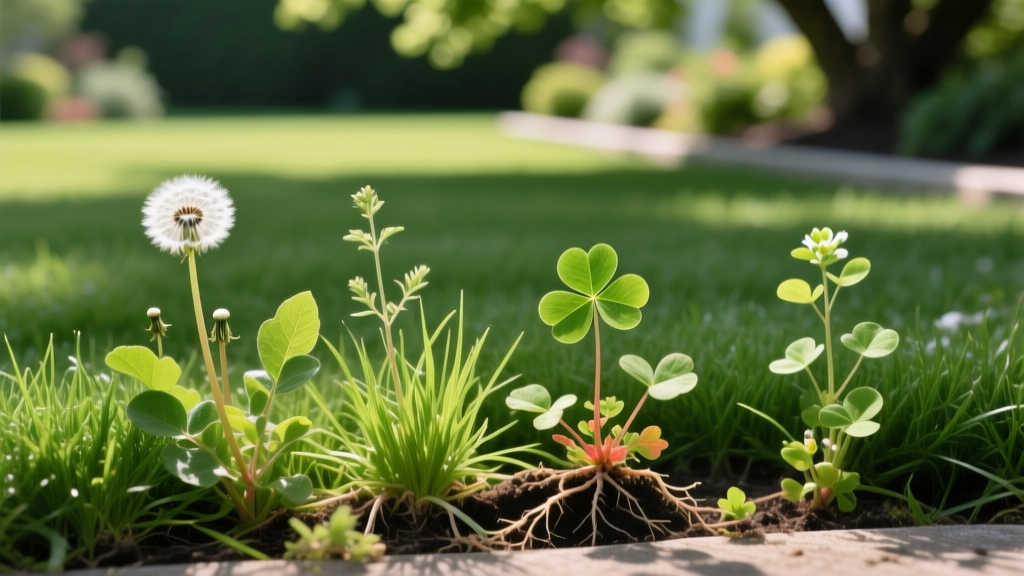
Lawn Weed Identification Pictures: Spot-Treatment Guide
The Visual Diagnostic Framework for Lawn Weeds
Blanket spraying your entire lawn with broad-spectrum herbicides is an outdated, ecologically damaging, and expensive approach to turf management. Modern turfgrass science heavily favors targeted spot-treatments, but this method hinges entirely on accurate visual diagnosis. Relying on high-quality lawn weed identification pictures is the first critical step in formulating a chemical or cultural eradication strategy. Misidentifying a grassy weed as a broadleaf weed will result in wasted chemicals and unchecked turf decline.
When cross-referencing your yard with lawn weed identification pictures, professional agronomists evaluate three primary morphological markers:
- Vernation and Ligule: How the young leaf emerges from the sheath (rolled vs. folded) and the presence of a membranous or hairy ligule at the blade-sheath junction.
- Growth Habit: Whether the plant exhibits a prostrate (creeping), bunch-type, or stoloniferous/rhizomatous spreading pattern.
- Leaf Venation and Margins: Parallel veins indicate grasses and sedges, while net-like (reticulate) veins indicate broadleaf dicots.
⚠️ Critical Diagnostic Warning: Never rely solely on flower color for identification. Many broadleaf weeds (like plantain and knotweed) produce inconspicuous green or brown flowers, while others (like dandelion and false dandelion) share identical yellow blooms but require entirely different herbicide active ingredients for control.
Broadleaf Weed Visuals and Spot-Treatment Protocols
Broadleaf weeds are generally the easiest to control in established turfgrasses because their physiological makeup differs vastly from monocot grasses. This allows for the use of selective synthetic auxins (Group 4 herbicides) that disrupt broadleaf cell division without harming your lawn.
| Weed Species | Visual Marker (From ID Pictures) | Active Ingredient | Mix Rate (Per 1 Gallon) | Surfactant Required? |
|---|---|---|---|---|
| Dandelion (Taraxacum officinale) | Deep jagged rosette, hollow stems exuding milky sap | 2,4-D + Dicamba | 1.5 fl oz | Yes (0.25% NIS) |
| White Clover (Trifolium repens) | Trifoliate leaves with white chevron, creeping stolons | Mecoprop (MCPP) | 1.0 fl oz | Yes (0.25% NIS) |
| Broadleaf Plantain (Plantago major) | Ribbed oval leaves, central fibrous seed spike | Triclopyr | 1.2 fl oz | Yes (0.5% NIS) |
| Wild Violet (Viola sororia) | Heart-shaped leaves, rhizomatous spread, purple flowers | Quinclorac + 2,4-D | 2.0 fl oz | Yes (Methylated Seed Oil) |
According to University of Minnesota Extension turfgrass specialists, wild violets are notoriously difficult to eradicate due to their waxy leaf cuticle. When spot-treating violets, replacing a standard Non-Ionic Surfactant (NIS) with a Methylated Seed Oil (MSO) is mandatory to penetrate the leaf surface and translocate the herbicide to the deep rhizomes.
Grassy Weed and Sedge Targeted Eradication
Grassy weeds present a unique challenge because they share the same monocot physiology as your desirable turf. Spot-treating these requires highly selective chemistry or precise application timing.
Crabgrass and Poa Annua
Crabgrass (Digitaria sanguinalis) is identified in visual guides by its prostrate growth habit, wide leaf blades, and distinct membranous ligule. For post-emergent spot-treatment of crabgrass in warm-season lawns (Bermuda, Zoysia), Quinclorac is the industry standard. Mix 1.5 tablespoons of Quinclorac per gallon of water. Note that Quinclorac can severely injure St. Augustinegrass; for St. Augustine, rely on pre-emergent barriers like Prodiamine instead.
Poa Annua (annual bluegrass) features an apple-green color and a distinct boat-shaped leaf tip. Post-emergent chemical control in cool-season lawns is largely ineffective without damaging the host turf. The most effective protocol is a fall application of Ethofumesate or a heavy reliance on pre-emergent herbicides applied when soil temperatures drop to 70°F.
The Nutsedge Exception: Not a Grass
Yellow Nutsedge (Cyperus esculentus) is frequently misidentified as a grassy weed in amateur lawn weed identification pictures. However, nutsedge is a sedge. The definitive visual and tactile test is the stem: 'Sedges have edges.' Roll the stem between your fingers; if it forms a distinct 'V' shape or triangle, it is a sedge. Standard grassy weed herbicides like Quinclorac will not kill nutsedge.
Spot-Treatment Protocol for Nutsedge:
- Active Ingredient: Halosulfuron-methyl (e.g., SedgeHammer) or Sulfentrazone.
- Mix Rate: 1 gram of Halosulfuron-methyl per 1000 sq ft, mixed into 1 gallon of water.
- Crucial Timing: Apply when the nutsedge is actively growing but before it produces more than three leaves. Once the plant enters the 3-leaf stage, it begins forming underground tubers (nutlets) that are immune to foliar herbicides.
Spot-Treatment Mixing and Application Masterclass
Having the right chemical is only half the battle. The physical application technique dictates whether the weed absorbs the lethal dose or whether the herbicide drifts onto your desirable turf.
💡 Pro-Tip: Nozzle Selection
Never use a cone nozzle for spot-treatments. Cone nozzles produce fine droplets that are highly susceptible to wind drift. Always equip your pump sprayer with a flat-fan nozzle (such as a TeeJet 8002EVS). Flat-fan nozzles produce larger, heavier droplets that fall directly onto the weed canopy, minimizing vapor drift and protecting surrounding turf.
Never use a cone nozzle for spot-treatments. Cone nozzles produce fine droplets that are highly susceptible to wind drift. Always equip your pump sprayer with a flat-fan nozzle (such as a TeeJet 8002EVS). Flat-fan nozzles produce larger, heavier droplets that fall directly onto the weed canopy, minimizing vapor drift and protecting surrounding turf.
The Ester vs. Amine Temperature Threshold
Many 2,4-D products come in two formulations: Amine and Ester. The NC State Turf Files database emphasizes that temperature dictates which formulation you should use:
- Amine Formulations: Best for warm weather (above 70°F). They have low volatility and will not vaporize and drift into nearby flower beds or vegetable gardens.
- Ester Formulations: Best for cool weather (50°F - 65°F). Esters penetrate the waxy cuticles of weeds much faster in cold temperatures but become highly volatile and dangerous to non-target plants when temperatures exceed 75°F.
Step-by-Step Spot-Spraying Procedure
- Calibrate: Fill your 2-gallon sprayer with water and spray a 10x10 ft (100 sq ft) test area to determine your walking speed and output rate.
- Mix: Add the required liquid herbicide, followed by the surfactant, and fill the rest with water. Agitate vigorously.
- Target: Hold the wand 18 inches above the weed. Spray just enough to make the leaves glisten (the 'spray to wet' method). Do not spray to the point of runoff, as herbicide dripping onto the soil can harm shallow turf roots.
- Mark: Place a small landscaping flag next to treated weeds. This prevents double-spraying (which causes soil toxicity) and helps you track the die-back progress over the next 14 days.
Frequently Asked Questions
How long does it take for spot-treated weeds to die?
Synthetic auxins (like 2,4-D and Dicamba) cause rapid, uncontrolled cell division. You will see visible leaf curling and twisting (epinasty) within 24 to 48 hours. Complete root necrosis typically takes 10 to 14 days. Systemic grassy weed herbicides like Quinclorac may take up to 21 days to show complete browning.
Should I mow before or after spot-treating?
Do not mow for 48 hours before or 48 hours after application. The weed needs maximum leaf surface area to absorb the chemical, and the herbicide needs time to translocate from the foliage down into the root system. Mowing too soon physically removes the treated foliage.
Can I mix pre-emergent and post-emergent herbicides in the same tank?
While chemically possible with some products, it is highly discouraged for spot-treatments. Pre-emergents require watering into the soil to create a chemical barrier, while post-emergents require drying on the leaf surface. Combining them in a spot-treatment scenario usually results in compromised efficacy for both applications. Always consult the EPA pesticide label guidelines before tank-mixing any agricultural chemicals.

