
Lawn Care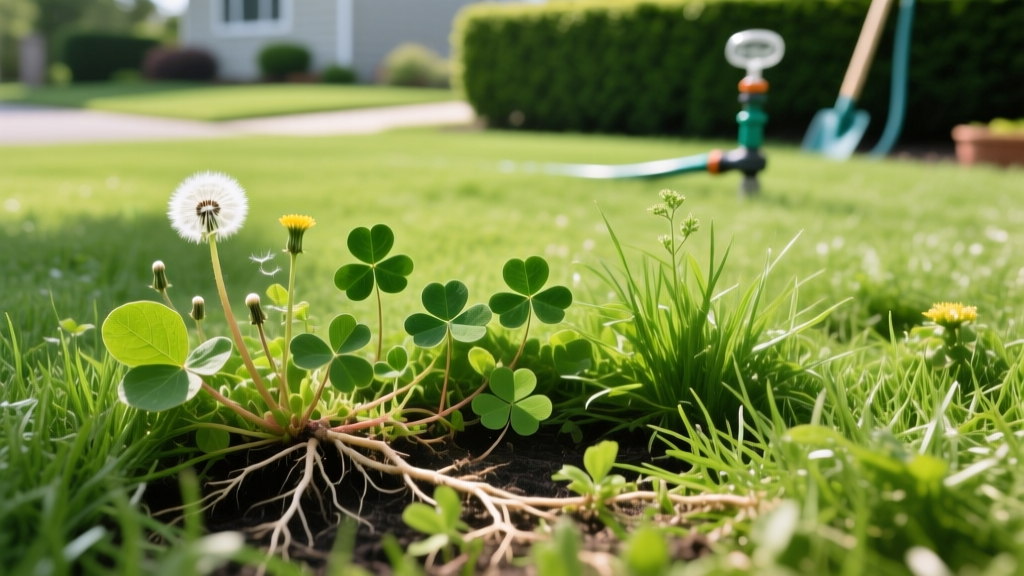
Lawn Weed Pics: Visual ID and Spot-Treatment Guide
Blanket-spraying an entire lawn with broad-spectrum herbicides is an outdated, expensive, and ecologically damaging practice. Modern turf management relies on precise spot-treatments, but accuracy requires correct identification. Browsing lawn weed pics to match visual traits—such as leaf venation, stem geometry, and root structure—is the critical first step before selecting an active ingredient. Misidentifying a sedge as a grassy weed, or a perennial broadleaf as an annual, guarantees herbicide failure and wasted money.
This guide translates visual identification into actionable spot-treatment protocols, providing exact chemical formulations, mixing ratios, and application windows for the most stubborn turf invaders.
The Visual Identification and Herbicide Matrix
Use this matrix to cross-reference the weed in your yard with the correct selective herbicide. According to the University of Minnesota Extension, matching the active ingredient to the weed's specific biological family is the primary determinant of control success.
| Weed Category | Common Species | Key Visual Identifier | Primary Active Ingredient | Estimated Cost (Spot Treat) |
|---|---|---|---|---|
| Broadleaf | Dandelion | Basal rosette, hollow stem with milky sap | 2,4-D + Dicamba + Carfentrazone | $0.05 / sq ft |
| Broadleaf | Creeping Charlie | Scalloped leaves, minty odor, purple flowers | Triclopyr + 2,4-D | $0.08 / sq ft |
| Grassy | Crabgrass | Prostrate growth, 'turkey foot' seed heads | Quinclorac | $0.12 / sq ft |
| Grassy | Quackgrass | Upright, auricles present, deep rhizomes | Glyphosate (Non-selective) | $0.02 / sq ft |
| Sedge | Yellow Nutsedge | Triangular stem, glossy yellow-green color | Halosulfuron-methyl | $0.15 / sq ft |
Broadleaf Weeds: Visual Cues and Spot-Treatment Protocols
Dandelion (Taraxacum officinale)
Visual ID: Look for a basal rosette of deeply lobed leaves pointing outward. The most definitive test is snapping the hollow flower stalk; if it exudes a white, milky latex sap, you have a dandelion. They feature a deep, brittle taproot that can extend 10 to 15 inches into compacted soil.
Treatment Protocol: Standard 2,4-D amine formulations often cause the leaves to curl and drop without killing the taproot, leading to rapid regrowth. Use a 4-way herbicide mixture containing 2,4-D, MCPP, Dicamba, and Carfentrazone (e.g., SpeedZone).
- Mixing Rate: 1.5 fl oz per 1 gallon of water per 1,000 sq ft.
- Timing: Apply when daytime temperatures are between 65°F and 80°F. Avoid application if rain is expected within 24 hours.
Creeping Charlie / Ground Ivy (Glechoma hederacea)
Visual ID: Creeping Charlie spreads via above-ground stolons. Crush a leaf between your fingers; if it emits a distinct minty or oregano-like odor, it is Creeping Charlie. The leaves are round with scalloped (crenate) edges, and it produces small, funnel-shaped purple flowers in early spring.
Treatment Protocol: This weed is notoriously resistant to basic 2,4-D. The Penn State Extension recommends formulations where Triclopyr is the primary active ingredient.
- Mixing Rate: Triclopyr ester at 0.75 fl oz per 1,000 sq ft.
- Pro Tip: Add a methylated seed oil (MSO) surfactant at 1% v/v to penetrate the waxy leaf cuticle.
- Timing: Fall applications (late September to October) are 3x more effective than spring applications, as the plant is actively translocating carbohydrates down into its root system for winter storage.
Grassy Weeds and Sedges: The Lookalikes
Grassy weeds and sedges are frequently misidentified by homeowners browsing generic lawn weed pics, leading to the purchase of ineffective broadleaf herbicides. According to NC State TurfFiles, distinguishing between these categories requires close inspection of the stem base and leaf collar.
Crabgrass vs. Quackgrass
Crabgrass (Digitaria sanguinalis): An annual weed with a prostrate, sprawling growth habit. The leaf sheath is often covered in fine hairs, and mature plants produce seed heads resembling a turkey's foot. Because it is an annual, post-emergent control relies on Quinclorac (e.g., Drive XLR8). Apply at 0.73 fl oz per 1,000 sq ft before the weed reaches the tillering stage (more than 3 leaves). Once crabgrass matures and turns purple in late summer, Quinclorac efficacy drops by over 60%.
Quackgrass (Elymus repens): A perennial grassy weed that grows upright and blends seamlessly with cool-season turfgrasses like Kentucky Bluegrass. The definitive visual ID is the presence of auricles—small, claw-like appendages at the collar where the leaf blade meets the sheath. Furthermore, pulling quackgrass reveals thick, white, underground rhizomes. There are no selective post-emergent herbicides for quackgrass in home lawns. You must spot-treat with a non-selective Glyphosate solution (2% v/v), wait 14 days for complete necrosis, and reseed the bare patch.
Yellow Nutsedge (Cyperus esculentus)
Visual ID: Remember the botanical adage: "Sedges have edges, rushes are round, grasses have nodes from their heads to the ground." Roll the stem of the suspected weed between your thumb and forefinger. If it feels distinctly triangular, it is a sedge. Nutsedge also grows vertically much faster than surrounding turf, creating bright yellow-green tufts that shoot above the canopy just three days after mowing.
Nutsedge Spot-Treatment Warning: Do not use standard broadleaf or grassy weed killers on nutsedge; they will not work. Use Halosulfuron-methyl (e.g., SedgeHammer). Mix one 13.5g water-soluble bag per 1,000 sq ft. Critical: Halosulfuron-methyl will fail completely without a Non-Ionic Surfactant (NIS). Add 0.25% v/v (approx. 1/2 teaspoon per gallon) of NIS to the tank to break the surface tension on the nutsedge's highly hydrophobic leaves.
The 1,000 Sq Ft Calibration Framework
The most common reason spot-treatments fail or cause turf phytotoxicity (chemical burn) is improper calibration. Never guess your mixing ratios. Use this exact water-test framework to calibrate your 1-gallon or 2-gallon pump sprayer:
- Mark the Area: Measure out exactly 1,000 square feet of your lawn (e.g., a 20 ft x 50 ft rectangle) using a tape measure and landscaping flags.
- Fill with Water: Fill your pump sprayer with exactly 1.5 gallons of plain water. Pressurize to 40 PSI (approx. 15-20 pumps).
- Spray and Time: Walk at your normal, comfortable spraying pace, using a flat-fan nozzle, overlapping passes by 30%. Spray the entire 1,000 sq ft area with just the water.
- Measure the Remainder: Check how much water is left in the tank. If you started with 1.5 gallons (192 oz) and have 48 oz left, you applied 144 oz (1.12 gallons) per 1,000 sq ft.
- Calculate the Mix: If the herbicide label calls for 1.5 fl oz per 1,000 sq ft, and your sprayer applies 1.12 gallons to cover that area, you will mix 1.5 fl oz of chemical into 1.12 gallons of water for your actual treatment.
Troubleshooting Herbicide Failures
If the weed in your lawn weed pics matches your yard, but the plant is still thriving 14 days after treatment, review these environmental and chemical failure modes:
- Temperature Volatilization: Applying ester-based herbicides (like Triclopyr or 2,4-D ester) when ambient temperatures exceed 85°F causes the chemical to vaporize. The gas drifts onto desirable plants, causing cupping and twisting, while the target weed receives a sub-lethal dose. Always spray before 10:00 AM during summer heat.
- Mowing Interference: Mowing 24 hours before or 48 hours after a spot-treatment removes the leaf surface area required to absorb the chemical and disrupts the translocation process down to the roots. Adjust your mowing schedule around your spray window.
- Hard Water Antagonism: If your local water supply is high in calcium and magnesium (hard water), these cations bind to the active ingredients in glyphosate and 2,4-D, rendering them inactive. Add Ammonium Sulfate (AMS) at a rate of 17 lbs per 100 gallons of water (approx. 2.5 oz per gallon) to the tank before adding the herbicide to condition the water.
- Rainfast Windows: Most systemic herbicides require 4 to 6 hours of dry weather to absorb through the cuticle. If a sudden thunderstorm occurs 2 hours post-application, the treatment must be repeated at a half-rate.
Post-Treatment Expectation: Do not expect immediate results from systemic herbicides. Broadleaf weeds will begin to show epinasty (stem twisting and leaf cupping) within 3 to 5 days, but complete root necrosis takes 14 to 21 days. Avoid pulling the weeds manually during this window; the physical removal of the dying plant prevents the herbicide from finishing its translocation to the root crown.

