
Lawn Care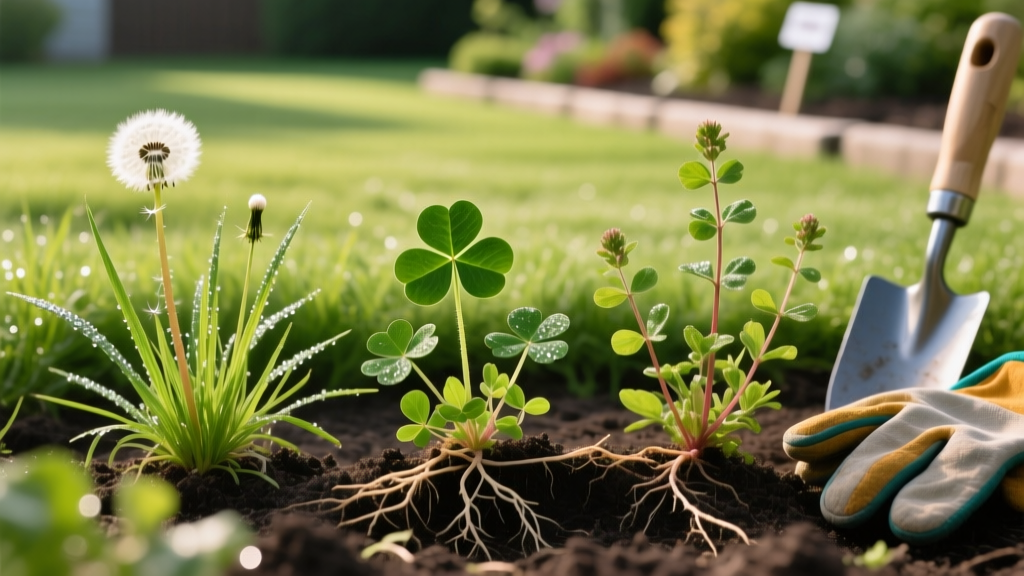
Lawn Weeds Identification Pictures & Spot-Treatment Guide
Misidentifying a turf intruder is the most expensive mistake in lawn care. Applying a broadleaf herbicide to a grassy weed, or a standard grass killer to a sedge, results in wasted chemical, potential turf phytotoxicity, and a rapidly spreading infestation. Utilizing high-quality lawn weeds identification pictures to match visual morphology with specific active ingredients is the cornerstone of professional spot-treatment. This guide bypasses generic advice to provide exact chemical protocols, mixing ratios, and application mechanics for the most stubborn turf weeds.
The Morphological Decision Tree: Stem and Leaf Architecture
Before consulting chemical labels, you must classify the weed into one of three botanical categories. Relying solely on leaf color is insufficient; you must physically inspect the stem and root structure.
- Broadleaf Weeds (Dicots): Feature net-like leaf veins, distinct taproots or rhizomes, and often produce showy flowers. Stems are typically round or slightly ridged.
- Grassy Weeds (Monocots): Exhibit parallel leaf veins, fibrous root systems, and hollow, round stems with distinct nodes (joints). They blend visually with desirable turf until they produce seed heads.
- Sedges (Cyperaceae): The ultimate imposters. Sedges look like grass but possess solid, triangular (V-shaped) stems and lack distinct nodes. Remember the botanical adage: 'Sedges have edges.'
Broadleaf Weeds: Visual Markers and Chemical Targets
Broadleaf weeds are generally the easiest to control, provided you select the correct synthetic auxin herbicide based on the specific species' resistance profile.
Dandelion (Taraxacum officinale) and Plantain (Plantago major)
These taproot weeds require systemic herbicides that translocate down to the root crown. Dandelions feature deeply lobed leaves and a hollow flower stalk that exudes milky sap. Plantain displays broad, oval leaves with prominent parallel-like ribs and a dense, shallow fibrous root system with a short taproot.
Spot-Treatment Protocol: Use a three-way herbicide containing 2,4-D, Mecoprop-p (MCPP), and Dicamba. For residential spot-treating, products like Ortho WeedClear for Lawns (amine formulation) are highly effective. Mix at 2 fl oz per gallon of water to cover 500 sq ft. Apply when temperatures are between 60°F and 80°F.
⚠️ Volatility Warning: Avoid ester-based 2,4-D formulations (often found in agricultural or commercial 'winter' blends) when daytime temperatures exceed 85°F. Esters vaporize in high heat and will drift, causing severe cupping and epinasty to nearby ornamental shrubs and garden beds. Always use amine formulations for summer spot-treatments.
White Clover (Trifolium repens) and Creeping Charlie (Glechoma hederacea)
Clover features trifoliate (three-part) leaves with white chevron markings and creeping stolons. Creeping Charlie (Ground Ivy) has scalloped, round leaves, square stems, and emits a distinct minty odor when crushed.
Spot-Treatment Protocol: These species are highly resistant to standard 2,4-D. You must use a formulation containing Triclopyr or Fluroxypyr. BioAdvanced All-In-One Lawn Weed and Crabgrass Killer contains Quinclorac and Triclopyr, making it ideal for these stubborn broadleaves. Expect to see wilting within 48 hours, but allow 14 days for complete root necrosis before a second application.
Grassy Weeds and Sedges: Spot-Treating the Look-Alikes
Grassy weeds and sedges require entirely different modes of action. Using a broadleaf killer here will only fertilize the weed while burning the surrounding desirable turf.
Crabgrass (Digitaria) vs. Poa Annua (Annual Bluegrass)
Crabgrass exhibits a prostrate growth habit with pale green, wide leaf blades and finger-like seed heads. Poa Annua is apple-green, grows upright in clumps, and features a distinct boat-shaped leaf tip with a membranous ligule.
Crabgrass Protocol: Post-emergent crabgrass requires Quinclorac or Fenoxaprop-p-ethyl. Bayer Advanced Bermudagrass Control (Fenoxaprop) is excellent for cool-season lawns, but Quinclorac-based products are superior for mature, multi-tiller crabgrass.
Poa Annua Protocol: Poa Annua is notoriously difficult to kill post-emergent in cool-season lawns without damaging the turf. Mesotrione (sold as Tenacity) is the gold standard. It inhibits HPPD, causing the Poa Annua to turn bright white before dying. Mix Tenacity at 1/2 tsp per gallon of water for spot treatments, and always include a non-ionic surfactant (NIS).
Yellow and Purple Nutsedge (Cyperus esculentus / rotundus)
Nutsedge grows 30% faster than surrounding turf in the summer, creating a spiky, uneven canopy. Yellow nutsedge has light green, tapering leaves and golden seed heads, while purple nutsedge has darker leaves with a distinct purple tinge at the base. According to the UC Statewide IPM Program, pulling nutsedge by hand often leaves the underground tubers (nutlets) intact, triggering the growth of multiple new plants.
Spot-Treatment Protocol: You must use Halosulfuron-methyl (SedgeHammer+) or Sulfentrazone. SedgeHammer+ packets are pre-measured and include the necessary surfactant. One 13.5g packet mixed with 1 gallon of water treats up to 1,000 sq ft. Apply when the nutsedge has reached the 3-to-5 leaf stage for optimal translocation to the tubers.
2026 Herbicide Matrix: Visual ID to Active Ingredient
| Weed Category | Visual Identification Key | Primary Active Ingredient | Top Product Example | Approx. Cost |
|---|---|---|---|---|
| Taproot Broadleaf | Deeply lobed leaves, milky sap, single taproot | 2,4-D + Dicamba + MCPP | Ortho WeedClear (Amine) | $15 / 32oz |
| Stoloniferous Broadleaf | Scalloped round leaves, square stems, mint odor | Triclopyr + Fluroxypyr | T-Zone Turf Herbicide | $45 / pt |
| Annual Grassy Weed | Prostrate growth, wide pale blades, finger seedheads | Quinclorac | Drive XLR8 | $60 / 32oz |
| Cool-Season Grassy Weed | Apple-green clumps, boat-shaped leaf tip, shallow roots | Mesotrione | Tenacity | $65 / 8oz |
| Sedge | Triangular (V-shaped) solid stem, spiky seedhead | Halosulfuron-methyl | SedgeHammer+ | $28 / 5-pack |
Precision Application Mechanics: Nozzles and Surfactants
The efficacy of your spot-treatment relies heavily on application physics. Standard consumer sprayer wands produce large, uneven droplets that bounce off waxy weed cuticles.
Nozzle Selection and Drift Mitigation
Replace the factory nozzle on your 1-gallon or 2-gallon pump sprayer with a TeeJet 110-degree flat-fan nozzle (e.g., TeeJet TT11002). Flat-fan nozzles produce a uniform spray pattern that ensures complete foliar coverage without excessive runoff. For spot-treating near sensitive flower beds, use an air-induction nozzle like the TeeJet TTI11002. These nozzles inject air into the droplet, creating heavy, drift-resistant bubbles that shatter upon leaf impact, virtually eliminating off-target wind drift.
The Chemistry of Surfactants
Herbicides like Tenacity (Mesotrione) and Drive XLR8 (Quinclorac) require a Non-Ionic Surfactant (NIS) to break the surface tension of the water droplet. Without NIS, the spray will bead up and roll off the weed.
Mixing Ratio: Add NIS at a rate of 0.25% v/v. In practical terms for a 1-gallon spot-treatment tank, this equals 1/2 teaspoon of surfactant. Note that products like SedgeHammer+ and Ortho WeedClear already include surfactant systems in their proprietary blends; adding extra can cause severe turf burn.
💡 Pro Tip: Use a Marking Dye
When spot-treating large lawns, it is easy to lose track of sprayed areas, leading to dangerous overlaps and phytotoxicity. Add 1/2 teaspoon of Blazon Blue or a generic turf marking dye to your tank. The dye stains the weed blue for 24-48 hours, providing a visual ledger of your application and ensuring uniform coverage.
When spot-treating large lawns, it is easy to lose track of sprayed areas, leading to dangerous overlaps and phytotoxicity. Add 1/2 teaspoon of Blazon Blue or a generic turf marking dye to your tank. The dye stains the weed blue for 24-48 hours, providing a visual ledger of your application and ensuring uniform coverage.
Post-Treatment Lawn Recovery and Reseeding Intervals
Spot-treating weeds leaves bare voids in the turf canopy that must be filled to prevent new weed germination. However, herbicide soil residual activity dictates when you can safely overseed. According to the University of Minnesota Extension, ignoring reseeding intervals will result in total seed failure.
- 2,4-D / Dicamba / Triclopyr: Generally safe to seed 3 to 4 weeks after application.
- Quinclorac (Crabgrass Killer): Highly persistent in soil. You must wait 21 to 28 days before seeding most cool-season grasses, and up to 12 months for certain fine fescues. Always check the specific seed species on the label.
- Mesotrione (Tenacity): Unique among herbicides, Tenacity is safe to use at the time of seeding for Kentucky Bluegrass, Tall Fescue, and Perennial Ryegrass. It actually acts as a pre-emergent barrier, protecting your new grass seed from competing weeds during germination.
- Halosulfuron (SedgeHammer): Requires a minimum 30-day waiting period before reseeding or sodding.
By cross-referencing high-resolution lawn weeds identification pictures with the morphological and chemical data above, you can execute surgical spot-treatments that eradicate the target weed while preserving the structural integrity and recovery timeline of your turfgrass.

