
Lawn Care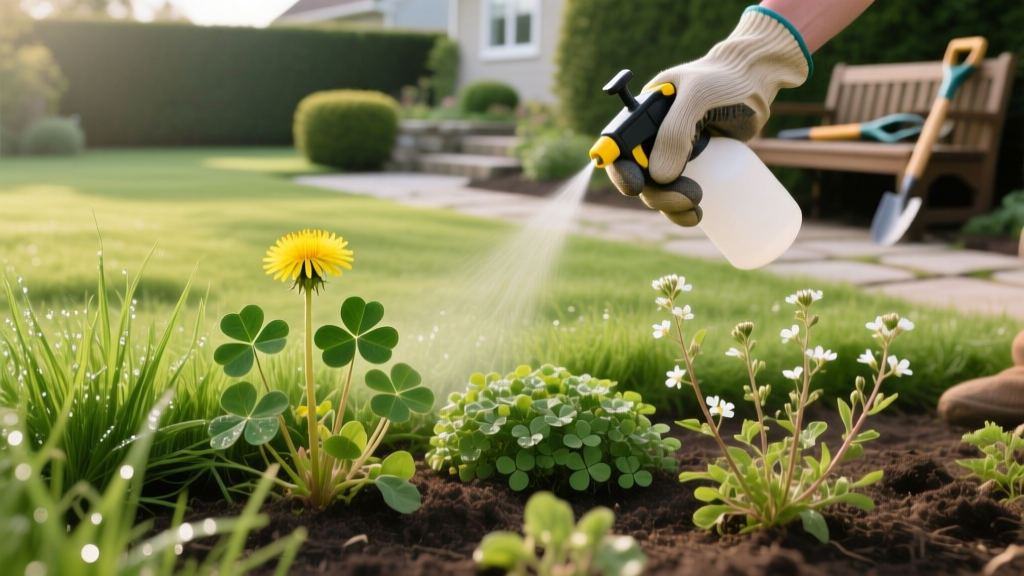
Lawn Weeds Identification and Spot-Treatment Guide for Common Invaders
Blanket spraying herbicides costs homeowners an average of $150 to $300 per season, unnecessarily stresses desirable turfgrass, and accelerates herbicide resistance. Accurate lawn weeds identification is the cornerstone of modern, integrated turf management. By correctly diagnosing the specific botanical family of an invader, you can deploy precise spot-treatments that eradicate the weed at the root while leaving your lawn completely unharmed.
This guide bypasses generic advice and provides a professional-grade framework for identifying and chemically controlling the three primary weed categories: broadleaf, grassy, and sedges.
The Diagnostic Triad: Categorizing Lawn Invaders
Before mixing any chemicals, you must determine the weed's structural classification. Herbicides are highly specific; applying a broadleaf killer to a grassy weed will yield zero results and waste your money. According to the NC State University TurfFiles database, misidentification is the leading cause of turf treatment failure.
Quick Visual Diagnostic Checklist
- Broadleaf Weeds: Feature net-like (reticulate) leaf veins, wide blades, and often produce showy flowers. Stems are typically solid and branching.
- Grassy Weeds: Mimic your turf. They have parallel leaf veins, hollow and round stems (culms), and nodes that are swollen. They rarely produce noticeable flowers in a mowed lawn.
- Sedges: The imposters. They look like grass but have solid, triangular stems (remember the rhyme: 'sedges have edges'). They do not have swollen nodes and produce distinct seed heads that look like small umbrellas or spikes.
Spot-Treatment Protocols for the 'Big Three'
1. Broadleaf Weeds (Dandelion, White Clover, Plantain)
Broadleaf weeds are generally the easiest to control post-emergence because their physiology differs drastically from monocot turfgrasses. The gold standard for broadleaf control is a three-way herbicide mixture containing 2,4-D, Dicamba, and Mecoprop-p (MCPP), or a formulation including Triclopyr for stubborn weeds like ground ivy and wild violet.
Application Specifics:
- Mix Rate: Typically 1.5 to 2.0 fluid ounces per gallon of water for spot-treating.
- Targeting: Spray only until the leaves are wet (to the point of runoff). Drenching the soil is unnecessary and increases the risk of root uptake by nearby desirable trees and shrubs.
- Cost: A 2.5-gallon concentrate of a professional three-way ester (like SpeedZone) costs around $120, but yields over 250 gallons of mixed solution, bringing the cost per spot-treatment to pennies.
2. Grassy Weeds (Crabgrass, Poa Annua, Goosegrass)
Grassy weeds are notoriously difficult to spot-treat because selective herbicides must kill a monocot without killing the surrounding monocot turf. Quinclorac is the premier active ingredient for post-emergent crabgrass (Digitaria spp.) control in cool-season lawns and Bermudagrass. For Poa Annua (annual bluegrass), post-emergent options are limited and often cause turf phytotoxicity; pre-emergent applications in late summer are vastly superior.
Application Specifics:
- Mix Rate: Quinclorac requires a higher dose, usually 0.375 to 0.73 fluid ounces per 1,000 square feet. For a 1-gallon spot sprayer covering roughly 250 sq ft, use about 0.15 oz.
- The Surfactant Rule: Quinclorac must be mixed with a methylated seed oil (MSO) or a high-quality non-ionic surfactant (NIS) at 0.25% v/v to penetrate the waxy cuticle of mature crabgrass.
- Edge Case Warning: Do not apply Quinclorac to St. Augustinegrass or Centipedegrass; it will cause severe chlorosis and stunting. Use UC Davis IPM guidelines for warm-season specific alternatives.
3. Sedges (Yellow Nutsedge, Purple Nutsedge)
Nutsedge (Cyperus spp.) thrives in compacted, poorly drained soils. A common amateur mistake is pulling nutsedge by hand. This snaps the shoot but leaves the rhizomes and tubers (nutlets) intact in the soil. A single yellow nutsedge tuber can produce up to 1,900 shoots in one growing season.
Application Specifics:
- Active Ingredients: Halosulfuron-methyl (the active ingredient in SedgeHammer) or Sulfentrazone. These are highly selective and safe for almost all warm- and cool-season turfgrasses.
- Timing: Treat when the sedge is young (3 to 8 leaf stage). If the plant has formed a purple/reddish base or visible seed heads, it is mature and will require a second application 6 to 10 weeks later.
- Cost: Halosulfuron-methyl is expensive by volume. A box of five 13.5-gram water-soluble packets costs roughly $25 to $35, but each packet treats up to 1,000 square feet, making it highly economical for spot treatments.
Herbicide Selection Matrix & Cost Breakdown
| Weed Category | Primary Active Ingredient | Brand Example | Mix Rate (per 1 Gal) | Avg. Cost per Treatment | Optimal Temp Range |
|---|---|---|---|---|---|
| Broadleaf (Dandelion, Clover) | 2,4-D + Triclopyr | SpeedZone / T-Zone | 1.5 - 2.0 oz | $0.15 | 60°F - 85°F |
| Grassy (Crabgrass) | Quinclorac | Drive XLR8 | 0.15 oz + MSO | $0.40 | 65°F - 90°F |
| Sedge (Yellow Nutsedge) | Halosulfuron-methyl | SedgeHammer | 1 packet (13.5g) | $5.00 - $7.00 | 60°F - 90°F |
Application Techniques: Maximizing Kill Rate
Identifying the weed and buying the right chemical is only half the battle. How you deliver the chemical dictates your success rate.
- Nozzle Selection: Never use a cone nozzle for spot-treating. Cone nozzles create fine mist particles that drift easily in the wind, potentially landing on desirable ornamental plants. Always use a flat-fan nozzle (such as a TeeJet 110-degree) which produces larger, heavier droplets that fall directly onto the target weed.
- Temperature Thresholds: Avoid applying ester-based herbicides (like Triclopyr or 2,4-D esters) when daytime temperatures exceed 85°F. High heat causes these chemicals to vaporize and drift, which will curl, stunt, or kill nearby tomato plants, roses, and shrubs. Apply early in the morning when temperatures are between 65°F and 75°F.
- The Mowing Rule: Do not mow for 48 hours before and 48 hours after a spot-treatment. You need maximum leaf surface area on the weed to absorb the herbicide, and you need time for the chemical to translocate down into the root system before the blade is severed.
Warning: The Surfactant Mistake
Many homeowners buy concentrated herbicides but skip the surfactant (sticker-spreader). Herbicide droplets without surfactant have high surface tension; they bead up and roll off the waxy leaves of mature weeds like crabgrass and plantain. Adding a non-ionic surfactant at a rate of 1/4 teaspoon per gallon breaks this surface tension, ensuring the chemical coats the leaf and penetrates the cuticle. This single step increases herbicide efficacy by up to 40%.
Common Misidentifications and Treatment Failures
Even experienced lawn care professionals occasionally fall victim to visual mimics. Here are the most frequent diagnostic errors:
- Tall Fescue Clumps vs. Grassy Weeds: In a Kentucky Bluegrass or fine fescue lawn, clumps of coarse Tall Fescue often look like a grassy weed. Failure mode: Homeowners spray Quinclorac on it, which does nothing to Tall Fescue. Solution: Tall Fescue is a desirable cool-season grass in many regions; if it is an unwanted contaminant clump, it must be manually dug out or spot-sprayed with a non-selective glyphosate, followed by reseeding.
- Wild Garlic vs. Nutsedge: Wild garlic (Allium vineale) emerges in early spring and features hollow, round stems, unlike the solid, triangular stems of nutsedge. Failure mode: Applying SedgeHammer (halosulfuron) to wild garlic yields poor results. Solution: Wild garlic requires a broadleaf herbicide containing 2,4-D and Dicamba, applied with a heavy surfactant to penetrate its waxy, tubular leaves.
- Dallisgrass vs. Crabgrass: Dallisgrass (Paspalum dilatatum) is a perennial grassy weed with a distinct, thick rhizome base and tall, prominent seed heads. Failure mode: Treating it like annual crabgrass with Quinclorac. Quinclorac provides poor control of Dallisgrass. Solution: Spot-treat Dallisgrass with MSMA (where legally permitted for commercial use) or carefully paint individual clumps with a 2% glyphosate solution to avoid turf damage.
Mastering lawn weeds identification transforms lawn care from a reactive, chemical-heavy chore into a precise, cost-effective science. By taking the time to examine the stem structure, leaf venation, and growth habit of the invader, you can select the exact active ingredient required, apply it at the optimal temperature, and eradicate the weed permanently without harming your turf.

