
Lawn Care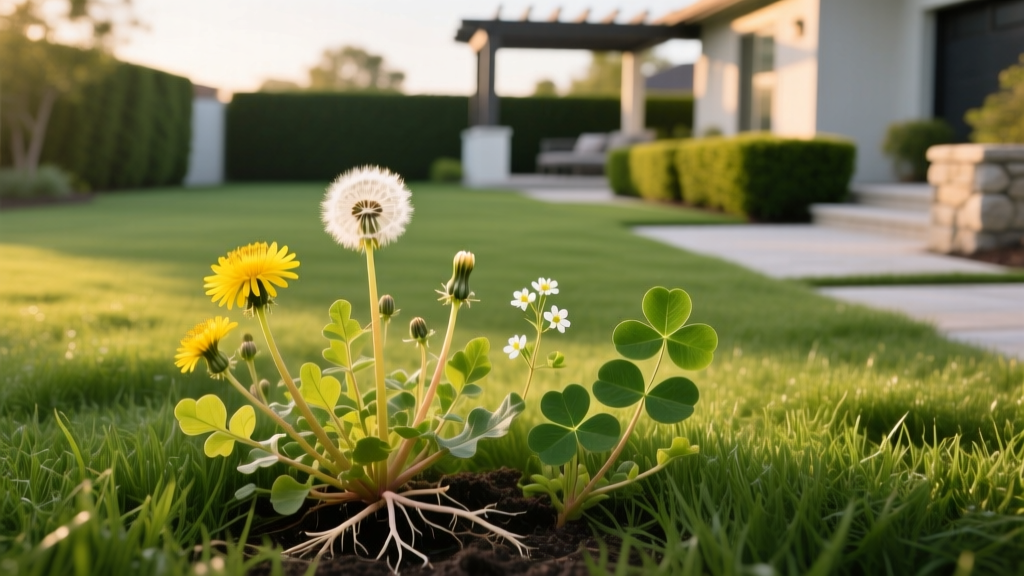
Identifying and Controlling Weeds That Look Like Flowers
The Decoy Blooms: Why Pretty Weeds Invade Your Lawn
Many homeowners intentionally leave patches of purple, yellow, or white blooms in their turf, assuming they are harmless native wildflowers. In reality, these are aggressive broadleaf weeds that use floral displays as a reproductive survival mechanism. By the time you notice the flowers, the weed has already established a complex underground network of rhizomes or stolons, making manual pulling ineffective. Identifying these botanical imposters early and applying targeted chemistry is the only way to reclaim your turfgrass.
Unlike grassy weeds, broadleaf flowering weeds thrive in compacted soil, low-nitrogen environments, and shaded areas where turfgrass struggles. According to the University of Minnesota Extension, weeds like Creeping Charlie can form dense, impenetrable mats that choke out Kentucky Bluegrass and Fescue within a single growing season.
Identification Matrix: 5 Common Weeds That Look Like Flowers
Use the table below to cross-reference the floral and foliar characteristics of the most common flowering lawn weeds.
| Weed Name | Flower Color & Shape | Leaf Identifier | Root / Spread System | Peak Bloom Season |
|---|---|---|---|---|
| Creeping Charlie (Ground Ivy) | Blue-purple, tubular | Scalloped edges, minty odor when crushed | Aggressive stolons (above ground) | Mid-Spring |
| Wild Violet | Purple/white, 5-petal | Heart-shaped, serrated edges | Rhizomes (below ground) | Early to Mid-Spring |
| White Clover | White/pink pom-pom spheres | Three-leaf clover, light 'V' watermark | Creeping stolons, shallow roots | Late Spring through Summer |
| Henbit | Purple, tubular whorls | Round, scalloped, clasping the square stem | Fibrous taproot (Winter Annual) | Early Spring |
| Lesser Celandine | Bright yellow, glossy daisy-like | Glossy, kidney-shaped, dark green | Tubers and bulbils | Very Early Spring (March) |
Deep Dive: The Floral Invaders
1. Creeping Charlie (Glechoma hederacea)
Often mistaken for a pleasant groundcover, Creeping Charlie is a perennial broadleaf weed in the mint family. It thrives in moist, shaded areas but will aggressively invade full-sun lawns if the turf is thin. The plant spreads via stolons (runners) that root at every node. If you pull it by hand and leave a single node behind, it will regenerate within two weeks.
2. Wild Violet (Viola sororia)
Wild violets are notoriously difficult to kill due to their waxy leaf cuticle, which repels standard water-based herbicides, and their deep, fleshy rhizomes. The Penn State Extension notes that violets also produce secondary, underground flowers (cleistogamous flowers) that self-pollinate below the soil surface, ensuring survival even if the top growth is completely eradicated.
3. White Clover (Trifolium repens)
White clover fixes its own nitrogen, allowing it to thrive in nutrient-poor soils where turfgrass starves. While some eco-conscious homeowners tolerate it, it creates an uneven, slippery surface and outcompetes surrounding grass. Its shallow stolon network makes it highly resistant to drought and close mowing.
4. Henbit (Lamium amplexicaule)
Henbit is a winter annual. It germinates in the fall, overwinters as a small rosette, and explodes into purple bloom in early spring before dying off in the summer heat. Spraying henbit in late spring is a waste of chemicals; the plant is already completing its life cycle and dropping seeds for the following year.
5. Lesser Celandine (Ficaria verna)
This highly invasive perennial emerges before your turfgrass even greens up. By the time you mow your lawn for the first time in April, Lesser Celandine has already flowered, dropped seed, and retreated underground, leaving behind tiny tubers that are impossible to rake or pull out.
Chemical Control Protocols: Beyond Standard Weed-and-Feed
Standard big-box store "Weed and Feed" granular products typically contain 2,4-D and Dicamba. While effective on dandelions, these active ingredients will fail miserably against Creeping Charlie and Wild Violets. You need specialized liquid concentrates and specific adjuvants.
The Triclopyr Requirement
To kill Creeping Charlie and Wild Violets, your herbicide must contain Triclopyr. Products like SpeedZone Broadleaf Herbicide (approx. $45-$60 per pint) or standalone Monterey Lawn Cop-B (approx. $30 per 8 oz) provide the necessary chemistry to penetrate tough broadleaf tissues and translocate down to the rhizomes.
Surfactants: The Secret to Penetrating Waxy Leaves
Wild violets and creeping charlie have hydrophobic (water-repelling) leaf surfaces. If you spray herbicide without a surfactant, the liquid will bead up and roll off into the soil, wasting the chemical and risking root damage to your turf.
- Non-Ionic Surfactant (NIS): Use for general broadleaf weeds like white clover and henbit. Cost: ~$15 per gallon. Mix at 0.25% v/v (1 teaspoon per gallon).
- Methylated Seed Oil (MSO): Mandatory for wild violets. MSO strips the waxy cuticle, forcing the Triclopyr into the plant's vascular system. Mix at 1% v/v (2.5 tablespoons per gallon).
Application Timing: The Fall Transfer Effect
The single biggest mistake homeowners make is spraying flowering weeds in the spring. In spring, sap flows upward to produce blooms. Herbicide applied then only burns the top growth. In early fall (when daytime temperatures drop to 65°F–75°F), weeds shift into survival mode, pulling carbohydrates downward into their roots for winter storage. Herbicide applied during this window is carried directly into the rhizomes, killing the plant from the inside out.
⚠️ Herbicide Volatility Warning
Never apply ester-based formulations of 2,4-D or Triclopyr when ambient temperatures exceed 85°F. At high temperatures, these chemicals vaporize and drift, causing severe twisting and cupping damage to non-target plants, including your neighbor's tomato gardens and ornamental shrubs.
Cultural Prevention: Fixing the Soil Environment
According to NC State Extension, weeds that look like flowers are primarily symptoms of underlying soil deficiencies. Eradicating them chemically is only a temporary fix if you do not correct the turf environment.
- Nitrogen Deficiency: White clover invades lawns lacking nitrogen. Implement a fertilization program delivering 2.5 to 3.0 lbs of nitrogen per 1,000 sq. ft. annually for cool-season grasses.
- Soil Compaction: Creeping Charlie thrives in compacted, poorly drained soils. Core aerate your lawn in the fall to break up the thatch layer and improve oxygen flow to turfgrass roots.
- Mowing Height: Raise your mower deck to 3.5 or 4 inches. Taller grass shades the soil surface, preventing weed seeds (like henbit and clover) from receiving the sunlight required for germination.
- Canopy Management: For heavily shaded areas where Creeping Charlie dominates, prune lower tree branches to allow dappled sunlight to reach the turf, or transition to a shade-tolerant groundcover like Pachysandra if grass refuses to grow.
By combining precise chemical identification with targeted fall applications and soil amendment, you can permanently remove these deceptive floral weeds and restore a dense, uniform turfgrass canopy.

