
Lawn Care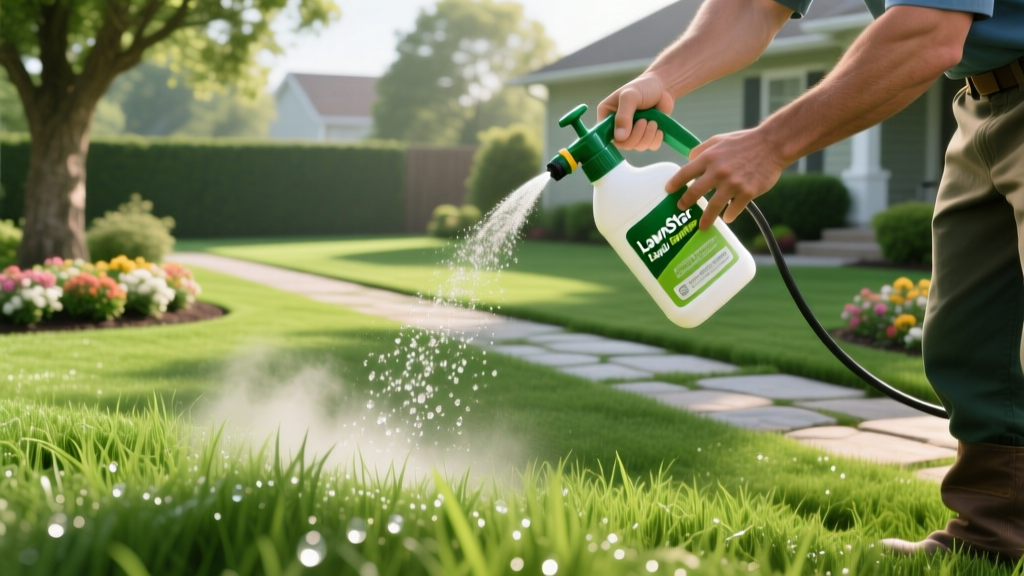
How to Apply LawnStar Liquid Fertilizer: Step-by-Step Guide
The Science of Liquid Turf Nutrition
Transitioning from granular to liquid turf nutrition fundamentally changes how your lawn absorbs essential macronutrients. Granular fertilizers require microbial breakdown and soil moisture to dissolve, a process that can take 7 to 14 days. Liquid formulations, such as those produced by LawnStar, bypass this delay by offering immediate foliar absorption and rapid soil penetration. According to turfgrass management guidelines from North Carolina State Extension, liquid nitrogen and micronutrients can be absorbed through the leaf cuticle within 15 to 30 minutes of application, making them highly efficient for correcting acute deficiencies.
LawnStar's product line leverages chelation technology and stabilized nitrogen sources. For instance, their Chelated Liquid Iron utilizes EDTA (ethylenediaminetetraacetic acid) chelation. This is critical because standard iron sulfate rapidly oxidizes and becomes unavailable in soils with a pH above 7.0. By binding the iron to an organic molecule, LawnStar ensures the nutrient remains bioavailable regardless of your soil's alkalinity, delivering that deep, dark blue-green color without triggering the aggressive top-growth flush associated with high-nitrogen applications.
Calibration and Equipment Setup
The most common failure point in liquid lawn care is improper equipment calibration. Applying too much liquid nitrogen (like LawnStar 30-0-0) will scorch the turf, while under-applying wastes product. You must choose between a hose-end sprayer for large areas or a backpack sprayer for precision.
Backpack Sprayer Calibration Protocol
For uniform coverage, a 2-gallon or 4-gallon backpack sprayer equipped with a flat-fan nozzle (such as a TeeJet 8002VS) is the professional standard. To calibrate your sprayer for LawnStar products:
- Measure a Test Area: Mark off exactly 1,000 square feet of your driveway or a dry section of the lawn.
- Water Test: Fill your sprayer with a known volume of plain water (e.g., 2 gallons).
- Spray the Area: Walk at your normal, steady pace (typically 3 mph), overlapping each pass by 50%. Spray the entire 1,000 sq ft area.
- Measure Residual: Pour the remaining water into a measuring cup. If you used 1.5 gallons to cover 1,000 sq ft, your output rate is 1.5 gallons per 1,000 sq ft.
💡 Pro Tip: Surfactant Integration
Always add a non-ionic surfactant (NIS) to your tank mix at a rate of 0.25% volume/volume (roughly 1 teaspoon per gallon). Surfactants break the surface tension of the water, allowing the LawnStar liquid fertilizer to spread evenly across the waxy grass blade rather than beading up and rolling off into the soil.
Step-by-Step LawnStar Application Protocol
Once your equipment is calibrated, follow this exact sequence to apply LawnStar liquid fertilizers safely and effectively.
Step 1: Prepare the Turf Canopy
Mow your lawn 24 hours prior to application. Removing the top third of the grass blade opens the canopy, allowing the liquid solution to reach the lower leaf tissue and the soil surface. Do not bag the clippings if they are short; returning them provides a baseline of slow-release organic matter.
Step 2: Mix the Solution
Always add water to the tank first, then add the LawnStar product, and finally add the surfactant. This order prevents excessive foaming. For LawnStar 16-4-8 Balanced NPK, the standard application rate is 12 to 16 fluid ounces per 1,000 square feet. If your calibration requires 1.5 gallons of water per 1,000 sq ft, mix 16 oz of fertilizer into 1.5 gallons of water.
Step 3: Execute the Spray Pattern
Apply the mixture during the early morning (between 6:00 AM and 9:00 AM) or late afternoon. Avoid midday applications when the sun is at its zenith. Maintain a consistent walking speed and keep the nozzle approximately 18 to 24 inches above the turf canopy to ensure the fan pattern has enough distance to fully develop and overlap correctly.
Step 4: Watering and Downtime
For foliar-targeted products like LawnStar Chelated Liquid Iron, do not water in. Allow the product to dry on the leaf blade for at least 4 to 6 hours to maximize stomatal absorption. For soil-targeted macronutrients like the 30-0-0 Liquid Nitrogen, a light watering (0.1 inches) immediately after application helps wash the nitrogen off the blades and into the root zone, mitigating the risk of foliar burn.
Seasonal LawnStar Maintenance Matrix
Turfgrass nutritional needs fluctuate based on soil temperature and the grass's growth cycle. Cool-season grasses (Fescue, Kentucky Bluegrass) require heavy feeding in the fall, while warm-season grasses (Bermuda, Zoysia) need peak nutrition in late spring and summer. The following matrix outlines a universal annual program using LawnStar formulations.
| Season | LawnStar Product | Rate per 1,000 sq ft | Primary Objective |
|---|---|---|---|
| Early Spring | 16-4-8 Balanced NPK | 12 - 16 oz | Root development and baseline nutrition |
| Late Spring | Chelated Liquid Iron | 3 - 5 oz | Deep greening without excessive vertical growth |
| Mid-Summer | 30-0-0 Liquid Nitrogen | 8 - 12 oz | Sustaining color during heat stress (reduce rate by 25%) |
| Early Fall | 16-4-8 Balanced NPK | 16 oz | Carbohydrate storage and winter prep for cool-season turf |
Troubleshooting Phytotoxicity and Burn
Liquid fertilizers are highly concentrated salts in suspension. If misapplied, they draw moisture out of the plant tissue via osmosis, resulting in phytotoxicity (fertilizer burn). Penn State Extension notes that turfgrass burn is rarely caused by the nutrient itself, but rather by the physical conditions during application.
⚠️ Warning: Iron and Heat Interaction
Never apply LawnStar Chelated Liquid Iron when ambient temperatures exceed 85°F (29°C). High heat accelerates droplet evaporation, concentrating the iron salts directly on the leaf blade and causing severe necrotic burning. If you must treat iron chlorosis in mid-summer, apply at dusk and irrigate lightly once the leaves have dried.
Common Application Mistakes to Avoid
- Overlapping Passes: Failing to turn off the sprayer nozzle at the end of a pass before turning around will result in double-application at the headlands, creating dark green or burnt stripes.
- Applying to Drought-Stressed Turf: If the grass blades are already curled or showing a bluish-gray tint from drought stress, their stomata are closed. Liquid fertilizer will sit on the surface and burn the tissue. Always irrigate deeply 24 hours before a liquid application if the soil is dry.
- Ignoring Tank Agitation: LawnStar products contain suspended micronutrients. If your backpack sprayer sits idle for more than 10 minutes, shake the tank vigorously before resuming to ensure the mixture remains homogenous.
Equipment Cleanup and Storage
Liquid fertilizers will corrode brass and stainless steel sprayer components if left to dry inside the tank and hoses. Immediately after application, triple-rinse the sprayer tank. Fill it with clean water, shake, and spray the water out through the nozzle to flush the hose and wand. Store the LawnStar bottles in a climate-controlled environment; freezing temperatures can cause the liquid emulsions to separate permanently, rendering the product ineffective for future applications.

