
Lawn Care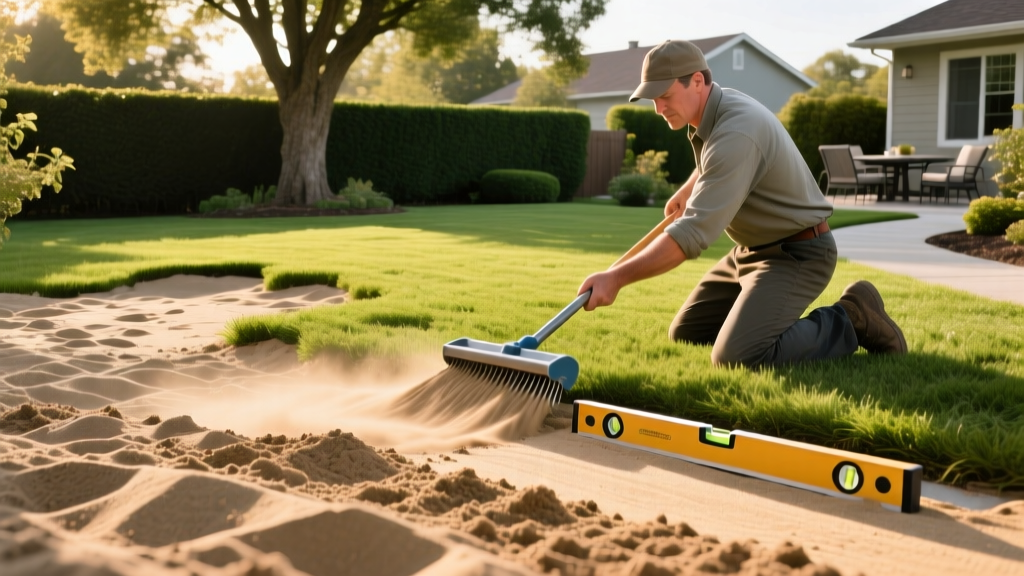
Leveling Yard With Sand: The Ultimate Step-by-Step Guide
The Physics of Sand: Why Particle Shape Matters
Leveling a yard with sand is not as simple as dumping bags of play sand from a hardware store onto your low spots. The success of sand topdressing relies entirely on soil physics—specifically, particle shape and pore space distribution. According to turfgrass research from the NC State University TurfFiles program, the angularity of sand grains dictates how well the soil drains and resists compaction over time.
When you use rounded sand (like play sand or beach sand), the spherical grains shift and slide past one another under foot traffic, eventually settling into a dense, impermeable layer that restricts water infiltration. Conversely, masonry sand is mechanically crushed, resulting in sharp, angular edges that interlock. This interlocking action maintains vital macro-pores in the soil profile, allowing oxygen and water to reach the turf's root zone while permanently raising the grade of the low spot.
Sand Type Comparison Matrix
| Sand Type | Grain Shape | Compaction Risk | Verdict for Lawns |
|---|---|---|---|
| Masonry Sand | Angular / Crushed | Low | Highly Recommended |
| Play Sand | Rounded / Smooth | High | Avoid Completely |
| Builder's Sand | Coarse / Mixed | Medium | Acceptable if Washed |
| River Sand | Semi-Rounded | Medium-High | Use Only as Last Resort |
Grass Type Dictates Your Topdressing Mix
A critical mistake homeowners make is applying 100% pure sand to cool-season lawns. Your grass species determines the exact topdressing ratio required for survival and nutrient retention.
The Cation Exchange Capacity (CEC) Rule
Pure sand has a near-zero CEC, meaning it cannot hold onto fertilizer nutrients. Warm-season grasses like Bermuda and Zoysia spread aggressively via stolons and rhizomes, easily pushing through pure sand to find nutrients in the native soil below. Cool-season grasses like Tall Fescue and Kentucky Bluegrass grow in bunches or spread slowly; they rely heavily on the topsoil layer for nutrient exchange. Therefore, cool-season lawns require a 70/30 mix of sand and screened compost to prevent nutrient leaching.
- Warm-Season Grasses (Bermuda, Zoysia, Centipede): 100% washed masonry sand.
- Cool-Season Grasses (Fescue, Kentucky Bluegrass, Ryegrass): 70% masonry sand / 30% screened topsoil or compost.
- Transition Zone Grasses: Assess your specific cultivar's stoloniferous growth rate; lean toward the 70/30 mix if unsure.
Step-by-Step Procedure: Leveling Your Yard
Proper execution requires specific timing and tooling. Plan this project for your lawn's peak growing season—late spring for warm-season grasses, and early fall for cool-season varieties. For comprehensive seasonal timing data, refer to the University of Minnesota Extension's turfgrass guidelines.
Step 1: Scalping and Dethatching
Lower your mower deck to its lowest safe setting for your grass type. For Bermuda, scalp it down to 0.5 inches. For Fescue, mow at 1.5 inches. Removing excess foliage ensures the sand makes direct contact with the soil surface rather than getting suspended in the thatch layer, which can lead to fungal diseases and hydrophobic dry spots.
Step 2: Core Aeration
Rent a gas-powered core aerator and make two passes over the entire lawn in perpendicular directions. Pulling 3-inch soil plugs creates channels for the sand to migrate deep into the subsoil, improving the structural grade from the bottom up rather than just masking the surface.
Step 3: Mixing and Calculating Materials
Calculate your material needs based on a maximum application depth of 1/4 to 1/2 inch per session. Applying more than 1/2 inch at once will smother the turf crown, blocking photosynthesis and killing the grass. Rule of thumb: One ton of masonry sand (approximately 1.35 cubic yards) will cover 1,000 square feet at a 1/4-inch depth.
If using a 70/30 mix for cool-season grass, mix the sand and compost in a wheelbarrow or on a tarp using a flat-edge transfer shovel until the color and texture are entirely uniform. Dry materials mix significantly easier; avoid mixing if rain is imminent.
Step 4: Application and Spreading
Dump the sand mixture in small, evenly spaced piles across the low areas of the yard. Using a specialized leveling rake (such as the Levelawn PRO or an Accuform aluminum drag rake, which retail between $120 and $160 in 2026), spread the material outward from the piles. The flat, wide base of a leveling rake pushes the sand into the aeration holes and depressions while simultaneously sweeping the grass blades clean. Avoid using a standard landscaping bow rake, as the tines will pull up the turf roots and create an uneven, streaked surface.
Step 5: Dragging and Watering
For large properties (over 5,000 sq ft), attach a steel chain-link drag mat or a specialized turf brush to a utility vehicle or lawn tractor to sweep the lawn. This forces the sand deep into the canopy. Immediately follow up with a deep, 30-minute irrigation cycle. The water washes the remaining sand off the grass blades and settles the material into the soil profile, eliminating air pockets.
2026 Cost Breakdown and Material Sourcing
Buying sand in 50-pound bags from a big-box store is a massive financial drain for anything larger than a 100-square-foot patch. For whole-yard leveling, you must source materials from a local landscape supply yard or quarry.
| Material | Bulk Price (Per Ton) | Bagged Equivalent Cost | Delivery Fee |
|---|---|---|---|
| Washed Mason Sand | $35 - $55 | $160+ (per ton equivalent) | $50 - $120 flat rate |
| Screened Compost | $40 - $65 | $180+ (per ton equivalent) | Bundled with sand |
Always request 'washed' masonry sand. Unwashed sand contains fine silt and clay dust (fines) that will clog soil pores and create a concrete-like hardpan when compacted by foot traffic.
Troubleshooting Common Sand-Leveling Failures
Failure 1: The Grass Turns Yellow and Dies
Cause: You applied the sand too thick. If the sand layer exceeds the height of the grass crown, the plant cannot photosynthesize.
Fix: Use a stiff-bristled push broom to aggressively sweep the excess sand off the turf blades and redistribute it to adjacent low spots. Never bury the crown.
Failure 2: Water Puddles on Top of the Sand
Cause: You used unwashed sand or play sand, creating a hydrophobic barrier, or the native soil beneath is heavy clay that was not aerated prior to topdressing.
Fix: Perform liquid aeration using a surfactant-based soil penetrant (like Aerify or a yucca extract solution) to break the surface tension and force water through the sand layer into the clay subsoil.
Failure 3: Weeds Explode After Leveling
Cause: You used cheap, unscreened topsoil in your 70/30 mix, which introduced thousands of dormant weed seeds to your lawn.
Fix: Only purchase certified weed-free compost or topsoil that has been heat-treated or properly aged. If weeds emerge, apply a targeted post-emergent herbicide like Quinclorac (for broadleaf and crabgrass) 14 days after the turf has fully recovered from the leveling stress.

