
Lawn Care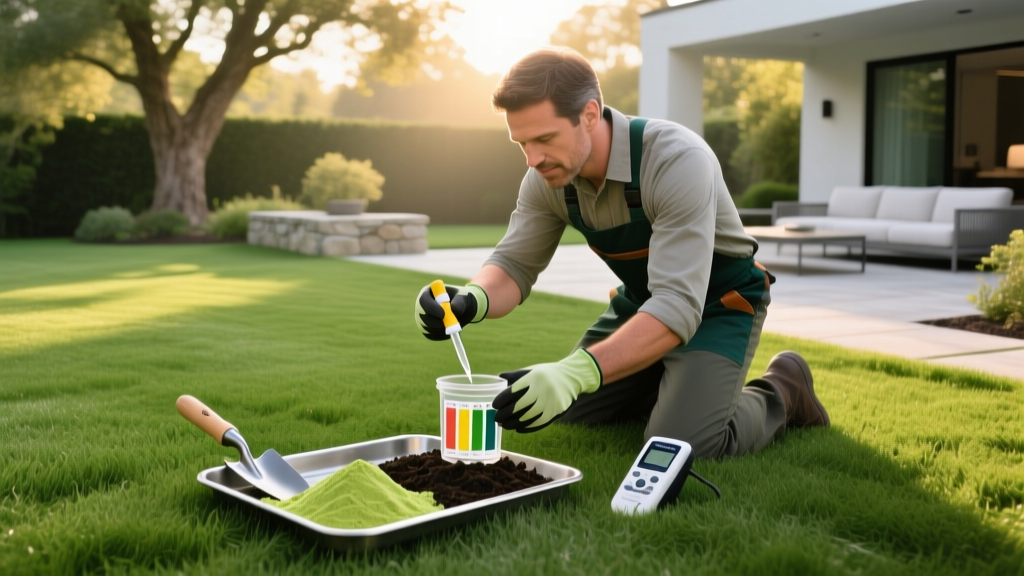
Mastering Lime Lawn Care: How to Test, Apply, and Balance Soil pH
The Master Switch of Turf Health: Understanding Soil pH
Applying premium nitrogen fertilizers to an acidic lawn is equivalent to pouring premium fuel into a car with a clogged injector. In the realm of soil amendments, lime lawn care is the foundational practice that unlocks nutrient availability. When soil pH drops below 6.0, essential macronutrients like phosphorus, potassium, and calcium become chemically bound to aluminum and iron, rendering them inaccessible to turfgrass roots. Conversely, a pH that is too high (alkaline) locks out vital micronutrients like iron and manganese, leading to severe chlorosis.
For cool-season grasses (Kentucky Bluegrass, Tall Fescue, Perennial Ryegrass), the optimal pH range is 6.2 to 6.8. Warm-season grasses (Bermuda, Zoysia, Centipede) tolerate slightly higher acidity, thriving between 5.8 and 6.5. Achieving these targets requires moving beyond generic bag recommendations and understanding the specific buffering capacity of your soil.
Expert Insight: Cation Exchange Capacity (CEC)
Soil pH does not exist in a vacuum. It is governed by your soil's CEC—its ability to hold and exchange positively charged ions (cations). Clay soils and soils high in organic matter have a high CEC, meaning they resist pH changes (high buffering capacity). Sandy soils have a low CEC and swing wildly in pH. This is why a sandy lawn might need 15 lbs of lime per 1,000 sq ft, while a heavy clay lawn with the exact same starting pH might require 50 lbs.
Soil pH does not exist in a vacuum. It is governed by your soil's CEC—its ability to hold and exchange positively charged ions (cations). Clay soils and soils high in organic matter have a high CEC, meaning they resist pH changes (high buffering capacity). Sandy soils have a low CEC and swing wildly in pH. This is why a sandy lawn might need 15 lbs of lime per 1,000 sq ft, while a heavy clay lawn with the exact same starting pH might require 50 lbs.
Selecting Your Amendment: Calcitic vs. Dolomitic vs. Enhanced
Not all agricultural limestone is created equal. The choice between calcitic and dolomitic lime should be dictated entirely by your soil test's magnesium (Mg) base saturation levels, not by what is cheapest at the local garden center.
| Lime Type | Calcium Carbonate Equivalence (CCE) | Magnesium Content | Best Use Case | Avg. Cost (40lb Bag) |
|---|---|---|---|---|
| Calcitic Limestone | 90% - 100% | < 5% | Soils with adequate/high Mg; standard pH correction. | $12 - $18 |
| Dolomitic Limestone | 90% - 110% | 10% - 40% | Mg-deficient soils; sandy soils prone to leaching. | $15 - $22 |
| Pelletized / Enhanced (e.g., Mag-I-Cal) | 100% - 130% | Variable (often added) | Fast-acting correction; clay soils; humic acid blends. | $25 - $35 |
According to University of Minnesota Turf Science, pulverized limestone reacts faster than granular but is notoriously difficult to apply without specialized equipment due to dust drift. For residential lawns, pelletized lime (which binds finely ground limestone into dust-free prills using a water-soluble binder) offers the best compromise between ease of application and reaction speed.
Decoding Your Soil Test: The Critical Role of Buffer pH
The most common failure point in DIY lime lawn care is applying lime based solely on the active soil pH reading. A standard pH test measures the current hydrogen ion concentration in the soil water. It does not tell you how much reserve acidity is hiding in the soil's CEC.
The SMP or Adams-Evans Buffer Test
When you send a soil sample to a reputable lab (like Penn State Extension's Agricultural Analytical Services Lab), they will perform a secondary test called a Buffer pH test. This involves mixing your soil with a chemical buffer solution to simulate the soil's resistance to change.
- Active pH 5.5 / Buffer pH 6.8: Low buffering capacity (likely sandy soil). Requires ~20 lbs of lime per 1,000 sq ft to reach a target of 6.5.
- Active pH 5.5 / Buffer pH 6.2: High buffering capacity (heavy clay or high organic matter). Requires ~45 to 50 lbs of lime per 1,000 sq ft to reach the exact same 6.5 target.
Warning: The 50 lb / 1,000 sq ft Threshold
If your soil test recommends more than 50 lbs of lime per 1,000 sq ft, do not apply it all at once. Split the application into two doses spaced six months apart (e.g., 25 lbs in early Fall, 25 lbs in late Spring). Over-applying lime in a single pass can cause a rapid pH spike that induces severe micronutrient deficiencies.
If your soil test recommends more than 50 lbs of lime per 1,000 sq ft, do not apply it all at once. Split the application into two doses spaced six months apart (e.g., 25 lbs in early Fall, 25 lbs in late Spring). Over-applying lime in a single pass can cause a rapid pH spike that induces severe micronutrient deficiencies.
Precision Application: Timing, Spreader Settings, and Integration
Lime is relatively immobile in the soil profile. It moves downward at a rate of approximately 1 inch per year in typical loam soils. Therefore, getting it into the root zone is critical.
Step-by-Step Application Protocol
- Core Aerate First: Always perform core aeration before liming. The 2-to-3-inch holes created by the aerator tines allow the lime to bypass the thatch layer and make direct contact with the soil matrix.
- Calibrate Your Spreader: For standard 40lb bags of pelletized lime (like Espoma Organic Garden Lime or Jonathan Green's Mag-I-Cal), a Scotts Rotary Spreader typically requires a setting between M and O (check the specific bag matrix, as prill size varies by manufacturer). Walk at a consistent 3 mph pace.
- Watering In: Apply 0.25 inches of irrigation immediately after spreading to dissolve the pelletized binder and begin moving the calcium carbonate into the soil pores.
The 14-Day Fertilizer Rule
Never apply lime concurrently with ammonium-based nitrogen fertilizers (like ammonium sulfate or urea). When lime (calcium carbonate) reacts with ammonium, it triggers a chemical process called ammonia volatilization, converting the expensive nitrogen into ammonia gas that escapes into the atmosphere. Wait a minimum of 14 days between liming and applying nitrogen fertilizers.
Troubleshooting Common Liming Failures
| Symptom | Root Cause | Corrective Action |
|---|---|---|
| Soil pH remains unchanged 6 months after application. | Lime was surface-applied over a thick thatch layer (>0.5 inches) without aeration. | Perform deep core aeration or liquid aeration (humic/fulvic acids) to incorporate the stranded lime. |
| Turfgrass turns pale yellow (chlorotic) shortly after liming. | Over-liming caused pH to spike above 7.2, locking out iron and manganese. | Apply a foliar spray of chelated iron (Fe-EDDHA) and elemental sulfur to gradually lower the pH. |
| Lime forms a hard, white crust on the soil surface. | Pulverized lime was applied to dry, compacted clay without subsequent irrigation. | Break up the crust with a stiff rake, apply a wetting agent, and water deeply. |
Frequently Asked Questions
Can I apply lime and grass seed at the same time?
Yes. Lime does not possess herbicidal properties and will not inhibit seed germination. In fact, if your soil is acidic, applying lime during your fall overseeding project will create a more hospitable environment for the new seedlings. However, ensure you are using a starter fertilizer that does not contain high levels of ammonium, which would conflict with the lime.
How long does it take for lime to actually change the soil pH?
Reaction time depends heavily on the particle size of the lime and soil moisture. Finely ground, pelletized lime incorporated via aeration and watered in will show measurable pH shifts in 3 to 6 weeks. Coarse, agricultural-grade pulverized lime applied to the surface can take 6 to 12 months to fully react and alter the root-zone pH.
Does liquid lime work as well as granular?
Liquid lime (calcium carbonate suspended in water or calcium chelates) provides an immediate, short-term pH adjustment and is excellent for quick fixes or hydroseeding mixes. However, it lacks the residual buffering capacity of granular limestone. For long-term structural soil amendment, granular calcitic or dolomitic lime remains the industry standard.

