
Lawn Care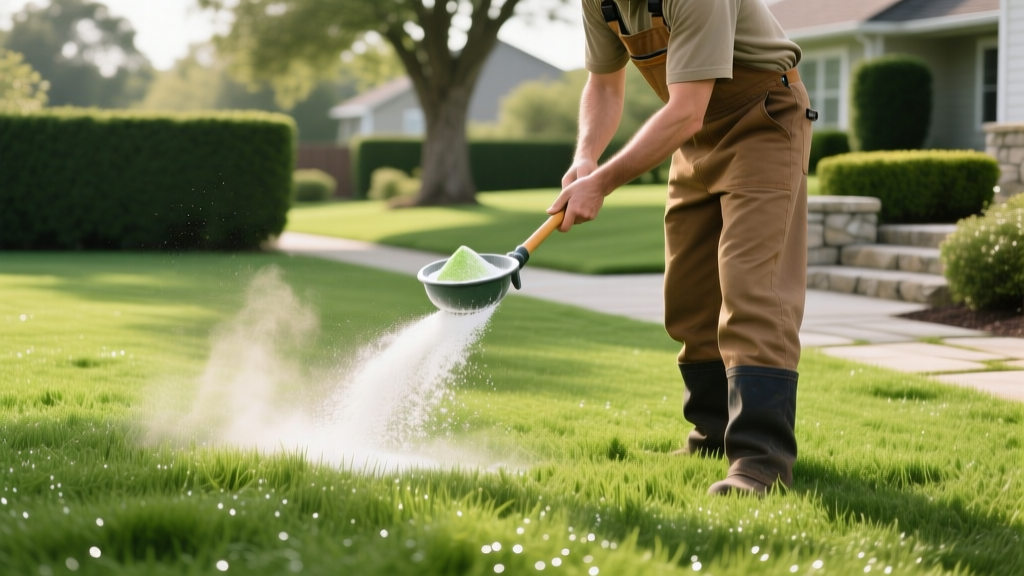
Essential Lime Powder Uses for Correcting Acidic Lawn Soil
The Chemistry Behind Lime Powder Uses in Turf Management
When turfgrass struggles to absorb nutrients despite regular fertilization, the culprit is often subterranean: soil acidity. Pulverized agricultural limestone, commonly referred to as lime powder, is the most cost-effective and chemically efficient amendment for neutralizing acidic soil profiles. Understanding the specific lime powder uses in lawn care requires looking past the surface and examining the Cation Exchange Capacity (CEC) of your soil.
Lime powder primarily consists of calcium carbonate (calcitic lime) or calcium magnesium carbonate (dolomitic lime). When introduced to moist, acidic soil, the carbonate ions react with hydrogen ions (which cause acidity) to form water and carbon dioxide. This reaction effectively removes the hydrogen ions from the soil solution, raising the pH and unlocking bound macronutrients like phosphorus, potassium, and molybdenum that are otherwise inaccessible to turfgrass roots in low-pH environments.
Calcitic vs. Dolomitic Lime: Before purchasing, review your soil test's magnesium levels. If magnesium is deficient (below 50 ppm), use dolomitic lime powder. If magnesium is adequate, use calcitic lime powder to avoid inducing a calcium-magnesium nutrient antagonism, which can lock out calcium uptake in heavy clay soils.
Diagnosing the Need: Water pH vs. Buffer pH
The most common mistake homeowners make when exploring lime powder uses is applying product based solely on a cheap liquid test kit's water pH reading. Professional agronomists rely on the SMP Buffer pH test. While water pH tells you the current acidity of the soil solution, the buffer pH measures the soil's reserve acidity (the hydrogen ions bound to clay and organic matter particles).
Sandy soils have low reserve acidity, meaning a small amount of lime powder will rapidly shift the pH. Heavy clay soils possess high reserve acidity, requiring significantly more lime powder to achieve the exact same pH shift. According to NC State Extension, applying lime without accounting for buffer pH frequently results in severe under-liming on clay soils or toxic over-liming on sandy soils.
Optimal Soil pH Targets by Grass Type
| Turfgrass Species | Season Type | Optimal Soil pH Range | Tolerance to Low pH |
|---|---|---|---|
| Kentucky Bluegrass | Cool-Season | 6.0 - 7.0 | Low (Struggles below 5.8) |
| Tall Fescue | Cool-Season | 5.8 - 6.5 | Moderate |
| Bermudagrass | Warm-Season | 5.8 - 6.5 | High (Tolerates 5.0) |
| Centipedegrass | Warm-Season | 5.0 - 6.0 | Very High (Prefers acidity) |
| St. Augustinegrass | Warm-Season | 6.0 - 7.5 | Low (Prone to iron chlorosis in acid) |
Step-by-Step Application: Calculating and Spreading
Pulverized lime powder is notoriously dusty and prone to clumping if exposed to ambient humidity. Unlike pelletized lime, which flows easily through rotary broadcast spreaders, lime powder requires a drop spreader equipped with an agitator bar to prevent bridging in the hopper.
Calculation Framework for a 5,000 Sq Ft Lawn
Assume your soil test indicates a water pH of 5.2 and a buffer pH of 6.4 on a loam soil profile. Your target is 6.5 for Tall Fescue. Based on standard agronomic charts, a buffer pH of 6.4 requires approximately 35 lbs of lime per 1,000 square feet to raise the water pH by one full unit.
- Total Material Needed: 35 lbs x 5 (for 5,000 sq ft) = 175 lbs of lime powder.
- Split Applications: Never apply more than 50 lbs per 1,000 sq ft in a single pass. Split the 175 lbs into two applications spaced 4 to 6 weeks apart to prevent surface crusting and salt shock.
- Spreader Calibration: Set a Scotts Classic Drop Spreader to setting 'K' (or roughly 3/4 open). Walk at a consistent 3.0 mph pace.
- Watering In: Lightly irrigate the lawn with 1/4 inch of water immediately after application to wash the powder off the grass blades and into the soil matrix, preventing foliar burn.
2026 Material and Equipment Costs
Pricing for soil amendments fluctuates with freight and mining costs. As of early 2026, bulk pulverized agricultural lime (often sold as 'ag-lime' at landscape supply yards) costs between $38 and $55 per ton, making it the most economical choice for properties exceeding half an acre. For standard residential lawns, 40-lb bags of bagged pulverized lime (such as Old Castle Sweetens or regional quarry brands) retail for $4.50 to $6.00 per bag. By contrast, pelletized lime typically costs $8.00 to $11.00 per 40-lb bag. While powder requires more careful handling, the cost savings on larger projects are substantial.
Advanced Lime Powder Uses Beyond Basic pH Adjustment
While correcting soil acidity is the primary function, experienced turf managers leverage lime powder for several secondary agronomic benefits:
- Moss Eradication: Moss thrives in compacted, acidic soils (pH below 5.5). Applying lime powder to raise the pH above 6.0 creates an environment hostile to moss spores while encouraging competitive turfgrass rhizome expansion.
- Thatch Decomposition: Soil microorganisms responsible for breaking down thatch layers operate optimally near a neutral pH. Liming acidic soils accelerates microbial activity, reducing the need for mechanical dethatching.
- Calcium Supplementation: In regions with heavy leaching rains (such as the Pacific Northwest), calcium is frequently stripped from the soil profile. Calcitic lime powder acts as a slow-release calcium source, vital for cell wall development in turfgrass, improving drought and heat tolerance.
Warning: Edge Effects on Acid-Loving Plants
When applying lime powder near property borders, maintain a strict 3-foot buffer zone around hydrangeas, azaleas, rhododendrons, and blueberry bushes. Runoff and lateral soil diffusion can raise the pH in these beds, causing severe iron chlorosis and stunted growth in acid-loving ornamentals.
When applying lime powder near property borders, maintain a strict 3-foot buffer zone around hydrangeas, azaleas, rhododendrons, and blueberry bushes. Runoff and lateral soil diffusion can raise the pH in these beds, causing severe iron chlorosis and stunted growth in acid-loving ornamentals.
Troubleshooting Over-Liming and Edge Cases
Applying too much lime powder can be just as damaging as leaving the soil acidic. When soil pH exceeds 7.2, micronutrients like iron, manganese, and zinc become insoluble. This manifests as interveinal chlorosis—the grass blades turn pale yellow while the veins remain green.
If you have accidentally over-limed your lawn, do not attempt to rapidly lower the pH with elemental sulfur, as this can cause extreme osmotic stress to the roots. Instead, apply a chelated iron foliar spray (such as Fe-EDDHA) at a rate of 3 ounces per 1,000 square feet to bypass the soil lock-out and provide immediate greening. Over the next 12 to 18 months, natural soil buffering and the use of acidifying fertilizers like ammonium sulfate (21-0-0) will gradually bring the pH back into the optimal zone. For deeper insights into managing micronutrient deficiencies caused by pH imbalances, University of Minnesota Turfgrass Science provides excellent diagnostic frameworks.
Frequently Asked Questions
Can I apply lime powder and synthetic fertilizer at the same time?
No. Applying lime powder simultaneously with nitrogen fertilizers containing ammonium can cause a chemical reaction that volatilizes the nitrogen, releasing it into the atmosphere as ammonia gas. Separate lime and fertilizer applications by at least 14 days.
How long does it take for lime powder to work?
Pulverized lime powder has a high surface area and begins reacting with soil moisture within 48 hours. However, achieving a uniform pH shift throughout the top 4 to 6 inches of the soil profile typically takes 3 to 6 months, depending on soil moisture and incorporation depth.
Should I aerate before or after applying lime powder?
Always core aerate before applying lime powder. The aeration holes provide direct pathways for the calcium carbonate to reach the subsoil and root zone, bypassing the thatch layer and dramatically accelerating the neutralization process.

