
Lawn Care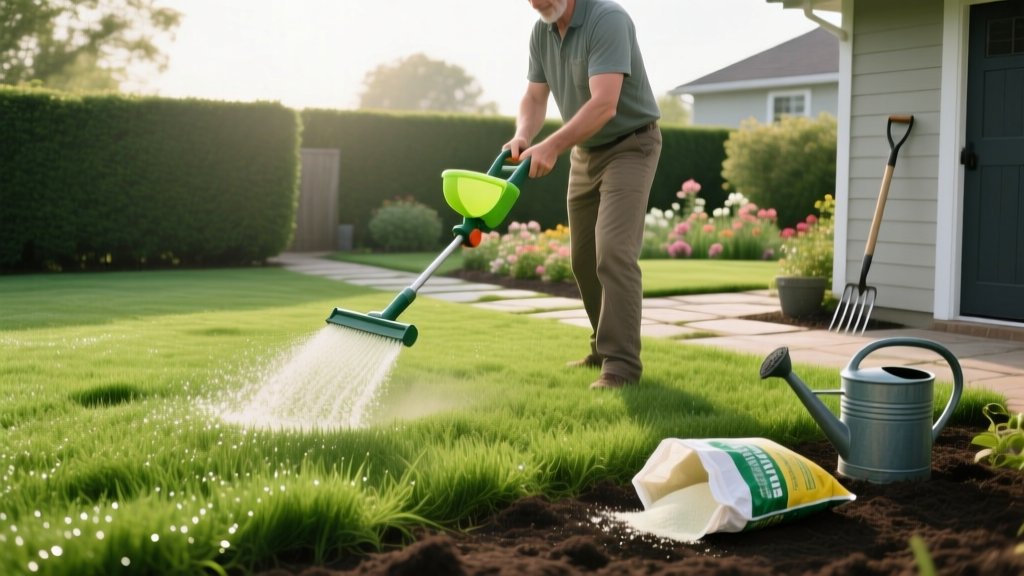
Lime Yard Treatment Guide: Fixing Acidic Soil for Healthier Grass
The Hidden Culprit Behind Thinning Turf: Soil Acidity
If your lawn is struggling despite regular fertilization, consistent watering, and proper mowing, the problem likely lies beneath the surface. Acidic soil (pH below 6.0) locks up essential macronutrients like nitrogen, phosphorus, and potassium, rendering your expensive fertilizer applications useless. A targeted lime yard treatment is the most effective soil amendment strategy to neutralize acidity, restore cation exchange capacity (CEC), and create an optimal environment for turfgrass root expansion.
According to the University of Minnesota Extension, cool-season grasses like Kentucky Bluegrass and Tall Fescue thrive in a soil pH range of 6.2 to 6.8. When pH drops below 5.5, aluminum and manganese become highly soluble and toxic to grass roots, while beneficial soil microbes that break down thatch become dormant. Applying agricultural limestone is not just about raising a number on a test kit; it is a fundamental structural correction for your soil profile.
Active pH vs. Buffer pH: The Science of Liming
Most homeowners make a critical error by looking only at the 'active pH' on their soil test results. Active pH measures the current hydrogen ion concentration in the soil water. However, it does not tell you how much lime is required to change that number. For that, you must understand Buffer pH.
Expert Insight: Buffer pH measures the soil's resistance to change, largely dictated by its Cation Exchange Capacity (CEC). Heavy clay soils have high buffering capacity and require significantly more lime to shift the pH by 0.5 points compared to loose, sandy soils with low buffering capacity.
When you receive a professional soil analysis from a lab like Logan Labs, they will provide both metrics. If your active pH is 5.5 and your buffer pH is 6.8, the lab will calculate the exact tons of calcium carbonate equivalent (CCE) needed per acre, which translates directly to pounds per 1,000 square feet for residential application.
Calcitic vs. Dolomitic Lime: Choosing the Right Amendment
Not all lime products are created equal. The two primary forms of agricultural lime used in turf management are calcitic and dolomitic. Choosing the wrong type can lead to nutrient imbalances, particularly regarding magnesium levels.
| Feature | Calcitic Lime | Dolomitic Lime |
|---|---|---|
| Primary Composition | Calcium Carbonate (CaCO3) | Calcium-Magnesium Carbonate |
| Magnesium Content | Low (< 5%) | High (10% - 20%) |
| Best Used When | Soil tests show adequate or high Mg levels | Soil tests indicate a magnesium deficiency |
| Reaction Speed | Reacts slightly faster in sandy soils | Slower to break down, longer residual effect |
| Top Product Example | Jonathan Green MAG-I-CAL Plus ($45 / 45 lbs) | Espoma Organic Garden Lime ($14 / 40 lbs) |
Pelletized vs. Pulverized Lime
For residential lawn care, always choose pelletized lime. Pulverized (powdered) lime is incredibly messy, poses an inhalation risk, and is easily blown away by wind before it reaches the soil. Pelletized lime, such as Greenview Fairway Formula Pelletized Lime, consists of finely ground limestone bound into uniform prills. These prills spread evenly through a standard rotary spreader and break down rapidly upon contact with moisture and soil microbes.
Step-by-Step Application Protocol
Executing a successful lime yard treatment requires precise timing and calibrated equipment. Follow this protocol for maximum efficacy.
- Conduct a Professional Soil Test: Do not guess. Pull 5-6 core samples from the top 4 inches of your lawn, mix them in a clean plastic bucket, and mail them to a reputable lab. Wait for the buffer pH recommendations.
- Calculate the Application Rate: A standard rule of thumb for loam soil is that 40 lbs of pelletized lime per 1,000 sq ft will raise the pH by approximately 0.5 points. If your soil test recommends 80 lbs per 1,000 sq ft, you must split the application into two separate treatments spaced 3 to 4 months apart to avoid salt shock to the turf.
- Calibrate Your Spreader: Use a broadcast (rotary) spreader for pelletized lime. For a standard Scotts Turf Builder EdgeGuard Mini spreader, set the dial to Setting 7 for most 40lb pelletized lime bags. Walk at a steady pace of 3 mph.
- Time the Application: The Michigan State University Extension notes that lime takes 6 to 12 months to fully react with the soil. Apply lime in the fall or early winter. The freeze-thaw cycles of winter and heavy spring rains will work the calcium carbonate deep into the root zone.
- Water the Turf: Immediately after spreading, apply 0.25 inches of irrigation. This washes the lime prills off the grass blades (preventing foliar burn) and initiates the breakdown process in the soil.
Critical Warning: Nitrogen Volatilization
Never apply lime and nitrogen fertilizer (especially urea or ammonium sulfate) on the same day. The high pH environment created by the dissolving lime will cause the ammonium to convert into ammonia gas, which evaporates into the atmosphere. You will lose up to 30% of your nitrogen investment. Always separate lime and nitrogen applications by at least 3 to 4 weeks.
Never apply lime and nitrogen fertilizer (especially urea or ammonium sulfate) on the same day. The high pH environment created by the dissolving lime will cause the ammonium to convert into ammonia gas, which evaporates into the atmosphere. You will lose up to 30% of your nitrogen investment. Always separate lime and nitrogen applications by at least 3 to 4 weeks.
Cost Breakdown and ROI of Liming
Investing in a lime yard treatment yields a high return on investment by maximizing the efficiency of your future fertilizer applications. Here is what you can expect to spend in 2026:
- DIY Soil Testing: $25 - $35 per comprehensive analysis.
- DIY Pelletized Lime: $12 - $18 per 40lb bag (covers ~1,000 sq ft). A 5,000 sq ft lawn requiring a 0.5 pH shift will cost roughly $75 in materials.
- Professional Application: Lawn care companies typically charge $0.03 to $0.05 per square foot for lime applications, totaling $150 - $250 for a standard 5,000 sq ft property.
While professional services save time and guarantee commercial-grade calibration, the DIY route is highly cost-effective for homeowners willing to rent or purchase a quality broadcast spreader.
Frequently Asked Questions
Can I apply too much lime to my lawn?
Yes. Over-liming can push your soil pH above 7.5, which induces severe micronutrient deficiencies, particularly iron chlorosis (yellowing of grass blades with green veins). This is why relying on buffer pH soil tests rather than visual guesswork is non-negotiable.
Will lime kill moss in my yard?
Lime does not directly kill moss. Moss thrives in compacted, shaded, and poorly drained soils, which often happen to be acidic. Raising the pH with a lime yard treatment makes the environment more favorable for grass to outcompete the moss, but you must also address soil compaction via core aeration and improve drainage to fully eradicate moss.
How often should I apply lime?
Liming is not an annual maintenance task like fertilization. A proper lime application should maintain optimal soil pH for 3 to 5 years. Retest your soil every three years to determine if a maintenance dose (typically 20 lbs per 1,000 sq ft) is required.

