
Lawn Care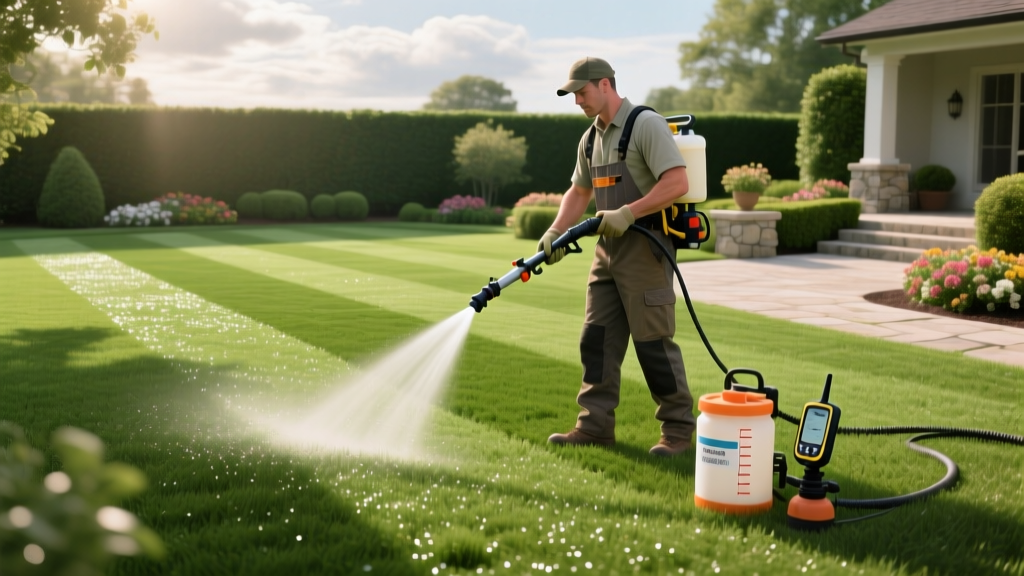
How to Liquid Aerate: Dosage, Coverage & Cost Guide
The Chemistry of Liquid Aeration: Surfactants vs. Physical Plugs
Liquid aeration represents a fundamental shift from mechanical soil disruption to chemical soil modification. Traditional core aeration relies on heavy machinery to physically extract 2-to-3-inch soil plugs, relieving compaction through physical voids. Liquid aeration, conversely, utilizes anionic and non-ionic surfactants—primarily Ammonium Lauryl Sulfate (ALS) and Sodium Laureth Sulfate (SLES)—to reduce the surface tension of water molecules. According to turfgrass research published by the USGA Green Section, these wetting agents allow moisture and dissolved nutrients to bypass hydrophobic (water-repellent) soil layers and penetrate deep into the root zone.
Most premium liquid aerators formulated in 2026 also blend these surfactants with humic and fulvic acids. While the surfactants handle immediate water infiltration, the humic substances chelate micronutrients and stimulate microbial activity, gradually improving soil structure from the inside out. However, because liquid aerators do not physically remove thatch or break severe hardpan clay, understanding exact dosage, coverage limitations, and cost-to-benefit ratios is critical before abandoning your mechanical aerator.
2026 Liquid Aerator Comparison Matrix: Dosage & Coverage
Not all liquid soil looseners are created equal. The concentration of active surfactants dictates both the application rate and the total coverage per bottle. Below is a breakdown of the three most reliable liquid aerate products currently on the market, detailing their active ingredients, precise dosage requirements, and real-world costs.
| Product Model | Active Ingredients | Dosage Rate | Bottle Size / Coverage | Avg. Cost |
|---|---|---|---|---|
| N-EXT AIR-8 | ALS Surfactant, 14% Humic Acid, 2% Fulvic Acid | 3 oz per 1,000 sq ft | 32 oz / 10,600 sq ft | $27.99 |
| Simple Lawn Solutions Aerating Soil Loosener | Proprietary Surfactant Blend, Humic Acid | 3 oz per 1,000 sq ft | 32 oz / 10,600 sq ft | $22.99 |
| Covington Naturals Liquid Aerator | SLES Surfactant, Kelp Extract, Humic Acid | 3 oz per 1,000 sq ft | 32 oz / 10,600 sq ft | $24.99 |
Pro Tip: Always calculate your lawn's exact square footage using a GPS measuring app or by measuring your property lines. Over-applying surfactants can lead to excessive soil foaming and temporary foliar burn, while under-applying will fail to break the soil's surface tension.
Calibration & Application: Getting the Exact Dosage Right
The most common failure point in liquid aeration is improper sprayer calibration. Surfactants require a specific carrier volume to push the active ingredients past the thatch layer and into the topsoil. The minimum recommended carrier rate is 1.5 gallons of water per 1,000 square feet.
⚠️ Calibration Warning: Never apply ALS-based liquid aerators when ambient temperatures exceed 85°F. High heat accelerates evaporation, leaving concentrated surfactant salts on the grass blades, which will cause severe tip burn within 24 hours. Always apply in the early morning or late evening.
Step-by-Step Hose-End Sprayer Setup
- Select the Right Sprayer: Use a dial-end hose sprayer (like the Ortho Dial N Spray) rather than a pump tank sprayer for lawns over 2,000 sq ft to ensure adequate water volume.
- Set the Dial: Pour the liquid aerator into the sprayer reservoir. Set the dial to 3 oz per gallon. If your sprayer only has '1 oz' and '4 oz' settings, use the 4 oz setting and walk slightly faster to maintain the 3 oz per 1,000 sq ft target.
- Establish Your Pace: Walk at a steady, consistent pace of approximately 3 mph. Overlapping your spray passes by 10% ensures uniform coverage without creating concentrated hot spots.
- The Water-In Requirement: Immediately after application, run your irrigation system or hose for 15-20 minutes to deliver roughly 0.25 inches of water. This pushes the surfactants off the grass blades and into the soil profile where they belong.
Cost Analysis: Liquid Aeration vs. Traditional Core Aeration
Homeowners often switch to liquid aeration to save money and avoid the physical labor of renting heavy machinery. Let's break down the true financial cost of both methods for a standard 10,000 square foot lawn over a 5-year period, assuming two aeration events per year (spring and fall).
- Liquid Aeration (DIY): At $25 per 32 oz bottle (covering 10,000 sq ft), two annual applications cost $50 per year. Over 5 years, the total cost is $250.
- Core Aeration (Machine Rental): Renting a walk-behind aerator costs roughly $90 for 4 hours. Add $30 for truck rental/gas, $20 for cleanup, and the physical toll of maneuvering a 250-lb machine. Annual cost: $140. Over 5 years: $700.
- Core Aeration (Professional Service): Lawn care companies typically charge $0.015 to $0.025 per square foot for core aeration. For 10,000 sq ft, expect to pay $200 per visit. Annual cost: $400. Over 5 years: $2,000.
While liquid aeration offers a massive 64% to 87% cost reduction over mechanical methods, it must be viewed as a soil conditioner rather than a direct 1:1 replacement for physical aeration in severely compacted soils.
The Limits of Liquid Aeration: When to Stick with Core Plugging
Despite the aggressive marketing claims of some manufacturers, liquid aerators cannot solve every soil issue. The Penn State Extension notes that severe physical compaction and thick organic barriers require mechanical intervention. Here are the specific edge cases where liquid aeration will fail, and you must rent a core aerator.
Scenario 1: Thatch Layers Exceeding 0.5 Inches
Surfactants reduce water surface tension, but they do not consume dead organic matter. If your lawn has a thatch layer thicker than half an inch, the liquid aerator will become trapped in the thatch mat. It will never reach the soil surface to break up compaction. In this scenario, you must perform mechanical dethatching or core aeration to physically pull the thatch plugs to the surface before liquid treatments will be effective.
Scenario 2: Severe Clay Hardpan & Construction Compaction
New construction sites often suffer from severe subsoil compaction where heavy machinery has compressed the clay into a concrete-like hardpan. Liquid surfactants can only penetrate and loosen the top 2 to 3 inches of soil. If your compaction issue extends 6 inches deep, liquid aeration will only scratch the surface. You need the 3-inch steel tines of a mechanical core aerator to physically fracture the deep hardpan and introduce organic topdressing into the voids.
Frequently Asked Questions
Can I mix liquid aerator with liquid fertilizer?
Yes, most humic-acid-based liquid aerators (like N-EXT AIR-8) are highly compatible with liquid nitrogen fertilizers and chelated iron. Mixing them in the same tank sprayer saves time and allows the surfactant to pull the fertilizer nutrients deeper into the root zone. Always perform a small 'jar test' first to ensure the chemicals do not precipitate or clump.
How long does it take to see results from liquid aeration?
Unlike core aeration, where you immediately see physical soil plugs on the lawn, liquid aeration works on a microscopic level. You will typically notice improved water infiltration and reduced puddling within 24 to 48 hours. Visible improvements in turf vigor, root depth, and drought tolerance generally manifest between 14 and 21 days post-application as microbial activity increases.
Is liquid aeration safe for pets and children?
Once the liquid aerator has been watered into the soil and the grass blades are completely dry, it is entirely safe for pets and children. The primary active ingredients (ALS and humic acids) are commonly found in agricultural soil amendments and pose no systemic toxicity risk once absorbed into the soil profile.

