
Lawn Care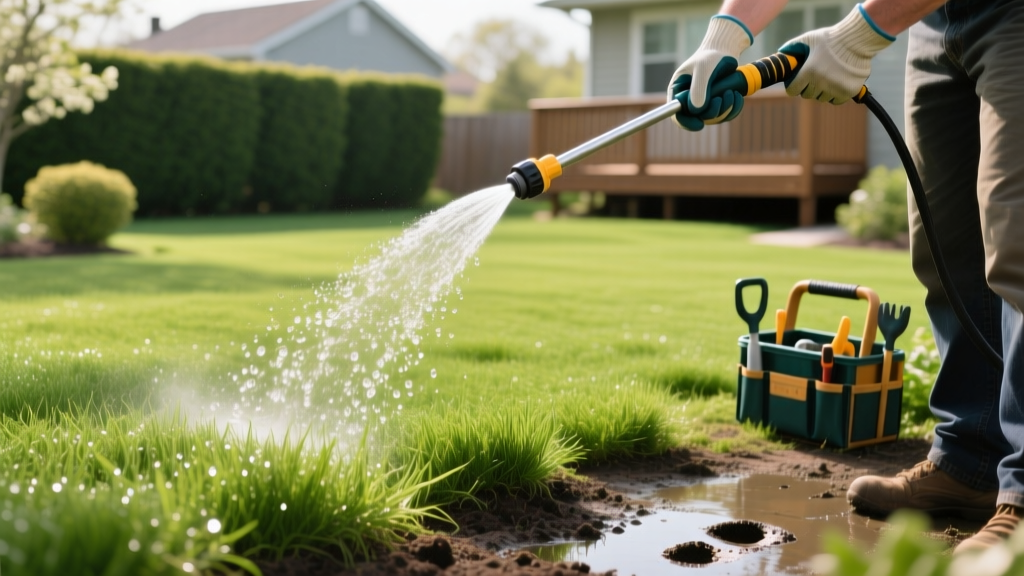
Liquid Aerator for Lawns: Step-by-Step Application Guide
The Chemistry: How Liquid Aerators Break Surface Tension
Unlike mechanical core aeration, which physically extracts 3-inch soil plugs to relieve deep compaction, a liquid aerator for lawns operates on a chemical level. These products are essentially high-concentration surfactants and soil conditioners. According to Penn State Extension, severe soil compaction restricts oxygen and water movement, but in many residential lawns, the primary barrier is hydrophobic (water-repellent) soil and high surface tension.
Liquid aerators utilize compounds like Ammonium Laureth Sulfate (ALS) and yucca extract (saponins) to reduce the surface tension of water. This allows moisture and dissolved nutrients to penetrate tightly bound clay particles and thatch layers, effectively "flocculating" the soil structure to create microscopic pore spaces. While they will not fix severe, deep-tire-rut compaction, they are highly effective for managing moderately compacted clay, improving drought tolerance, and maximizing fertilizer uptake between mechanical aeration cycles.
Decision Matrix: Liquid Aeration vs. Core Aeration
Before mixing your solution, determine if a liquid aerator is the correct tool for your lawn's current condition. Use this matrix to decide:
| Factor | Liquid Aerator (Surfactant) | Core Aeration (Mechanical) |
|---|---|---|
| Cost per 1,000 sq ft | $3.50 - $6.00 | $15.00 - $25.00 (Pro) / $85+ (Rental) |
| Primary Mechanism | Reduces water surface tension | Physically removes soil cores |
| Best Soil Type | Moderately compacted clay, hydrophobic soils | Severely compacted soils, heavy thatch (>0.5") |
| Labor & Time | 20 minutes (hose-end sprayer) | 2-4 hours (heavy machinery operation) |
| Frequency | Every 4-6 weeks during growing season | 1-2 times per year (Spring/Fall) |
Step-by-Step Liquid Aerator Application Protocol
Achieving uniform coverage requires precise calibration. Most commercial liquid aerators, such as N-EXT AirR8 or Simple Lawn Solutions Aerating Agent, recommend an application rate of 3 to 4 ounces per 1,000 square feet. Follow this exact procedure to avoid chemical burn or wasted product.
Step 1: Soil Moisture Testing and Mowing Prep
Do not apply liquid aerators to bone-dry soil or saturated mud. Test your soil moisture by pushing a 6-inch screwdriver into the lawn. If it penetrates with moderate resistance, the soil is ready. Mow your lawn to your standard height (e.g., 3.5 inches for Tall Fescue, 1.5 inches for Bermuda) to ensure the surfactant reaches the soil surface rather than coating the grass blades.
Step 2: Calibrating the Hose-End Sprayer
Most liquid aerators are applied via a dial-style hose-end sprayer.
- Calculate Total Product: For a 5,000 sq ft lawn at a rate of 3 oz per 1,000 sq ft, you need 15 oz of liquid aerator.
- Fill the Tank: Pour exactly 15 oz of the liquid aerator into the sprayer reservoir.
- Set the Dial: Adjust the sprayer dial to "3 oz" (or the closest setting, like 1 tbsp/gallon, depending on your specific model's calibration chart).
- Top Off (Optional): If your sprayer requires a minimum volume to siphon correctly, add water to the 15 oz of product until the tank is full, ensuring the total mixture will cover your target area before the tank empties.
Step 3: The Application Pattern
Attach the sprayer to your garden hose and turn the water on fully. Walk at a steady pace of roughly 3 feet per second. Spray in a North-South grid pattern, then immediately do a second pass in an East-West direction. This cross-hatch method prevents streaking and ensures the surfactant penetrates the thatch layer uniformly. Keep the sprayer nozzle at least 18 inches above the turf canopy to maintain a wide fan spray.
Step 4: The Post-Application Watering Protocol
Surfactants must be washed off the grass blades and into the soil profile to work. According to NC State Turfgrass Science, wetting agents require immediate incorporation. Within 30 minutes of application, run your irrigation system or attach a standard oscillating sprinkler to deliver exactly 0.1 to 0.2 inches of water. Place a few empty tuna cans on the lawn to measure the water depth; once they collect 0.15 inches, shut off the water. This pushes the ALS molecules directly into the root zone without leaching them past the active turf roots.
Optimal Timing by Grass Type
Liquid aerators rely on active root growth and microbial activity to maximize soil structure improvements. Apply them during peak growing seasons:
- Cool-Season Grasses (Kentucky Bluegrass, Tall Fescue, Perennial Ryegrass): Apply in early spring (when soil temperatures reach 55°F) and early fall (September). Avoid applications during the peak heat stress of July and August, as surfactants can increase turf susceptibility to drought if irrigation is inconsistent.
- Warm-Season Grasses (Bermuda, Zoysia, Centipede, St. Augustine): Apply from late May through August. The high soil temperatures (75°F - 85°F) accelerate the chemical interaction between the surfactants and the clay particles.
Active Ingredient Breakdown: What to Look For
Not all liquid aerators are formulated equally. When reading the label, look for these specific active ingredients:
- Ammonium Laureth Sulfate (ALS): The industry standard anionic surfactant. It aggressively breaks water surface tension and helps flush sodium from the soil profile.
- Yucca Extract (Saponins): A natural, non-ionic surfactant that improves lateral water movement in the thatch layer and reduces localized dry spot (LDS).
- Humic and Fulvic Acids: Often blended with ALS in premium products (like N-EXT AirR8). These carbon-based acids chelate nutrients and stimulate microbial activity, aiding in the natural decomposition of thatch.
Warning: Common Application Mistakes
Do not mix liquid aerators with broadleaf herbicides (like 2,4-D or Dicamba) in the same tank. Surfactants increase the absorption rate of chemicals into plant tissue, which can cause severe phytotoxicity and burn your turfgrass. Always apply liquid aerators at least 7 days before or after chemical weed control treatments.
Managing Expectations and Long-Term Soil Health
A liquid aerator for lawns is a maintenance tool, not a miracle cure for neglected soil. If your lawn suffers from a thatch layer thicker than 0.75 inches or severe physical compaction from heavy foot traffic, you must perform mechanical core aeration first. Use liquid aerators as a supplemental treatment to extend the benefits of core aeration, improve the efficacy of your liquid fertilizers, and maintain optimal soil moisture retention throughout the growing season. Consistent applications every 4 to 6 weeks will yield cumulative improvements in soil friability and root depth over a 12-month period.

