
Lawn Care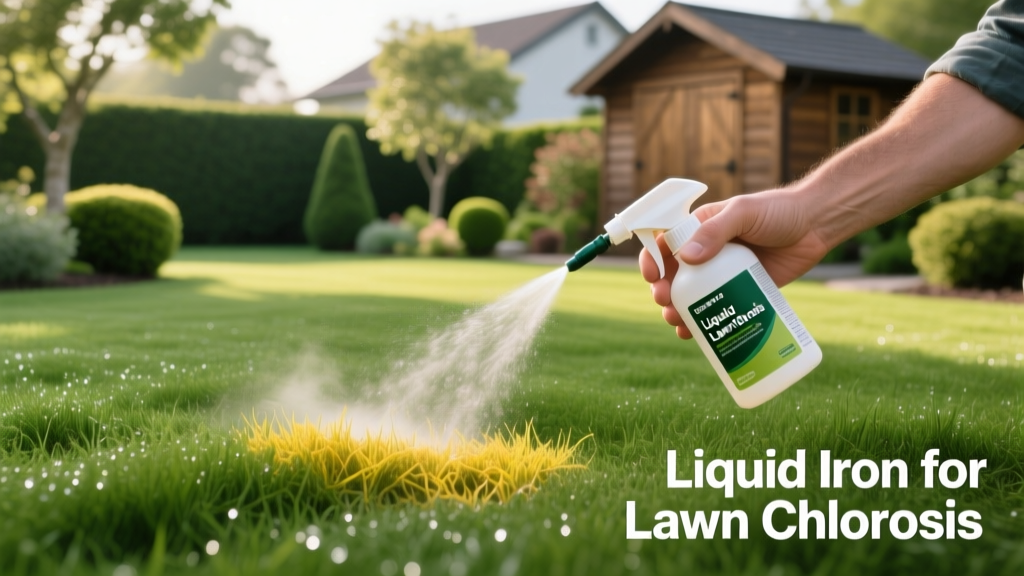
Using Liquid Iron for Lawn Chlorosis: Application & Dosage Guide
Diagnosing Iron Chlorosis vs. Nitrogen Deficiency
When turfgrass develops a yellowish tint despite adequate nitrogen fertilization, the culprit is often iron chlorosis. Iron is an essential micronutrient that acts as a catalyst in chlorophyll synthesis. Without it, grass cannot produce the green pigment required for photosynthesis, even if macronutrients are abundant. Misdiagnosing iron deficiency as a nitrogen deficiency is a common homeowner error that leads to over-fertilization, excessive top growth, and increased disease susceptibility.
| Symptom | Iron Deficiency (Chlorosis) | Nitrogen Deficiency |
|---|---|---|
| Location on Plant | Newest growth (top of canopy) | Oldest growth (bottom of canopy) |
| Leaf Appearance | Interveinal chlorosis (yellow leaf, green veins) | Uniform yellowing of the entire leaf blade |
| Soil pH Correlation | Highly prevalent in alkaline soils (pH > 7.2) | Unrelated to soil pH; caused by poor fertilization |
| Growth Rate | Normal or slightly stunted | Severely stunted, thinning turf |
Because iron is an immobile nutrient within the plant, it cannot be translocated from older leaves to newer ones. This is why iron deficiency always manifests on the youngest tissue first. If your lawn is yellowing uniformly from the soil up, you need nitrogen. If the new shoots are pale yellow with distinct green veins, you need iron supplementation.
The Soil pH Trap: Why Granular Iron Fails
Many homeowners attempt to fix chlorosis by applying granular iron sulfate to the soil. In acidic soils (pH below 6.5), this works adequately. However, in alkaline soils (pH above 7.2), which are common in the western United States and areas with high calcium carbonate, granular iron sulfate rapidly oxidizes into insoluble iron hydroxide. The iron is physically present in the soil, but the grass roots cannot absorb it.
Warning: Applying more granular iron to high-pH soil will not cure chlorosis. It simply wastes money and can lead to toxic salt buildup in the root zone. To bypass soil chemistry entirely, you must use a foliar application of chelated liquid iron.
Chelation involves binding the iron ion to an organic molecule (like EDTA, DTPA, or EDDHA). This protective shell prevents the iron from reacting with soil minerals and keeps it bioavailable. When applied as a foliar spray, liquid iron for lawn care bypasses the root zone entirely, absorbing directly through the leaf stomata and delivering results in as little as 24 to 48 hours.
Top Chelated Liquid Iron Formulations (2026 Market)
Not all liquid iron products are created equal. The efficacy of the product depends on the chelating agent and the concentration of elemental iron. Here is a breakdown of the most effective formulations currently available for residential and commercial turf management.
1. Southern Ag Chelated Liquid Iron (5% Fe)
- Chelating Agent: EDTA (Ethylenediaminetetraacetic acid)
- Best For: Soil pH up to 7.5; foliar and soil drench applications.
- Cost: Approximately $18 to $22 per gallon.
- Expert Insight: This is a workhorse product. EDTA is highly stable in slightly acidic to neutral conditions. If your soil pH exceeds 7.5, EDTA begins to lose its grip on the iron ion, making it less effective for soil drenches, though it remains perfectly viable for foliar spraying.
2. LawnStar Chelated Liquid Iron (6% Fe)
- Chelating Agent: EDTA combined with humic acid.
- Best For: Homeowners seeking a dual-action micronutrient and soil conditioner.
- Cost: Approximately $24 to $28 per 32 oz bottle.
- Expert Insight: The inclusion of humic acid helps improve overall nutrient uptake and soil structure. However, the higher price per ounce makes it less economical for large properties (over 5,000 sq ft).
3. Simple Lawn Solutions Liquid Iron
- Formulation: Bioavailable iron mixed with seaweed extract.
- Best For: Quick green-up before events; high-stress summer periods.
- Cost: Approximately $20 to $24 per 32 oz bottle.
- Expert Insight: The seaweed extract provides natural cytokinins, which help the grass tolerate heat stress while the iron corrects the chlorosis. Excellent for cool-season grasses like Kentucky Bluegrass during summer transitions.
Step-by-Step Foliar Application Protocol
Applying liquid iron requires precision. Over-application can cause phytotoxicity (leaf burn), while under-application will yield negligible results. Follow this exact protocol for optimal absorption.
- Calculate the Area: Measure your lawn accurately. Treat only the affected areas if the chlorosis is localized, or broadcast spray if the entire lawn is deficient.
- Mix the Solution: The standard foliar application rate is 2 to 4 ounces of chelated liquid iron per 1,000 square feet. Dilute this in 1 to 1.5 gallons of water. The water acts merely as a carrier to ensure even distribution.
- Add a Surfactant: This step is non-negotiable. Add 0.5 ounces of a non-ionic surfactant (such as Southern Ag Surfactant or Pelican Blue) per gallon of water. Surfactants break the surface tension of the water droplets, allowing the iron solution to spread evenly across the waxy grass blade rather than beading up and rolling off.
- Time the Application: Spray early in the morning when temperatures are below 80°F and the sun is not at its peak. Liquid iron applied in high heat and direct sunlight will dry too quickly, leaving concentrated iron salts on the leaf tip, which causes severe burning.
- Delay Watering: Do not irrigate the lawn for at least 24 hours after application. The iron needs time to penetrate the leaf cuticle and enter the stomata. Watering too soon will wash the product off the blade and into the soil, where it may become locked up.
Troubleshooting: Staining, Burn, and Reversion
While liquid iron for lawn care is highly effective, it introduces specific operational hazards that you must manage.
The Concrete Staining Hazard
Iron oxidizes rapidly when exposed to oxygen and moisture, forming iron oxide (rust). If your spray mixture hits a concrete driveway, patio, or stone walkway, it will leave permanent-looking orange or brown stains within minutes.
Pro Tip: Always keep a garden hose with a spray nozzle running nearby when edging your spray pattern. If overspray hits concrete, rinse it immediately with high-pressure water. If a stain sets, you will need to apply a commercial rust remover containing oxalic acid to dissolve the iron oxide.
Leaf Burn (Phytotoxicity)
If your grass tips turn brown or black 24 hours after application, you have experienced iron burn. This is almost always caused by one of three factors:
- Applying during temperatures exceeding 85°F.
- Exceeding the 4 oz per 1,000 sq ft maximum dosage rate.
- Failing to use a surfactant, causing the solution to pool at the leaf tip and dry into a concentrated salt crystal.
Chlorosis Reversion
Foliar liquid iron is a corrective treatment, not a permanent cure. Because iron is immobile, the treated leaves will remain green, but the next flush of growth may emerge yellow if the underlying soil deficiency remains. For long-term management in high-pH soils, incorporate elemental sulfur into your aeration program to gradually lower soil pH, or plan on applying liquid iron every 3 to 4 weeks during the peak growing season. According to Texas A&M Agrilife Extension, repeated foliar applications are often the most practical solution for highly alkaline clay soils where permanent pH alteration is chemically unfeasible.
Final Considerations for Turf Managers
Liquid iron is an invaluable tool in the turf management arsenal, capable of transforming a pale, anemic lawn into a deep, dark green carpet in a matter of days. By accurately diagnosing interveinal chlorosis, selecting an EDTA-chelated formulation, and adhering to strict foliar application protocols with a non-ionic surfactant, you can bypass soil pH lockout and deliver the micronutrients your grass desperately needs. Always prioritize morning applications, protect your hardscapes from overspray, and monitor new growth to determine your reapplication interval.

