
Lawn Care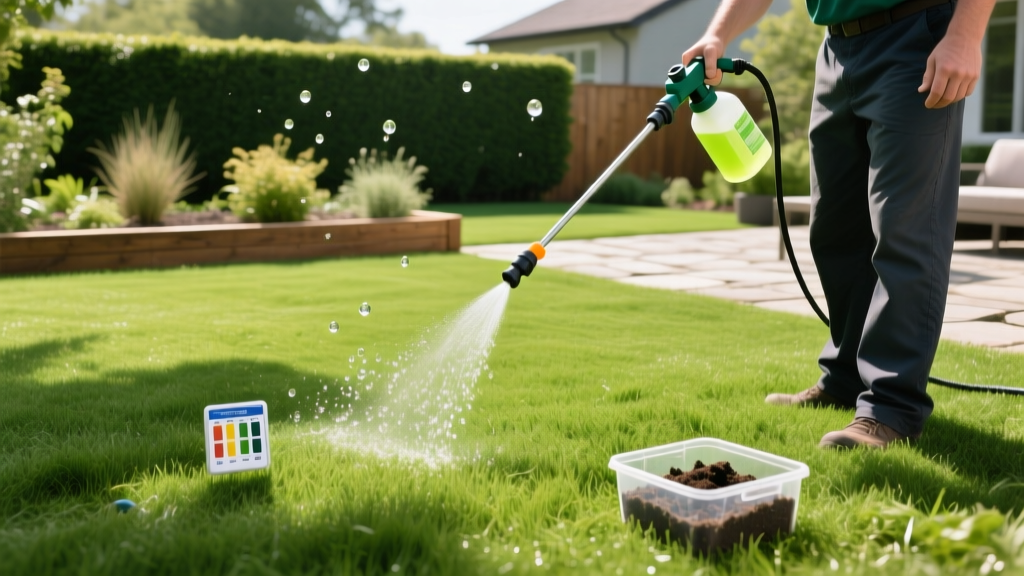
Liquid Lime for Lawns: Fast-Acting Soil pH Correction Guide
The Chemistry of Micronized Calcium Suspensions
When turfgrass struggles to absorb nitrogen, phosphorus, and potassium despite regular fertilization, the culprit is almost always soil acidity. In soils with a pH below 5.8, hydrogen and aluminum ions dominate the soil's cation exchange sites, effectively locking out essential macronutrients. While traditional agricultural lime (calcium carbonate) has been the standard remedy for decades, liquid lime for lawns has emerged as a rapid-response alternative for modern turf management.
Liquid lime is not a true solution; it is a highly concentrated suspension of micronized calcium carbonate (CaCO3) or calcium hydroxide (Ca(OH)2) particles dispersed in water. The critical differentiator is particle size. Standard pelletized lime features particles ranging from 100 to 600 microns, requiring months of soil moisture and microbial activity to break down. In contrast, premium liquid formulations utilize particles milled to under 45 microns. This exponential increase in surface area allows the calcium to react with soil colloids in a matter of weeks rather than months, rapidly displacing acidic hydrogen ions and freeing up bound nutrients.
Expert Insight: Liquid lime works primarily as a soil drench, not a foliar feed. While sub-45-micron particles can penetrate the leaf cuticle marginally, the primary mechanism of action requires the suspension to reach the thatch layer and rootzone, where calcium ions (Ca2+) exchange places with hydrogen ions (H+) on the soil's clay and organic matter colloids.
Liquid vs. Pelletized Lime: Performance Matrix
Choosing between liquid and granular amendments requires understanding their distinct operational profiles. Liquid formulations excel at maintenance and mild corrections, while pelletized lime remains necessary for severe soil reclamation.
| Feature | Liquid Lime Suspensions | Pelletized / Granular Lime |
|---|---|---|
| Reaction Time | 2 to 4 weeks | 3 to 6 months |
| Calcium Carbonate Equivalence (CCE) | Low per volume (requires frequent dosing) | High per volume (single application) |
| Application Method | Hose-end sprayer or backpack sprayer | Broadcast or drop spreader |
| Cost per 1,000 sq. ft. | $3.50 - $6.00 | $1.50 - $3.00 |
| Best Use Case | Annual maintenance, pH shifts of 0.1 - 0.3 | Severe acidity, pH shifts > 0.5 |
Diagnosing the Need: Soil pH Thresholds
Before purchasing any amendment, a laboratory soil test is non-negotiable. Guessing soil pH based on visual symptoms (like moss encroachment or yellowing grass) often leads to misdiagnosis, as iron chlorosis and nitrogen deficiency mimic low-pH symptoms. According to the Clemson University Home & Garden Information Center, turfgrass species have specific pH optima where nutrient availability peaks.
- Cool-Season Grasses (Tall Fescue, Kentucky Bluegrass, Ryegrass): Target pH 6.2 to 6.8.
- Warm-Season Grasses (Bermuda, Zoysia, Centipede): Target pH 5.8 to 6.5. (Note: Centipedegrass specifically prefers the lower end, around 5.5 to 6.0).
Warning: The Over-Liming Hazard
Applying calcium when soil pH is already above 7.0 induces micronutrient lockout, specifically iron, manganese, and zinc. This results in severe interveinal chlorosis (yellowing with green veins) that cannot be fixed by adding more nitrogen. Always test before treating.
Applying calcium when soil pH is already above 7.0 induces micronutrient lockout, specifically iron, manganese, and zinc. This results in severe interveinal chlorosis (yellowing with green veins) that cannot be fixed by adding more nitrogen. Always test before treating.
Top Liquid Lime Formulations and Application Rates
The market has matured significantly, moving beyond simple calcium water-mixes to complex formulations that include humic acids and chelated micronutrients. Here is a breakdown of the leading professional-grade liquid lime products currently available:
1. Simple Lawn Solutions Liquid Lime
This formulation utilizes a concentrated calcium carbonate suspension paired with a proprietary surfactant to reduce water surface tension, allowing the micronized particles to penetrate dense thatch layers more effectively.
Rate: 3 to 6 ounces per 1,000 square feet.
Cost: Approximately $28.00 for a 32 oz quart (covers up to 10,000 sq. ft. at maintenance rates).
2. Jonathan Green MAG-I-CAL Plus (Liquid Variant)
While widely known for their granular products, Jonathan Green's liquid MAG-I-CAL line combines soluble calcium with humic and fulvic acids. The humates act as natural chelators, buffering the calcium and preventing it from precipitating out of the suspension in hard water. This product also includes magnesium, addressing dual deficiencies common in sandy, leached soils.
Rate: 4 ounces per 1,000 square feet.
Cost: Approximately $35.00 for a 32 oz quart.
3. N-EXT Carbon Earth / Greene County Foliars
Favored by commercial lawn care operators, these ultra-concentrated formulations often use calcium hydroxide or highly reactive calcium oxide derivatives. They require careful handling and precise calibration but offer the fastest pH bump on the market.
Rate: 2 to 4 ounces per 1,000 square feet.
Cost: $45.00+ per gallon (highly cost-effective at scale).
For comprehensive baseline data on how soil amendments interact with local soil profiles, the University of Minnesota Extension provides excellent regional frameworks for interpreting cation exchange capacity (CEC) alongside pH readings.
Step-by-Step Hose-End Application Protocol
Liquid lime will quickly settle and separate in the bottle. Proper agitation and equipment calibration are critical to prevent clogging and ensure even distribution.
- Shake Vigorously: Invert and shake the bottle for a minimum of 60 seconds before opening. The suspension should look like a thick, uniform milkshake with no hard sediment at the bottom.
- Calibrate the Sprayer: Use a dial-adjustable hose-end sprayer. Set the dial to the manufacturer's recommended output (typically 2 to 4 ounces per gallon of water). If your sprayer lacks a dial, use a dedicated pump sprayer for better control.
- Apply in Optimal Conditions: Spray during the early morning or late evening. Applying liquid lime in direct sunlight when temperatures exceed 85°F (29°C) causes rapid water evaporation, leaving concentrated calcium deposits on the grass blades that can cause foliar burn.
- Water In Immediately: Liquid lime must reach the soil. Within 30 minutes of application, run your irrigation system or use a sprinkler to apply exactly 0.1 to 0.2 inches of water. This washes the calcium off the leaf tissue and drives it into the rootzone.
- Flush Equipment: Calcium residues will calcify and ruin sprayer nozzles. Immediately flush your hose-end sprayer with clean water for 2 minutes, and run a 50/50 white vinegar and water solution through it monthly to dissolve microscopic buildup.
Troubleshooting Common Application Failures
| Symptom | Root Cause | Corrective Action |
|---|---|---|
| White spotting on grass blades | Product dried on foliage before watering in | Always water in with 0.1 inches of irrigation within 30 mins. |
| Sprayer nozzle clogging mid-job | Suspension settled; inadequate agitation | Shake bottle every 2-3 minutes during application; use inline filters. |
| No change in soil pH after 6 weeks | pH deficit too large for liquid volume | Switch to pelletized lime for bulk correction; use liquid for maintenance. |
The Cost-Benefit Decision Framework
Liquid lime is not a silver bullet for severely degraded soils. If your soil test reveals a pH of 4.8 and you are growing Tall Fescue, you need to raise the pH by roughly 1.5 points. This requires approximately 75 to 90 pounds of pelletized lime per 1,000 square feet. Attempting to achieve this with liquid lime would require dozens of applications over several years, costing hundreds of dollars and wasting valuable time.
However, if your soil test shows a pH of 5.9 and your target is 6.3, liquid lime is the superior choice. It eliminates the physical labor of hauling 40-pound bags, prevents the white dusting of granular lime on hardscapes, and begins freeing up locked phosphorus within 21 days. For high-maintenance lawns where precision, speed, and ease of application are prioritized over raw material cost, integrating a liquid lime application into your spring and fall aeration routines will yield visibly thicker, greener turf by maximizing your fertilizer ROI.

