
Lawn Care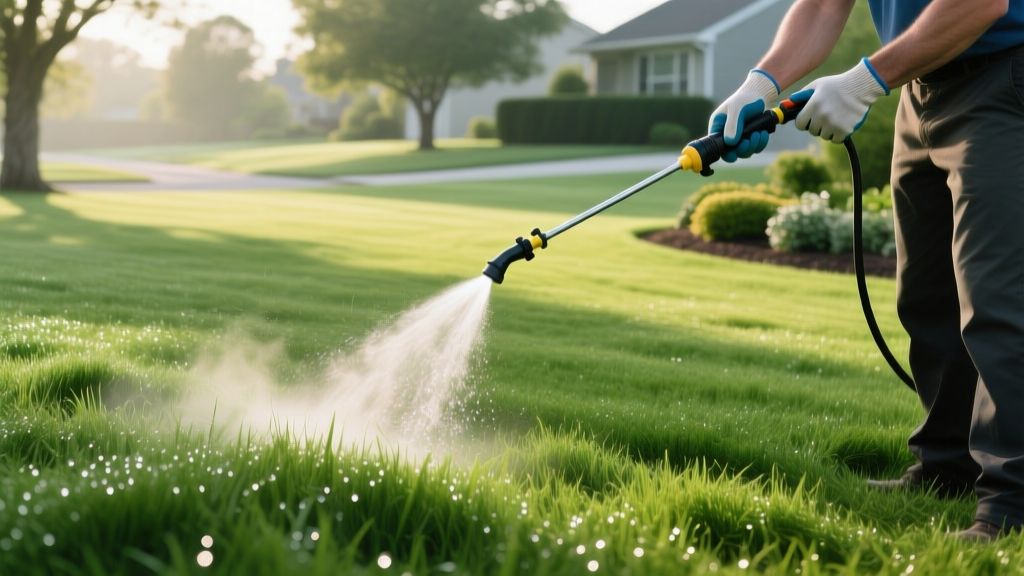
How to Apply Liquid Nitrogen Fertilizer for Rapid Lawn Green-Up
The Mechanics of Foliar Uptake in Turfgrass
Liquid nitrogen fertilizer provides the fastest visual response in turfgrass management because it bypasses the soil microbiome and relies heavily on foliar uptake. When applied as a fine mist, nitrogen in the form of urea or ammonium penetrates the leaf cuticle within 1 to 4 hours. According to University of Florida IFAS Extension, foliar absorption is highly efficient for quick green-up, but it requires precise dilution to avoid osmotic stress and leaf burn. Unlike granular fertilizers that require soil moisture to dissolve and microbial activity to convert into plant-available nitrate, liquid nitrogen is immediately bioavailable upon contact with the leaf blade.
Expert Insight: Foliar feeding is a supplement, not a replacement for soil nutrition. Liquid nitrogen excels at providing rapid aesthetic corrections and supporting micro-dosing strategies, but your foundational soil nitrogen should still come from slow-release granular sources to maintain deep root growth.
Product Selection: Agricultural UAN vs. Branded Retail
Homeowners and turf professionals generally choose between agricultural-grade UAN (Urea Ammonium Nitrate) and pre-formulated retail liquid fertilizers. Understanding the chemical composition and cost-per-pound of nitrogen is critical for budgeting and efficacy.
| Product Type | N-P-K Ratio | Nitrogen Sources | Avg. Cost (Per Gallon) | Best Use Case |
|---|---|---|---|---|
| UAN 28% (Agricultural) | 28-0-0 | 50% Urea, 25% Ammonium, 25% Nitrate | $12 - $18 | Large properties, professional micro-dosing |
| Branded Retail (e.g., Simple Lawn Solutions) | 28-0-0 | Primarily Urea-based with humic acids | $35 - $45 | Small suburban lawns, hose-end sprayer kits |
| Stabilized Liquid Urea | 15-0-0 | Methylene Urea (slow-release liquid) | $40 - $55 | Summer applications where burn risk is high |
UAN 28% is the industry standard for professional turf managers. One gallon of UAN 28 weighs approximately 10.6 pounds. Because it contains three forms of nitrogen, it provides an immediate nitrate response, a short-term ammonium response, and a longer-lasting urea response. Retail brands often add humic acid or kelp to justify the premium price tag, which can aid in soil conditioning but does not increase the raw nitrogen efficiency.
Exact Application Math and Mixing Ratios
The most common failure point with liquid nitrogen fertilizer is mathematical error leading to fertilizer burn. The standard safe application rate for foliar liquid nitrogen is 0.10 to 0.15 lbs of actual Nitrogen per 1,000 square feet. Here is the exact calculation for mixing UAN 28% to achieve a 0.15 lbs N rate:
- Calculate N per Gallon: 10.6 lbs (weight of 1 gal UAN 28) × 0.28 (28% N) = 2.968 lbs of N per gallon.
- Determine Gallons Needed: 0.15 lbs target ÷ 2.968 lbs per gallon = 0.0505 gallons.
- Convert to Fluid Ounces: 0.0505 gallons × 128 fl oz = 6.46 fl oz of UAN 28 per 1,000 sq ft.
⚠️ Burn Warning: Never exceed 0.20 lbs of N per 1,000 sq ft when applying liquid nitrogen in temperatures above 80°F. High salt index combined with rapid evaporation will cause severe osmotic draw, resulting in necrotic leaf tips within 24 hours. Always water the lawn lightly (0.1 inches) 12 hours after application to wash residual salts off the blade and into the soil profile.
Equipment Calibration: Nozzles and Pressure
How you deliver the liquid nitrogen dictates its effectiveness. Foliar uptake requires fine droplets that coat the leaf surface without immediately dripping onto the soil.
Backpack Sprayer Configuration
For precise application, use a backpack sprayer calibrated to 40 PSI. Equip the wand with a TeeJet 8004 VS flat fan nozzle. This nozzle produces a uniform, flat spray pattern ideal for overlapping passes. Walking at a steady 3 mph with a 40 PSI output will deliver roughly 1.5 gallons of mixed solution per 1,000 square feet, providing enough carrier water to evenly distribute the 6.5 oz of UAN 28 without causing runoff.
Hose-End Sprayer Limitations
While consumer hose-end sprayers (like the Ortho Dial N Spray) are convenient, they lack volumetric precision. If using a hose-end sprayer, set the dial to the specific fluid ounce rating calculated for your lawn's square footage, and walk at a consistent pace. Note that municipal water pressure fluctuations can alter the dilution ratio by up to 15%, making backpack or pump sprayers the superior choice for liquid nitrogen.
Seasonal Timing Framework
Liquid nitrogen should be deployed strategically based on your grass type and the current growth cycle. Penn State Extension emphasizes that nitrogen timing must align with peak root development windows to prevent excessive top-growth at the expense of root mass.
Cool-Season Grasses (Fescue, Kentucky Bluegrass, Ryegrass)
- Early Spring (April): Apply 0.10 lbs N/1,000 sq ft to break winter dormancy and stimulate early chlorophyll production without pushing vulnerable, lush growth before late frosts.
- Summer (June - August): Avoid liquid nitrogen. High heat combined with rapid nitrogen uptake increases susceptibility to brown patch (Rhizoctonia solani) and Pythium blight.
- Early Fall (September): Apply 0.15 lbs N/1,000 sq ft to support root carbohydrate storage for winter survival.
Warm-Season Grasses (Bermuda, Zoysia, Centipede)
- Late Spring (May): Apply 0.15 lbs N/1,000 sq ft immediately after the 100% green-up phase to fuel aggressive lateral spread.
- Peak Summer (July): Micro-dose every 14 days at 0.10 lbs N/1,000 sq ft to maintain deep green color during heavy mowing regimes.
- Early Fall (September): Cease all liquid nitrogen applications 6 weeks before the first historical frost date to allow the turf to harden off.
Troubleshooting Common Liquid N Failures
Even with correct math, environmental variables can disrupt liquid nitrogen efficacy. Use this diagnostic framework to correct application issues:
- Symptom: Yellow/brown streaking across the lawn in parallel lines.
Cause: Improper nozzle overlap or walking speed inconsistencies with a flat fan nozzle.
Fix: Switch to a cross-spray pattern (spray North-South, then East-West at half the calculated rate) or upgrade to an anti-drip nozzle valve to prevent leaking during turns. - Symptom: Grass turns dark green but growth rate stalls; soil test shows low pH.
Cause: Nitrogen volatility. Urea-based liquids left on the leaf surface in high-pH soils can volatilize into ammonia gas if not watered in.
Fix: Always irrigate with 0.1 inches of water 4 to 12 hours post-application to move the urea into the soil where the urease enzyme can convert it safely. - Symptom: Leaf tips turn white and brittle within 48 hours.
Cause: Osmotic burn from applying during peak midday heat or using hard water with high dissolved solids as a carrier.
Fix: Restrict applications to early morning (before 9 AM) or late evening. Test your carrier water's EC (Electrical Conductivity); if it exceeds 1.5 dS/m, switch to distilled or filtered water for mixing.

