
Lawn Care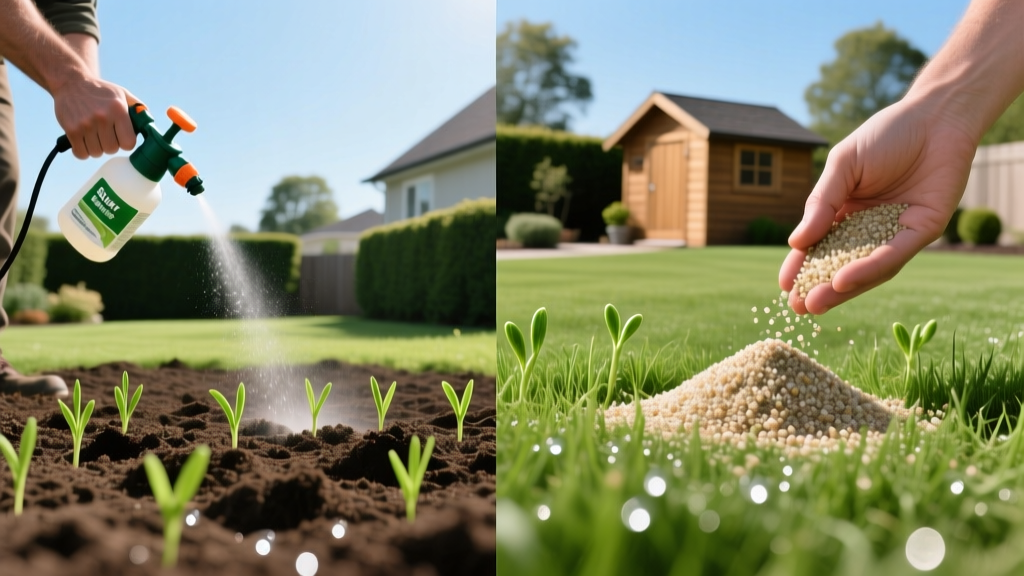
Liquid Starter Fertilizer vs Granular for New Grass Seed
The Phosphorus Problem: Why New Seed Struggles
Establishing a new lawn from seed or sod is a race against time, weeds, and weather. While most homeowners focus heavily on watering schedules, the hidden bottleneck for new turf is nutrient accessibility—specifically, phosphorus (P). Phosphorus is the primary driver of early root development, ATP energy transfer, and seedling vigor. However, phosphorus is notoriously immobile in soil. When applied as a traditional granular starter fertilizer, P granules dissolve slowly and rarely move more than half an inch from their original placement. If the germinating seed's radicle (first root) does not physically intercept the granule, the seedling starves.
This is where liquid starter fertilizer changes the establishment paradigm. By delivering a dissolved, bioavailable nutrient solution directly into the seedbed via a soil drench, liquid formulations bypass the slow dissolution phase. The phosphorus is immediately available in the soil solution, coating the root zone and accelerating the transition from germination to active tillering.
Key Terminology: Soil Drench vs. Foliar Feed
When applying liquid starter fertilizer to new seed, you are performing a soil drench. The goal is to water the nutrients into the top 1 to 2 inches of soil where the seed resides. Foliar feeding (spraying the leaves) is ineffective for starter fertilizers because newly germinated grass lacks the leaf surface area and cuticle development required to absorb meaningful quantities of phosphorus.
Liquid Starter Fertilizer vs. Granular: The Head-to-Head Matchup
Choosing between liquid and granular is not just about convenience; it is a decision about nutrient use efficiency and establishment speed. According to turfgrass establishment guidelines from the University of Minnesota Extension, ensuring uniform nutrient distribution in the top inch of soil is critical for seedling survival. Liquid excels here, while granular relies on mechanical spreading precision and subsequent rainfall to break down prills.
| Feature | Liquid Starter (e.g., 6-24-6) | Granular Starter (e.g., 24-25-4) |
|---|---|---|
| Nutrient Availability | Immediate (dissolved in soil solution) | Delayed (requires water to dissolve prill) |
| Distribution Uniformity | High (coats soil particles evenly) | Variable (depends on spreader calibration) |
| Cost per 1,000 sq ft | $8.00 - $12.00 | $3.50 - $5.00 |
| Application Equipment | Hose-end sprayer or pump tank | Broadcast or drop spreader |
| Risk of Seed Burn | Low (if diluted correctly) | Moderate (if prills rest directly on seed) |
While granular is undeniably cheaper per square foot, liquid starter fertilizer provides a premium return on investment by reducing the time the seedbed remains bare and vulnerable to weed invasion and erosion.
Top Liquid Starter Formulations for 2026 Seedings
Not all liquid fertilizers are created equal. A true 'starter' requires a high middle number (Phosphorus) relative to Nitrogen and Potassium. Here are the most effective liquid profiles currently on the market for turf establishment:
1. High-Phosphorus Root Builders (6-24-6 Profile)
Products like Simple Lawn Solutions 6-24-6 or PetraTools Liquid Starter are engineered specifically for root strike. The 24% phosphorus content provides a massive energy reserve for the developing radicle. These typically retail for $32 to $38 per 32-ounce bottle, treating up to 3,200 square feet. They often include fulvic acid, which acts as a natural chelator, keeping the phosphorus mobile in the soil and preventing it from binding to clay particles.
2. Balanced Micro-Boost Starters (10-18-10 Profile)
For soils that already have moderate baseline phosphorus levels, a 10-18-10 formulation offers a more balanced approach. These liquids provide enough P to stimulate roots while supplying sufficient Nitrogen to push early blade growth. They are ideal for overseeding existing lawns where you want to support new seed without causing massive top-growth surges in the established grass.
3. Organic Acid-Based Liquids (Bone Meal Emulsions)
For homeowners managing high-pH soils (above 7.2), synthetic liquid phosphorus will quickly precipitate out of the solution. In these scenarios, liquid bone meal emulsions or humic-acid-blended organic starters are mandatory. The organic acids buffer the phosphorus, allowing it to remain available to the seedling even in alkaline conditions.
Step-by-Step Soil Drench Application Protocol
To maximize the efficacy of liquid starter fertilizer, precision in application is required. Follow this protocol for optimal seed-to-soil contact and nutrient uptake.
- Conduct a Mehlich-3 Soil Test: Before opening a bottle, verify your soil's pH and baseline P levels. If your soil pH is above 7.5, liquid phosphorus will bind with calcium. You must lower the pH with liquid sulfur or switch to an organic acid-based starter.
- Prepare the Seedbed: Grade, rake, and firm the soil. Apply the liquid starter before dropping the seed. This ensures the nutrient is in the top 1-inch zone where the seed will sit, rather than washing the seed away if applied after.
- Calibrate the Sprayer: Use a dial-adjustable hose-end sprayer (like a Gilmour or Ortho dial sprayer). Set the dial to 2 oz per gallon. This dilution rate prevents salt burn on delicate embryonic roots while delivering sufficient nutrient volume.
- Apply the Drench: Walk at a steady pace of approximately 4 seconds per 100 square feet. Apply a fine mist until the top 1 inch of soil is visibly moistened, but avoid creating runoff or puddles.
- Sow the Seed: Immediately broadcast your grass seed over the treated soil. The seed will rest directly on the nutrient-rich soil solution.
- Water In Gently: Use a sprinkler with a fine mist nozzle to water the seedbed. This pushes the liquid fertilizer exactly 0.5 to 1 inch deep, perfectly aligning with the seed placement.
Common Application Mistakes and Failure Modes
Warning: The 'More is Better' Nitrogen Trap
Many homeowners mistakenly choose a liquid fertilizer with a high Nitrogen first number (e.g., 20-5-5) thinking it will 'kickstart' the lawn. Applying high nitrogen to ungerminated seed or seedlings under 2 inches tall causes rapid, weak cellular expansion. This results in 'damping off' disease and severe seedling burn. Always prioritize the Phosphorus (middle number) for the first 30 days.
Another critical failure mode is ignoring soil temperature. Liquid starter fertilizers are highly effective, but they cannot overcome biological dormancy. If soil temperatures at the 2-inch depth are below 50°F (for cool-season grasses like Kentucky Bluegrass or Tall Fescue), microbial activity and root metabolism are too slow to absorb the dissolved nutrients. The liquid P will simply sit in the soil solution and eventually leach or bind. Consult the UMass Amherst Turf Program guidelines to ensure you are seeding within the optimal biological window—typically late summer to early fall for cool-season turf.
Frequently Asked Questions
Can I mix liquid starter fertilizer with liquid pre-emergent?
Generally, no. Most liquid pre-emergents (like Prodiamine or Dithiopyr) require a specific carrier volume and soil activation depth that conflicts with the shallow drench required for starter fertilizers. Furthermore, applying pre-emergent over new seed will inhibit the grass seed's root development just as it does weed seeds. Wait until the new grass has been mowed at least three times before applying pre-emergents.
How often should I reapply liquid starter during the germination phase?
Apply once at seeding, and a second time roughly 21 to 28 days post-germination, once the seedlings have reached 1.5 inches in height. This second application supports the critical tillering phase where the single blade begins to produce lateral shoots.
Is liquid starter safe for newly laid sod?
Yes, and it is highly recommended. Newly harvested sod has had its root system violently sheared off. A liquid 6-24-6 drench applied immediately after laying the sod—and watered in heavily—provides the exact biochemical signals and nutrients required to force new root hairs into the underlying native soil, preventing the 'sod roll-up' effect during the first summer heatwave.

