
Lawn Care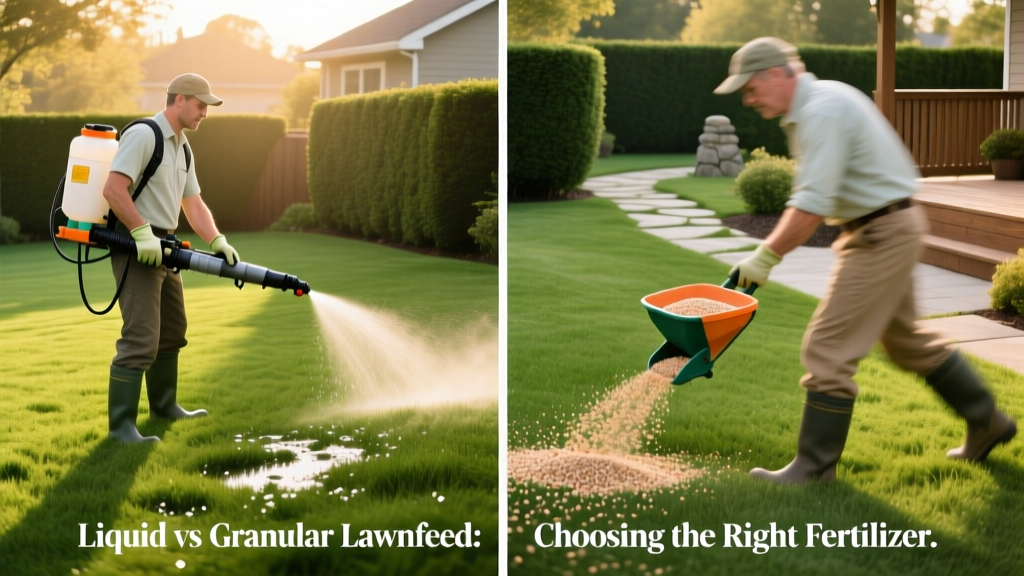
Liquid vs Granular Lawnfeed: Choosing the Right Fertilizer
The Core Difference: Foliar vs. Soil Absorption
Choosing between liquid and granular lawnfeed is not just a matter of application preference; it fundamentally changes how your turfgrass metabolizes nutrients. Granular formulations rely on soil moisture and microbial activity to break down prills and release nitrogen into the root zone. Liquid formulations, conversely, offer immediate foliar absorption through the leaf stomata, bypassing the soil matrix entirely for rapid greening. Understanding these mechanical differences is critical for building an effective 2026 turf nutrition program that avoids nutrient lockout and foliar burn.
Granular Lawnfeed: The Slow-Release Workhorse
Granular lawnfeed remains the backbone of professional turf management due to its extended feeding window and lower burn risk. However, not all granular nitrogen sources are created equal. The market is dominated by two primary slow-release technologies:
- Polymer-Coated Sulfur-Coated Urea (PCSU): This technology uses a physical polymer barrier that degrades based on soil temperature and moisture. It provides a highly predictable 8 to 12-week release curve, making it ideal for late-spring and summer applications when soil temperatures consistently exceed 65°F.
- Methylene Urea (MU) and Urea Formaldehyde (UF): These rely on soil microbes to break down carbon-nitrogen chains into plant-available ammonium. If you apply MU-based lawnfeed in early spring when soil temperatures are below 55°F, microbial activity is too low to process the nitrogen, resulting in severe nutrient lockout and delayed greening.
Edge Case Warning: Applying microbe-dependent granular lawnfeed (like UF) to cool, wet spring soils is a common failure mode. The nitrogen will sit inert on the soil surface and may wash away in heavy rains before microbes become active. Always check your 2-inch soil temperature before the first spring application.
Liquid Lawnfeed: Fast-Acting Precision Nutrition
Liquid lawnfeed excels in corrective scenarios and micronutrient delivery. Because it is already in a soluble state, it can be absorbed through the grass blade within 24 hours. This makes liquid formulations superior for delivering chelated iron, manganese, and zinc, which often become locked up in high-pH soils when applied in granular form.
However, liquid lawnfeed carries a significantly higher salt index. Applying a liquid 16-4-8 NPK blend at rates exceeding 0.5 lbs of nitrogen per 1,000 square feet without immediate irrigation will draw moisture out of the leaf tissue, causing severe osmotic stress and visible foliar burn. According to turfgrass research from the University of Minnesota Extension, liquid applications require precise calibration of hose-end or pump sprayers to prevent overlapping passes that double the local nutrient concentration.
Head-to-Head Comparison Matrix
| Feature | Granular Lawnfeed | Liquid Lawnfeed |
|---|---|---|
| Absorption Route | Root zone (soil drench) | Foliar (leaf stomata) and root |
| Response Time | 7 to 21 days | 24 to 72 hours |
| Longevity | 6 to 12 weeks | 2 to 4 weeks |
| Burn Risk | Low (if watered in) | High (requires strict calibration) |
| Micronutrient Efficacy | Poor in high-pH soils | Excellent (chelated forms) |
Real-World Cost Breakdown (Per 1,000 Sq Ft)
When budgeting your annual turf program, the upfront cost of the product is only half the equation. You must factor in application frequency and equipment depreciation.
- Granular Cost: A premium 50 lb bag of 24-0-11 PCSU lawnfeed typically retails for $48 to $55 and covers 12,500 square feet. This equates to roughly $3.84 to $4.40 per 1,000 sq ft per application. With a 10-week release curve, you only need 3 to 4 applications per year.
- Liquid Cost: A commercial-grade 2.5-gallon jug of 16-4-8 liquid lawnfeed costs around $75 and covers 10,000 square feet at standard dilution rates. This equates to $7.50 per 1,000 sq ft per application. Because it degrades rapidly, maintaining consistent color requires applications every 3 to 4 weeks, drastically increasing the annual cost and labor hours.
Pro-Tip for Hybrid Programs: The most cost-effective strategy used by elite turf managers is a hybrid approach. Use granular lawnfeed for your heavy macronutrient base (Nitrogen, Phosphorus, Potassium) in spring and fall, and reserve liquid lawnfeed strictly for summer micronutrient spoon-feeding and chelated iron applications to maintain dark green color without pushing excessive top growth.
Decision Framework: Matching Lawnfeed to Your Grass Type
Your specific turfgrass species dictates which lawnfeed formulation will yield the best results without triggering disease or stress.
Cool-Season Grasses (Kentucky Bluegrass, Tall Fescue, Perennial Ryegrass)
Cool-season grasses experience their peak root growth in early fall and secondary growth in spring. Granular lawnfeed is heavily favored here. A high-nitrogen granular application in September provides the slow-release nutrition necessary for deep root establishment before winter dormancy. Liquid lawnfeed is generally avoided on cool-season turf during the heat of summer, as the rapid nitrogen uptake can exacerbate brown patch and Pythium blight pressure.
Warm-Season Grasses (Bermuda, Zoysia, Centipede, St. Augustine)
Warm-season grasses thrive in high heat and respond aggressively to frequent, lighter feedings. Liquid lawnfeed is highly effective for Bermuda and Zoysia during the peak summer months (June through August). Because these grasses are actively photosynthesizing at maximum capacity, they can metabolize liquid foliar sprays rapidly without the burn risk associated with cool-season species. The University of Wisconsin Extension notes that frequent, low-rate liquid applications prevent the luxury consumption of nitrogen that leads to thatch buildup.
Critical Application Mistakes to Avoid
- Skipping the Calibration Step: Never guess your liquid sprayer output. Fill your sprayer with water, spray a 1,000 sq ft area of concrete or driveway, and measure exactly how much water was used. Adjust your lawnfeed concentrate ratio to match that specific water volume.
- Applying Granular to Wet Foliage: If morning dew is heavy or it just rained, granular lawnfeed prills will stick to the grass blades instead of falling to the soil surface. When the prills eventually dissolve on the leaf, they will cause severe localized tip burn. Always apply granular formulations to dry turf, followed immediately by 0.25 inches of irrigation to wash the prills into the soil.
- Ignoring Soil pH: If your soil pH is above 7.2, granular phosphorus and iron will chemically bind to calcium in the soil, rendering them completely unavailable to the grass roots. In high-pH scenarios, you must switch to liquid lawnfeed containing chelated iron (Fe-EDDHA) to bypass soil lockout.

