
Lawn Care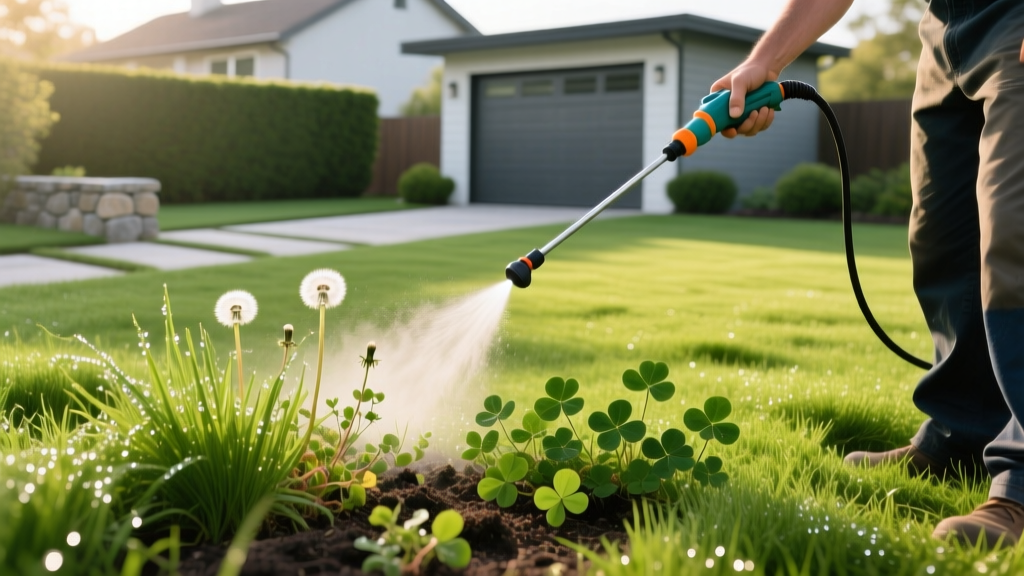
Liquid Weed and Feed Lawn Guide: Spot-Treating Stubborn Weed Species
The Professional Distinction: Blanket Sprays vs. Spot-Treatments
When homeowners search for a liquid weed and feed lawn solution, they are typically met with hose-end sprayers designed for blanket applications across the entire yard. While effective for general maintenance, blanket spraying is highly inefficient for deep-rooted perennials or isolated grassy weed invasions. More importantly, spraying high-nitrogen liquid fertilizer directly onto isolated weed patches can cause localized fertilizer burn on the surrounding desirable turf, particularly during summer heat.
For true spot-treatment, turf professionals separate the herbicide from the liquid fertilizer. The protocol involves applying a dedicated liquid herbicide concentrate mixed with a non-ionic surfactant directly to the weed foliage, followed by a broadcast granular or liquid feed application days later. This targeted approach maximizes herbicide uptake while protecting your turf from chemical stress.
⚠️ Surfactant Warning: Never apply liquid spot-treatments without a surfactant. Weeds like plantain and purslane have waxy cuticles that repel water-based herbicides. Adding a non-ionic surfactant at a 0.5% v/v rate breaks the surface tension, allowing the active ingredients to penetrate the leaf tissue.
The Chemistry of Liquid Weed and Feed Formulations
To spot-treat effectively, you must understand the active ingredients in your liquid concentrate. Most commercial 'three-way' liquid herbicides rely on a synergistic blend of synthetic auxins. According to the Environmental Protection Agency (EPA), these chemicals mimic plant growth hormones, causing susceptible broadleaf weeds to grow uncontrollably and collapse.
- 2,4-D (Amine or Ester): The backbone of most liquid blends. Highly effective on dandelions and plantain. Amine formulations are safer for warm-season grasses and high-temperature applications.
- Dicamba: Fast-acting and crucial for tough, low-growing broadleaves like white clover and chickweed. It moves rapidly through the plant's phloem.
- MCPP-p (Mecoprop-p): Provides the 'third way' in broadleaf control, targeting spurge and ground ivy (creeping charlie) that often resist 2,4-D alone.
- Quinclorac: The rare inclusion in liquid weed and feed blends that specifically targets grassy weeds, particularly crabgrass, by inducing senescence and ethylene production.
Spot-Treatment vs. Blanket Application: Decision Matrix
Choosing between a targeted liquid spot-treatment and a full-yard blanket application depends on weed density, root architecture, and environmental conditions. Use the matrix below to determine your application strategy.
| Variable | Spot-Treatment (1-2 Gallon Sprayer) | Blanket Application (Hose-End Sprayer) |
|---|---|---|
| Weed Density | Less than 15% of total lawn area | Greater than 20% of total lawn area |
| Primary Targets | Deep taproots (dandelion), isolated patches of clover | Diffuse annuals (henbit), widespread spurge |
| Temperature Limit | Can be applied up to 85°F (with amine formulations) | Best applied below 80°F to prevent turf stress |
| Fertilizer Integration | Herbicide only; fertilize separately via broadcast | Combined liquid herbicide + liquid UAN fertilizer |
Species-Specific Spot-Treatment Protocols
Not all weeds respond to the same chemical pathways. The University of Minnesota Extension notes that matching the active ingredient to the weed's specific biological vulnerabilities is the primary driver of spot-treatment success.
Dandelions & Deep-Rooted Perennials
Dandelions possess a thick taproot that stores carbohydrates, allowing them to regenerate if only the top growth is killed. Protocol: Use a 2,4-D amine concentrate. Mix at a rate of 2.0 fluid ounces per gallon of water. Apply until the leaves are visibly wet but not dripping. The systemic action will pull the chemical down into the taproot over 7 to 14 days. Do not mow for 48 hours before or after application to maximize leaf surface area.
White Clover & Ground Ivy
Clover and ground ivy spread via stolons and have waxy leaf surfaces that repel standard sprays. Protocol: A three-way blend containing Dicamba and MCPP-p is mandatory. You must add a methylated seed oil (MSO) or non-ionic surfactant. Apply in the early morning when stomata are open. Expect to see 'epinasty' (twisting and curling of the stems) within 24 hours. A second spot-treatment is usually required 21 days later to catch late-germinating stolons.
Crabgrass & Grassy Weeds
Standard broadleaf liquid weed and feed products will not harm crabgrass because it shares the same monocot biology as your desirable turf. Protocol: You must source a liquid concentrate containing Quinclorac. Quinclorac is safe on Kentucky Bluegrass, Fescue, and Bermuda, but will severely injure St. Augustinegrass. Apply at 1.5 oz per gallon. Note that mature crabgrass (with more than 3 tillers) will require two applications spaced 14 days apart.
Calibration and Mixing: The 1-Gallon Spot-Treat Formula
Precision is critical. Over-mixing liquid concentrates will not kill weeds faster; it will only increase the risk of phytotoxicity to your surrounding grass. According to UC Davis Integrated Pest Management, improper calibration is the leading cause of turf damage during DIY spot-treatments.
- Fill the Tank Halfway: Add 0.5 gallons of clean water to your 1-gallon pump sprayer.
- Add the Herbicide: Measure exactly 1.5 to 2.5 fl oz of your chosen liquid concentrate (check the label for your specific grass type) and pour it in.
- Add the Surfactant: Measure 1/3 teaspoon (approx. 1.6 ml) of non-ionic surfactant. This achieves the vital 0.5% v/v concentration.
- Add Marking Dye: Drop 4 to 5 drops of blue turf marking dye. This prevents you from accidentally double-spraying the same weed, which causes chemical burn.
- Agitate and Fill: Secure the lid, shake vigorously for 10 seconds, then fill the remaining tank with water to the 1-gallon line. Shake once more.
💡 Pro Tip: The 'Pin-Stream' Nozzle
Swap the standard cone-spray nozzle on your pump sprayer for a flat-fan or pin-stream nozzle. Cone nozzles create fine mist droplets that easily drift onto desirable plants in the wind. A pin-stream nozzle delivers a heavy, targeted stream directly into the center of the weed rosette, eliminating drift entirely.
Swap the standard cone-spray nozzle on your pump sprayer for a flat-fan or pin-stream nozzle. Cone nozzles create fine mist droplets that easily drift onto desirable plants in the wind. A pin-stream nozzle delivers a heavy, targeted stream directly into the center of the weed rosette, eliminating drift entirely.
Environmental Safeguards and Drift Mitigation
Liquid herbicides are highly susceptible to volatilization (turning into a gas) and physical drift. When applying a liquid weed and feed lawn spot-treatment, you must monitor the microclimate.
"Never apply ester-based 2,4-D formulations when ambient temperatures exceed 80°F. Esters vaporize rapidly in the heat, and the resulting gas will drift into nearby ornamental beds, causing severe cupping and twisting in sensitive shrubs like tomatoes, hydrangeas, and redbuds. Always switch to amine formulations for late spring and summer spot-treatments."
Furthermore, restrict applications to wind speeds below 5 MPH. If the leaves of your desirable turf are wet from morning dew, delay the application; the liquid herbicide will dilute and run off the weed foliage onto the soil, rendering the foliar uptake useless.
Post-Application Recovery and Fertilizer Timing
Because we excluded the 'feed' (fertilizer) component from the localized spot-treatment to prevent burn, you must time your actual lawn feeding correctly. Wait 7 to 10 days after your liquid herbicide application before applying a granular or broadcast liquid fertilizer. This waiting period allows the herbicide to fully translocate through the weed's root system without the nitrogen stimulating rapid new top-growth that could outpace the chemical's lethal effects. Once the weeds begin to yellow and collapse, apply a balanced, slow-release nitrogen fertilizer (such as a 24-0-6 with 50% methylene urea) to help the surrounding turf aggressively fill in the bare spots left behind.

