
Lawn Care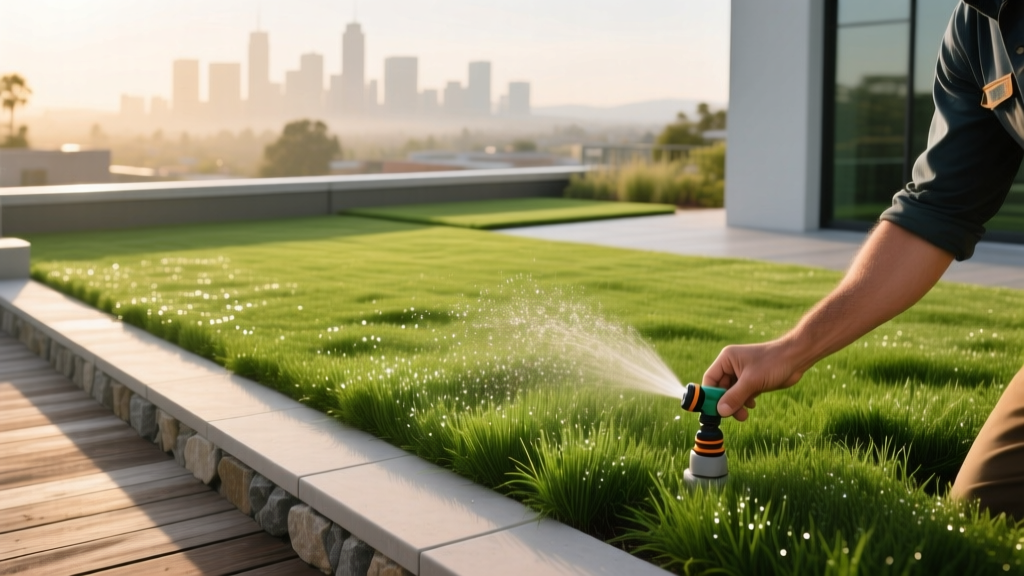
Livermore Rooftop Grass: Step-by-Step Maintenance Guide
The Tri-Valley Microclimate Challenge
Livermore, California (USDA Zone 9b, Sunset Zone 14) presents extreme conditions for turfgrass: summer highs routinely exceeding 95°F, low humidity, and strong afternoon delta winds. When you elevate that environment 20 feet into the air onto a rooftop, the evapotranspiration (ET) rates and wind desiccation multiply. Maintaining Livermore rooftop grass requires abandoning traditional ground-level lawn care and adopting specialized intensive green roof protocols.
Unlike extensive green roofs planted with shallow-rooted sedums, an intensive rooftop lawn requires 6 to 12 inches of engineered lightweight media to support turfgrasses like TifTuf Bermuda or Zeon Zoysia. According to Green Roofs for Healthy Cities, the structural load of this saturated media can reach 40 to 80 pounds per square foot. Every maintenance procedure must account for both the biological needs of the grass and the structural integrity of the underlying waterproofing membrane.
⚠️ Structural Safety Warning: Never use heavy, gas-powered core aerators, dethatchers, or ride-on mowers on a rooftop. Concentrated point-loads can crack the drainage mat, puncture the root barrier, and compromise the EPDM or TPO waterproofing membrane, leading to catastrophic interior leaks.
Phase 1: Membrane-Safe Irrigation Calibration
Rooftop soil media is engineered for rapid drainage to prevent structural overloading during winter storms. A standard FLL-compliant intensive green roof mix contains 40-60% expanded shale or pumice, 20-30% compost, and 10-20% coarse sand. This high-porosity profile holds very little available water, meaning traditional oscillating sprinklers are highly inefficient due to Livermore’s afternoon wind drift.
To comply with Tri-Valley water conservation mandates while keeping turf alive, install a sub-surface drip grid or low-angle micro-sprays. Netafim’s Techline CV (with check valves) prevents low-head drainage, which is critical on sloped roof decks. Pair this with a smart ET-based controller like the Rachio 3e, which pulls hyper-local Livermore weather data to adjust watering schedules daily.
Livermore Rooftop Irrigation Schedule (Zeon Zoysia / TifTuf Bermuda)
| Season | Weekly ET Deficit | Drip Grid Runtime | Frequency |
|---|---|---|---|
| Spring (April-May) | 1.0 - 1.5 inches | 45 minutes | 2x per week |
| Peak Summer (June-Aug) | 2.0 - 2.5 inches | 60 minutes | 3x per week |
| Fall (Sept-Oct) | 1.2 - 1.8 inches | 45 minutes | 2x per week |
| Winter (Nov-March) | N/A (Dormant) | System Winterized | 0x (Rely on rain) |
Phase 2: Nutrient Management in Engineered Media
Because lightweight pumice and shale lack the Cation Exchange Capacity (CEC) of natural topsoil, they cannot hold onto water-soluble nutrients. Applying standard fast-release urea will result in immediate leaching through the drainage mats and into the municipal storm system.
For Livermore rooftop grass, rely exclusively on polymer-coated urea (PCU) or sulfur-coated fertilizers. Products like Polyon 19-5-9 (90-day release) or Osmocote ProGrade 19-5-9 release nutrients based on soil temperature, not moisture. Apply at a rate of 1.5 to 2.0 lbs of actual Nitrogen per 1,000 square feet annually, split into three applications: early May, mid-July, and early September. Always sweep stray granules off hardscapes to prevent staining and localized salt burn on the roof deck.
Phase 3: Weight-Conscious Mowing Protocols
Mowing a rooftop lawn introduces two major variables: structural weight limits and membrane protection. A standard 21-inch gas push mower weighs roughly 90 lbs and poses a severe hydrocarbon leak risk if tipped or stored on the roof.
Transition to lightweight, lithium-ion robotic mowers or manual reel mowers. The Husqvarna Automower 450X or 520H weighs under 40 lbs and distributes its weight across wide, low-pressure wheels. When installing the boundary wire for a robotic mower, never use landscape staples or screws. Instead, use non-penetrating, UV-stable adhesive mounting pads (such as 3M VHB tape-backed plastic clips) glued directly to the perimeter parapet wall or hardscape borders to secure the wire.
Set the cutting height to 1.5 inches for Bermuda or 2.0 inches for Zoysia. Rooftop grass experiences higher UV exposure and wind stress; cutting it too short will expose the shallow soil profile to rapid moisture loss and encourage weed invasion.
Phase 4: Non-Penetrating Aeration & Weed Control
Over time, foot traffic and organic matter accumulation will compact the top layer of the engineered media. However, mechanical core aeration is strictly prohibited on green roofs. The hollow tines will easily pierce the 40-mil root barrier and the underlying waterproofing membrane.
Safe Alternatives for Soil Compaction
- Liquid Aeration: Apply humic acid and fulvic acid blends (e.g., N-EXT Air-8) to break down soil compaction at a molecular level and stimulate deeper root growth without mechanical penetration.
- Ultra-Shallow Solid Tining: If physical aeration is absolutely necessary, use a manual pitchfork or a specialized shallow-tine aerator restricted to a maximum depth of 1.5 inches, ensuring it never reaches the drainage mat layer.
Rooftop Weed Management
Rooftops are highly susceptible to wind-blown weed seeds, particularly marestail, fleabane, and annual bluegrass (Poa annua). Pre-emergent herbicides like prodiamine can be used, but they must be watered in carefully to avoid washing into roof drains. For post-emergent control, avoid broad-spectrum spraying near parapet edges where wind drift could damage adjacent rooftop gardens or solar panels. Spot-treat with FeHEDTA (iron-based herbicide) for broadleaf weeds, which is safer for rooftop drainage systems and aligns with EPA green infrastructure guidelines for protecting local watersheds.
Troubleshooting Rooftop Turf Decline
When rooftop grass fails, the cause is rarely a pathogen; it is almost always a failure in the physical environment or maintenance protocol. Use this diagnostic matrix to identify and correct issues specific to Livermore’s elevated microclimates.
| Symptom | Probable Cause | Corrective Action |
|---|---|---|
| Brown, crispy leaf tips on windward side | Wind desiccation outpacing drip irrigation | Add micro-spray heads to windward perimeter; increase runtime by 15%. |
| Yellowing (chlorosis) across entire roof | Nitrogen leaching from high-porosity media | Apply polymer-coated urea (PCU); switch to slow-release only. |
| Spongy, wet patches near roof drains | Drainage mat clogged with organic thatch/debris | Clear scupper drains; apply liquid dethatcher; rake surface lightly. |
| Localized dead circles (3-6 inches) | Fertilizer salt burn or dog urine concentration | Flush area with 2 gallons of water; replant with 4-inch turf plugs. |
Maintaining an intensive green roof in Livermore requires a paradigm shift from traditional landscaping. By prioritizing membrane safety, utilizing slow-release chemistry, and automating irrigation to combat delta winds, your rooftop turf will remain a resilient, functional asset rather than a structural liability. For ongoing pest and disease identification, consult the UC Statewide Integrated Pest Management Program to ensure any treatments used at elevation remain environmentally compliant.

