
Lawn Care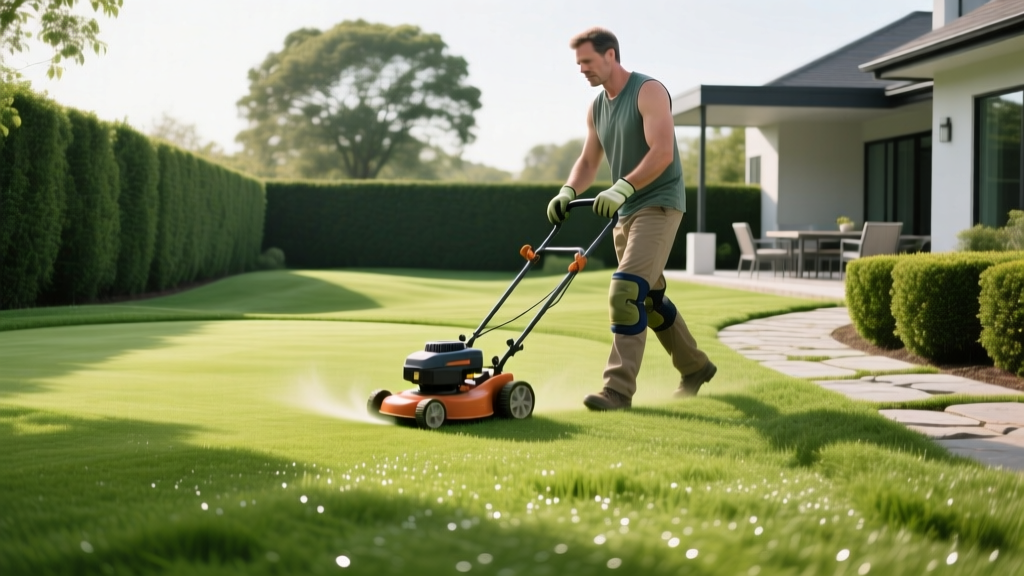
Achieving Golf Green Grass: Step-by-Step Home Lawn Maintenance
Achieving true golf green grass in a residential setting requires abandoning standard lawn care practices. A backyard putting green or high-end turf area demands agronomic precision, specialized equipment, and a rigorous daily maintenance schedule. Standard rotary mowers, granular weed-and-feed products, and deep weekly watering will quickly destroy the dense, low-cut canopy required for a smooth, fast ball roll. This guide outlines the exact step-by-step procedures used by professional golf course superintendents, adapted for homeowners managing ultradwarf Bermudagrass or Creeping Bentgrass.
Selecting the Right Golf Green Grass Species
Before executing maintenance procedures, your grass species must be genetically capable of surviving heights of cut (HOC) below 0.25 inches. Standard Kentucky Bluegrass or Tall Fescue will scalp and die at these heights. You must choose between the two primary golf green species based on your climate zone.
| Species / Cultivar | Climate Zone | Optimal HOC | Stimpmeter Speed Potential | Primary Disease Threat |
|---|---|---|---|---|
| Penn A-4 Creeping Bentgrass | Cool-Season (Zones 4-7) | 0.125" - 0.150" | 10.5 - 12.0 | Dollar Spot, Pythium Blight |
| MiniVerde Ultradwarf Bermudagrass | Warm-Season (Zones 8-10) | 0.125" - 0.187" | 11.0 - 12.5 | Spring Dead Spot, Nematodes |
| TifEagle Bermudagrass | Warm-Season (Zones 8-10) | 0.125" - 0.150" | 11.5 - 13.0 | Take-All Root Rot |
Step 1: Mowing with a Reel Mower at Exact HOC
Rotary mowers rely on a single high-speed blade that tears grass and requires a minimum deck clearance of 0.5 inches. Golf green grass must be mowed between 0.125 inches (1/8") and 0.187 inches (3/16"). This requires a bedknife and reel cylinder mower.
Equipment Reality Check: As of 2026, entry-level residential reel mowers like the Tru Cut H-20 retail around $1,350, while commercial-grade walk-behinds like the Baroness LM56XB exceed $4,500. Do not attempt to maintain golf green grass with a sub-$500 manual push reel mower; they lack the weight and bedknife precision to maintain a consistent daily cut.
Daily Mowing Protocol
- Frequency: Mow 5 to 7 days per week during peak growing season. Missing two days results in a spongy canopy that slows ball roll and invites disease.
- Pattern Alternation: Change your mowing direction daily (e.g., North-South on Monday, East-West on Tuesday, diagonal on Wednesday) to prevent grain formation, which severely alters putt break and speed.
- Bedknife Maintenance: Backlap the reel and bedknife with 120-grit lapping compound every 30 hours of operation to ensure a scissor-like cut. A dull reel shreds the leaf tip, turning the green brown and increasing water loss.
Step 2: Spoon-Feeding Fertilization
Standard lawns receive 1.0 lb of nitrogen per 1,000 sq. ft. every 6 weeks. Golf green grass cannot handle this salt load; heavy applications cause massive flushes of vertical growth, destroying surface smoothness and requiring aggressive growth regulators to manage.
Superintendents use a "spoon-feeding" approach, applying 0.10 to 0.20 lbs of nitrogen per 1,000 sq. ft. every 5 to 7 days. This provides a steady, predictable growth rate.
"The goal of fertilizing a putting green is not to maximize growth, but to sustain a minimal, consistent growth rate that recovers from ball marks and foot traffic without producing excess thatch." — NC State TurfFiles
Recommended Fertilizer Products
- Anderson's Contec DG 15-0-15: A dispersing granule that breaks down into thousands of micro-particles upon watering, preventing fertilizer burn at low HOC.
- Peter's 20-20-20 Water Soluble: Applied via a hose-end siphon or backpack sprayer at 0.15 lbs N/1000 sq. ft. for immediate canopy uptake.
- Calcium Nitrate (15.5-0-0): Used during cool-season spring and fall transitions to promote cell wall strength in Bentgrass without excessive leaf elongation.
Step 3: Topdressing with USGA-Spec Sand
Thatch accumulation is the primary enemy of golf green grass. As organic matter builds up from decaying roots and stolons, the surface becomes spongy, holding excess moisture and promoting fungal pathogens like Pythium. To combat this, you must dilute the organic layer by topdressing with sand.
Sand Selection and Application Rates
Do not use masonry sand or play sand from a big-box store. These contain fine silts and clays that will seal the soil profile, causing anaerobic conditions and black layer. According to USGA Course Care guidelines, topdressing sand must be washed, sub-angular, and meet strict particle size distributions.
- Particle Size: 85% to 90% of the sand particles must fall between 0.15 mm and 0.85 mm (medium to coarse sand).
- Application Rate: Apply 100 to 150 lbs of sand per 1,000 sq. ft. every 14 to 21 days during the active growing season.
- Cost Expectation: USGA-spec sand typically costs $45 to $70 per ton from local landscape supply yards, plus delivery fees.
After spreading the sand with a calibrated drop spreader, drag the green with a heavy drag mat or a piece of chain-link fence to work the sand into the canopy and expose the grass leaves to sunlight.
Step 4: Precision Irrigation and Syringing
Golf green grass is maintained at a deliberate moisture deficit to keep the turf firm and fast. Overwatering leads to soft surfaces, shallow root systems, and disease outbreaks.
Moisture Meter Usage
Invest in a handheld TDR (Time Domain Reflectometry) moisture meter, such as a TurfTronics or Pelican probe (retailing between $350 and $600). Take 10 readings across the green each morning.
- Bentgrass Target: 18% to 22% volumetric water content (VWC).
- Bermudagrass Target: 15% to 20% VWC.
If readings drop below the target, apply just enough water to return to the baseline—typically 0.05 to 0.10 inches. Hand-watering dry spots with a hose is vastly superior to running automated sprinkler heads, which inevitably overwater compacted areas.
The Art of Syringing
During mid-summer heat stress, when canopy temperatures exceed 85°F, Bentgrass and Bermudagrass will shut down photosynthesis. Syringing involves lightly misting the grass canopy with a fine spray nozzle for 15 to 30 seconds. This does not water the soil; it utilizes evaporative cooling to drop the leaf temperature by 3°F to 5°F, keeping the plant metabolically active without waterlogging the root zone.
Step 5: Routine Venting and Core Aeration
Because golf greens are heavily compacted by foot traffic and frequent sand topdressing, the soil profile loses oxygen. Roots suffocate without oxygen, leading to rapid summer decline.
Venting (Weekly/Bi-Weekly)
Use a solid-tine or needle-tine aerator (like a Turfco XT5 or a manual spiker) to punch 2-inch deep holes every 7 to 14 days. This releases toxic gases (like hydrogen sulfide) and allows oxygen to reach the rhizosphere without disrupting the smooth surface of the green.
Core Aeration (Bi-Annually)
Twice a year (late spring and early fall), perform a hollow-tine core aeration using 1/4-inch or 3/8-inch tines. This physically removes organic matter and relieves deep compaction. Expect the green to be unputtable for 10 to 14 days following core aeration as the holes heal and are filled with topdressing sand.
Frequently Asked Questions
Can I use plant growth regulators (PGRs) on home golf green grass?
Yes. Products containing trinexapac-ethyl (such as Syngenta's Primo Maxx) are industry standards. Applied at 0.2 to 0.4 fl oz per 1,000 sq. ft. every 21 days, PGRs inhibit gibberellic acid production, reducing vertical shoot growth by up to 50% while increasing root mass and chlorophyll density. This results in a darker, denser, and significantly faster putting surface.
How do I repair ball marks on ultradwarf Bermudagrass?
Unlike Bentgrass, Bermudagrass heals laterally. Use a standard ball mark repair tool, but do not push the soil upward into a peak. Gently pull the edges of the depression toward the center, then tamp it flat with your putter. Topdress the repaired area with a handful of sand to protect the exposed stolons from drying out.

