
Lawn Care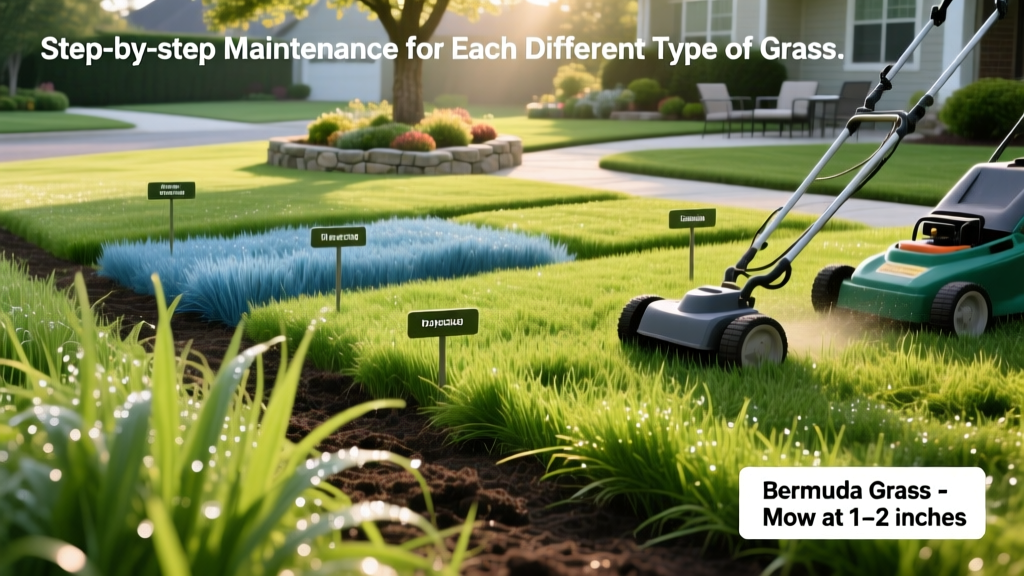
Step-by-Step Maintenance for Each Different Type of Grass
Applying a universal maintenance schedule is the fastest way to ruin a turf ecosystem. Every different type of grass has distinct evolutionary triggers, root depths, and nutrient uptake cycles. What promotes aggressive stolon growth in warm-season Bermuda grass will actively encourage fungal disease and root burn in cool-season Kentucky Bluegrass. To achieve a professional-grade lawn, you must align your cultural practices—mowing, fertilization, aeration, and chemical applications—with the specific biological needs of your turf species.
This guide provides exact, step-by-step maintenance procedures for the most common residential turfgrasses, utilizing current 2026 agronomic standards and precise application rates.
The Grass Identification Framework
Before executing any chemical or mechanical procedures, confirm your grass species. Misidentification leads to catastrophic failures, such as applying MSMA (an arsenical herbicide) to a St. Augustine lawn, which will cause immediate, irreversible phytotoxicity.
- Cool-Season Grasses (Northern U.S., Transition Zone): Kentucky Bluegrass (KBG), Turf-Type Tall Fescue (TTTF), Perennial Ryegrass, Fine Fescue. These grasses thrive in 60°F to 75°F air temperatures and grow most vigorously in spring and fall.
- Warm-Season Grasses (Southern U.S., Deep South): Bermuda, Zoysia, St. Augustine, Centipede, Bahia. These grasses peak between 80°F and 95°F and enter complete winter dormancy, turning brown after the first hard frost.
For authoritative regional identification, consult the turfgrass extension databases provided by the University of Minnesota Extension for cool-season varieties, and the University of Florida IFAS for warm-season profiles.
Cool-Season Protocol: Kentucky Bluegrass & Tall Fescue
Cool-season lawns require a heavy fall-focused maintenance schedule. The primary goal is to build deep carbohydrate reserves in the root system before winter dormancy and summer heat stress.
Step 1: Spring Pre-Emergent and Early Fertilization
Apply a pre-emergent herbicide like Prodiamine (Barricade) or Dithiopyr (Dimension) when soil temperatures at a 2-inch depth consistently reach 50°F to 53°F for three consecutive days. This targets crabgrass before germination. Follow this with a light application of a slow-release nitrogen fertilizer, such as Milorganite or a 20-0-10 synthetic blend with methylene urea, applying exactly 0.5 to 0.75 lbs of actual nitrogen per 1,000 square feet.
Step 2: Summer Mowing and Disease Management
Raise your mower deck to the maximum setting. For TTTF, maintain a 3.5 to 4.0-inch cut; for KBG, maintain 2.5 to 3.0 inches. Taller grass shades the soil, reducing water evaporation and suppressing weed seed germination. Monitor for Brown Patch (Rhizoctonia solani) in Tall Fescue during periods of high humidity and night temperatures above 68°F. If detected, apply a preventative fungicide containing Azoxystrobin or Pyraclostrobin immediately.
Warning: Summer Dormancy Trap
Cool-season grasses will naturally slow growth and brown out when soil temperatures exceed 85°F. Do not over-fertilize with high-nitrogen synthetic blends during July and August. Forcing top-growth during heat stress depletes root carbohydrates and increases susceptibility to drought damage and Pythium blight.
Step 3: Fall Core Aeration and Overseeding
Between late August and mid-September, perform core aeration using a heavy walk-behind aerator (minimum 300 lbs) to pull 3-inch plugs. This relieves soil compaction and breaks up thatch. Immediately overseed KBG at 2 lbs per 1,000 sq ft, or TTTF at 6 to 8 lbs per 1,000 sq ft. Follow with a starter fertilizer (e.g., 18-24-12) to support rapid seedling root development.
Warm-Season Protocol: Bermuda, Zoysia, and St. Augustine
Warm-season grasses demand aggressive summer feeding and strict thatch management. Their maintenance calendar is inverted compared to cool-season species, with peak activity occurring from May through August.
Step 1: Spring Scalping and Pre-Emergent Timing
Wait until the lawn is at least 50% green and the threat of the final frost has passed. Lower your mower deck to its lowest setting and scalp the lawn, bagging all clippings to remove dead winter tissue. This promotes rapid, even green-up. Apply a pre-emergent when soil temperatures hit 55°F. Note: If you plan to sprig or plug warm-season grass in the spring, do not use Prodiamine, as it will inhibit the rooting of new stolons. Use Dithiopyr instead, which offers early post-emergent control without stunting vegetative establishment.
Step 2: Peak Summer Nitrogen Loading
Once the lawn is fully green and actively growing, begin monthly applications of nitrogen. Bermuda grass is a heavy feeder and requires 1.0 to 1.5 lbs of nitrogen per 1,000 sq ft per month during peak summer. Use a high-quality urea or ammonium sulfate blend for rapid response, or polymer-coated sulfur-coated urea (PCSCU) for a steady 45-day release. St. Augustine and Centipede require far less—limit applications to 0.5 lbs of nitrogen per 1,000 sq ft per month to prevent thatch accumulation and large patch disease.
Step 3: Precision Mowing and Reel Maintenance
Mowing heights for warm-season grasses are drastically lower. Hybrid Bermuda grass thrives at 0.5 to 1.0 inches, which requires a heavy reel mower to prevent scalping on uneven terrain. Zoysia should be maintained at 1.0 to 1.5 inches, while St. Augustine requires a higher 2.5 to 4.0-inch cut due to its broad leaf blade and above-ground stolon growth. Never remove more than one-third of the leaf blade in a single mowing session.
Master Maintenance Comparison Matrix
Use this data table to quickly reference the exact agronomic requirements for the most common turf species. These figures are based on optimal residential management practices.
| Grass Species | Optimal Mowing Height | Annual Nitrogen (lbs/1000 sq ft) | Core Aeration Window | Primary Disease Threat |
|---|---|---|---|---|
| Kentucky Bluegrass | 2.5 - 3.5 inches | 2.0 - 4.0 | Late Aug - Sept | Dollar Spot, Rust |
| Turf-Type Tall Fescue | 3.0 - 4.0 inches | 2.0 - 3.0 | Late Aug - Sept | Brown Patch |
| Hybrid Bermuda | 0.5 - 1.5 inches | 3.0 - 6.0 | May - June | Spring Dead Spot |
| Zoysia (Japonica/Matrella) | 1.0 - 2.0 inches | 2.0 - 3.0 | May - June | Large Patch |
| St. Augustine | 2.5 - 4.0 inches | 2.0 - 4.0 | April - May | Take-All Root Rot |
| Centipede | 1.0 - 2.0 inches | 1.0 - 2.0 | April - May | Iron Chlorosis |
For deeper insights into cultivar selection and regional adaptability, the Clemson Home & Garden Information Center provides excellent localized data on soil pH preferences, particularly for Centipede grass, which demands highly acidic soils (pH 5.0 to 6.0) to prevent severe iron chlorosis.
Transition Zone Edge Cases and Solutions
Homeowners in the Transition Zone (stretching from Kansas and Missouri across to Virginia and North Carolina) face a unique agronomic dilemma: summers are too hot for traditional cool-season grasses, and winters are too cold for reliable warm-season survival.
The TTTF / KBG Blend Strategy: The industry standard for overcoming this is planting a blend of 90% Turf-Type Tall Fescue and 10% Kentucky Bluegrass. The TTTF provides deep, drought-tolerant roots and heat resistance, while the KBG utilizes its rhizomatous growth habit to fill in bare spots and recover from physical damage. Winter Overseeding Warm-Season Lawns: If you maintain a dormant Bermuda lawn in the southern transition zone and desire winter color, overseed with Perennial Ryegrass in October. Apply at 8 to 10 lbs per 1,000 sq ft. Be aware that the ryegrass will compete with the Bermuda for water and nutrients during the critical spring green-up phase, requiring aggressive mowing and nitrogen suppression in April to force the ryegrass out and allow the Bermuda to emerge.
Soil Testing: The Non-Negotiable First Step
Regardless of the different type of grass you maintain, blind fertilizer applications are financially wasteful and environmentally damaging. Before purchasing any granular amendments, extract 10 to 15 soil cores from your lawn at a 4-inch depth, mix them in a clean plastic bucket, and submit a composite sample to your local university extension laboratory. A standard soil test (typically $15 to $25) will reveal your exact phosphorus and potassium levels, base saturation percentages, and cation exchange capacity (CEC), allowing you to purchase only the specific N-P-K ratio your soil actually requires.

