
Lawn Care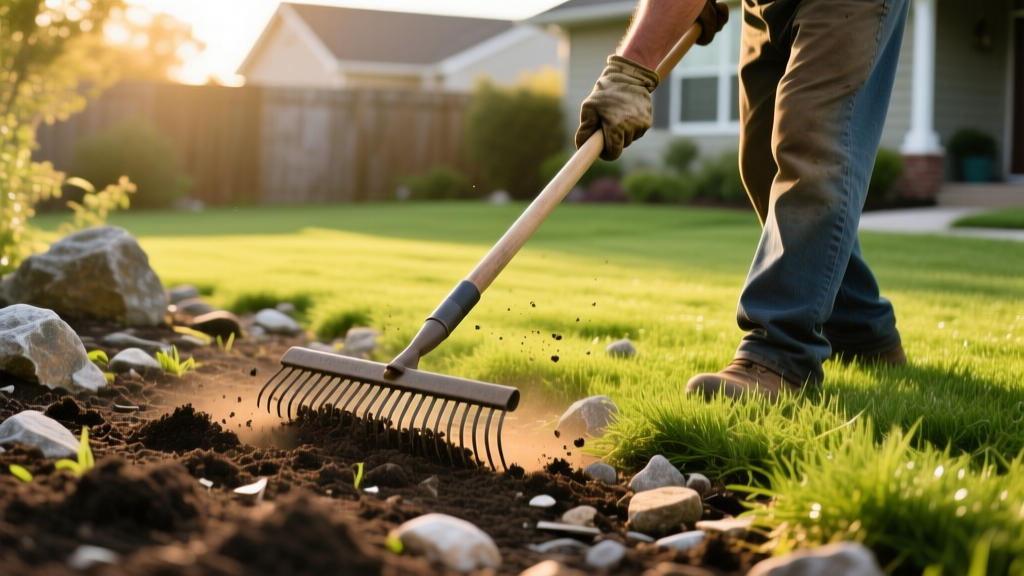
The Practical Guide to Raking Rocks and Clearing Stony Lawn Soil
Stony soil destroys mower blades, prevents proper seed-to-soil contact during overseeding, and creates uneven surfaces that pool water. For homeowners in regions with glacial till or heavy clay, raking rocks is not a one-time landscaping chore; it is an annual maintenance requirement driven by soil thermodynamics. This guide details the exact tools, techniques, and soil management strategies required to efficiently clear rocks from your lawn and prepare a viable seedbed.
The Geology of a Stony Lawn: Why Frost Heave Pushes Rocks Upward
Before selecting equipment, it is critical to understand why your lawn generates new rocks every spring. The phenomenon is known as frost heave. When soil moisture freezes, it expands by approximately 9%. This expansion pushes subterranean rocks upward. During the spring thaw, the ice melts and the fine soil particles settle back into the voids beneath the rock, effectively locking the stone at a higher elevation.
According to soil science research from the University of Maine Extension, regions with shallow water tables and silty-clay loam soils experience the most severe frost heave. This means that even if you thoroughly cleared your yard of stones three years ago, the freeze-thaw cycle will continuously harvest new rocks from the subsoil. Attempting to rake rocks when the soil is saturated will only pull up clumps of topsoil and tear the turf root system. The optimal time for raking rocks is mid-spring, when the soil has dried to a 'friable' state—moist enough to crumble, but dry enough that it does not stick to the tines of your rake.
Equipment Matrix: Choosing the Right Tools for Raking Rocks
Selecting the wrong tool results in broken handles, wasted labor, and incomplete clearance. The correct implement depends entirely on your yard's square footage and the size of the embedded stones.
| Tool Category | Specific Model Recommendation | Best Application | Tine Spacing | Estimated Cost |
|---|---|---|---|---|
| Manual Stone Rake | Truper 16-Inch Stone Rake (15-Gauge Steel) | Yards under 5,000 sq ft; precision work around garden beds | 1.0 inch | $45 - $60 |
| Manual Bow Rake | Bully Tools 92344 Fiberglass Bow Rake | Leveling topsoil after initial rock removal | 2.5 inches | $35 - $45 |
| Tow-Behind ATV Rake | Polar ATV/UTV Landscape Rake (48-inch) | Properties 1/2 acre to 2 acres; sandy or loamy soils | 1.5 inches | $250 - $350 |
| Tractor PTO Rake | Country Manufacturing 48" Landscape Rake | Acreage; heavy clay soils; deep subsoil rock clearance | 1.25 inches | $600 - $950 |
Manual Strategies for Residential Lawns (Under 1/4 Acre)
For standard suburban lots, mechanized equipment is often impractical due to tight turning radii and fence lines. The most effective manual implement is a dedicated stone rake, not a standard leaf rake or garden bow rake. A stone rake features rigid, forward-facing steel tines designed to penetrate the top 2 inches of soil and lever stones to the surface.
When purchasing a manual rake, prioritize the handle material. Ash wood handles are traditional but prone to snapping under the lateral torque required to dislodge embedded cobblestones. Heavy-duty fiberglass handles, such as those found on the Bully Tools line, offer superior tensile strength and will not rot if left in damp conditions. Ensure the rake head is welded directly to the handle ferrule rather than secured with a simple friction pin, which will loosen after a few hours of raking rocks.
Mechanized Solutions for Acreage and Heavy Clay Soils
If you are managing over 10,000 square feet of land, manual raking is mathematically inefficient. Tow-behind landscape rakes pulled by an ATV or riding mower utilize the vehicle's weight and momentum to fracture compacted soil and bring subsurface rocks to the top.
When using a tow-behind rake, set the tine depth to a maximum of 1.5 inches for the first pass. Digging too aggressively on the initial pass will overwhelm the rake basket with heavy clay and root matter, rendering it useless for capturing stones. Make a second pass at a 2.5-inch depth only after the surface debris has been cleared. For sub-compact tractors (e.g., Kubota BX series), a Category 0 or Category 1 three-point hitch landscape rake provides superior down-pressure compared to tow-behind models, allowing the tines to slice through hardpan soil layers that harbor larger stones.
The 4-Step Protocol for Raking Rocks and Preparing a Seedbed
Raking rocks is rarely an isolated task; it is usually the first phase of a lawn renovation or overseeding project. Follow this sequence to maximize efficiency and protect your turf.
- Mow and Bag: Lower your mower deck to 1.5 inches and use a bagging attachment. Removing the grass canopy exposes the soil surface, making it significantly easier to spot and extract half-buried stones.
- Moisture Calibration: Water the lawn lightly 24 hours before raking. The soil should be damp to a depth of 2 inches. If the soil is bone dry, the tines will bounce off the hardpan; if it is muddy, you will destroy the soil structure and create compaction ruts.
- The Overlap Pass: When raking, pull the tool backward toward your body to catch the rocks, then push forward to level the displaced soil. Overlap each pass by 4 inches to ensure no strips of stones are missed.
- Topsoil Sieving: For small, high-visibility areas like front yard parkways, build a simple screen frame using 2x4 lumber and 1/2-inch galvanized hardware cloth. Shovel the raked soil and rock mixture onto the screen to reclaim the valuable topsoil, allowing only the stones and debris to remain.
CRITICAL SAFETY WARNING: Before utilizing deep-penetrating mechanized rakes or digging bars to dislodge large boulders, you must contact your local utility locator service (such as Call 811 in the United States). Irrigation lines, shallow fiber-optic cables, and gas lines are frequently buried less than 6 inches below the surface in residential landscaping zones. Mechanical raking can easily sever these lines, resulting in severe injury or thousands of dollars in repair costs.
Managing the Haul: Disposal Costs and Repurposing Options
A common failure point in lawn renovation is underestimating the sheer weight of harvested rocks. According to data compiled by the USDA Natural Resources Conservation Service, a cubic yard of mixed gravel and soil can weigh between 2,600 and 3,000 pounds.
If you are renting a standard 10-yard roll-off dumpster, be aware that most waste management companies enforce a strict 2-ton to 3-ton weight limit for these containers. Filling a 10-yard dumpster entirely with rocks will result in massive overage fees (often $100+ per ton over the limit) or a refusal to haul the container. Instead, order a specific 'heavy debris' or 'dirt and concrete' dumpster, which features lower sides and is rated for 10 tons. Expect to pay between $350 and $550 for a 10-yard heavy debris roll-off, depending on your local landfill tipping fees.
Alternatively, repurpose the harvested stone. Wash the rocks with a hose and sort them by size. Stones larger than 2 inches are ideal for filling the base trenches of French drains or dry creek beds. Smaller pea-sized gravel can be used as a low-maintenance mulch alternative in xeriscaping beds or as traction material for icy driveways in the winter.
Long-Term Soil Mitigation to Reduce Future Rock Surfacing
While you cannot entirely stop frost heave in northern climates, you can mitigate its impact on your lawn's surface. The most effective long-term strategy is aggressive topdressing with organic compost. By adding a 1/4-inch layer of screened compost annually during core aeration, you build a thick, spongy buffer layer of organic matter above the mineral soil.
This organic layer acts as a thermal insulator, slightly reducing the depth of the frost line in the immediate turf zone. More importantly, it creates a soft matrix that allows smaller rocks to be pushed downward by foot traffic and mowing equipment, rather than sitting rigidly on the surface where they strike mower blades. Over a three-to-five-year period, consistent topdressing combined with annual light raking will drastically reduce the volume of stones that reach the turf canopy, transforming a stony, uneven yard into a soft, highly manageable lawn.

