
Lawn Care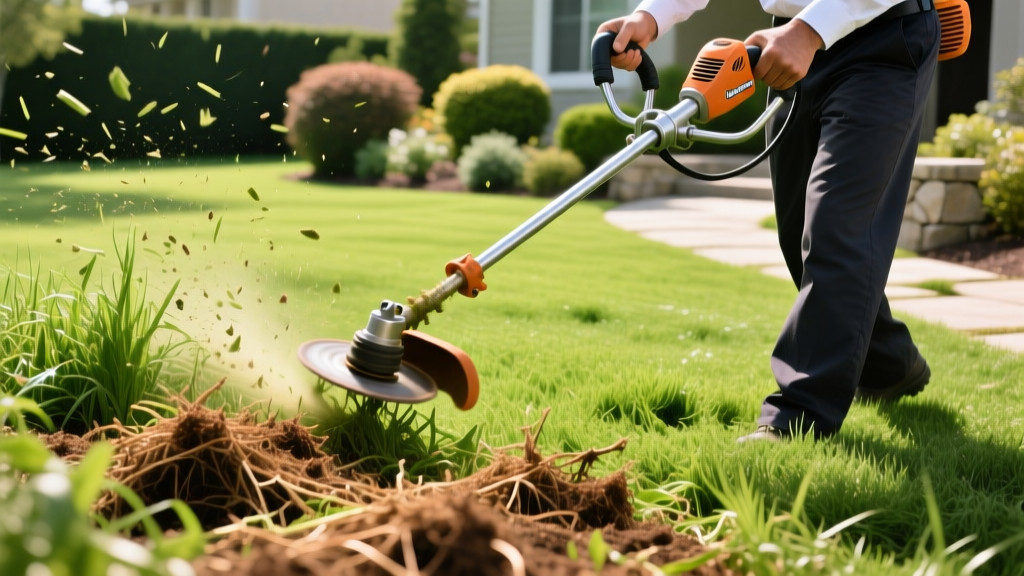
Spot-Treating Deep-Rooted Weeds With a Maruyama Weed Eater
The Chemical Ceiling in Perennial Weed Management
When managing high-value turfgrass, lawn care professionals eventually hit a chemical ceiling. Post-emergent herbicides like MSMA are heavily restricted or banned in many municipalities, and non-selective options like glyphosate cause unacceptable collateral damage to surrounding desirable turf. This is particularly true for deep-rooted perennials and sedges, such as Dallisgrass (Paspalum dilatatum) and Yellow Nutsedge (Cyperus esculentus), which store massive energy reserves in subterranean rhizomes and tubers.
According to turfgrass pathology data from NC State Extension, mature Dallisgrass crowns can withstand multiple applications of selective herbicides, often regenerating within 14 days. To achieve true eradication without chemical burn, mechanical crown excision is required. This is where professional-grade equipment, specifically a Maruyama weed eater (brush cutter), transitions from a simple trimming tool to a surgical turf management instrument.
Why the Maruyama Weed Eater Excels at Mechanical Extraction
Consumer-grade string trimmers rely on flexible braided cables inside the drive shaft. Under the heavy load of digging into soil or slicing through dense, fibrous weed crowns, these cables whip, lose torque, and stall. Maruyama’s professional series (such as the BC2600 and BC330 lines) utilize a rigid, solid-steel drive shaft. This engineering difference provides three critical advantages for spot-treatment:
- Instantaneous Torque Transfer: When the blade encounters a dense Dallisgrass root mass, the RPM does not bog down. The solid shaft transfers engine torque directly to the cutting head, allowing the blade to slice through fibrous crowns cleanly rather than tearing them.
- Precision RPM Control: Maruyama’s commercial 2-stroke and 4-mix engines allow the operator to hold a steady 6,500 RPM for delicate soil-scouring without stalling, a feat impossible with cable-driven trimmers.
- Reduced Harmonic Vibration: Spot-treatment requires holding the cutting head at a precise 45-degree angle for 10 to 15 seconds per weed. Maruyama’s isolated anti-vibration engine mounts reduce operator fatigue, ensuring the blade depth remains consistent at exactly 1.5 inches below the soil surface.
Weed-Specific Blade Selection Matrix
Using the wrong attachment on a Maruyama weed eater will either scalp the surrounding turf or fail to sever the weed's apical meristem. Match your cutting head to the target species based on root architecture.
| Target Weed Species | Root/Crown Depth | Recommended Maruyama Attachment | Extraction Technique |
|---|---|---|---|
| Dallisgrass | Crown: 1.5" - 2.5" | 3-Tooth Steel Grass Blade (10") | Scoop and Lift (45° angle) |
| Yellow Nutsedge | Tubers: 8" - 14" (Crown: 2") | 8-Tooth Brush Blade (10") | Crown Severing & Soil Aeration |
| Goosegrass | Taproot Base: 1" - 2" | Heavy-Duty Nylon Head (4-string) | Base Scouring (Parallel to soil) |
| Crabgrass (Mature) | Fibrous Base: 0.5" | Standard Nylon Head (0.095" line) | Surface Defoliation & Scalping |
Step-by-Step Crown Excision Protocol
Mechanical spot-treatment is not about mowing the weed down; it is about removing the crown and the top inch of the taproot. Follow this protocol for optimal results.
1. Pre-Extraction Soil Hydration
Do not attempt mechanical extraction in bone-dry, compacted soil. The Maruyama’s steel blade will bounce off hardened earth, damaging the turf and dulling the blade. Irrigate the target area to achieve 30% to 40% field capacity 12 hours before treatment. The soil should be moist enough to yield to the blade, but not so wet that it turns to mud and clogs the cutting head.
2. Calibrating the Approach Angle
Hold the Maruyama weed eater so the drive shaft is at a 30-degree angle to the ground, positioning the blade guard slightly away from the desirable turf. Tilt the cutting head so the left side of the blade (the 7 o'clock to 9 o'clock position on the rotation) makes contact with the soil. This utilizes the downward cutting force, pushing the blade into the earth rather than lifting it out.
3. The Crown Excision Cut
Engage the throttle to reach 7,500 RPM. Approach the Dallisgrass or Nutsedge clump from the edge. Gently press the spinning 3-tooth blade into the soil about 1.5 inches deep, circling the weed clump to sever the lateral rhizomes. Finally, slide the blade directly under the center of the crown and lever upward to pop the entire root mass out of the ground.
⚠️ Warning: Nutsedge Tuber Management
As noted by Penn State Extension, Yellow Nutsedge produces tubers (nutlets) deep in the soil profile that cannot be reached by a brush cutter. The goal of using the Maruyama weed eater on Nutsedge is strictly to sever the crown and the uppermost rhizome network. Removing the crown starves the deeper tubers of photosynthetic energy, forcing them to exhaust their reserves trying to regenerate, which makes subsequent pre-emergent herbicide applications vastly more effective.
Troubleshooting Common Spot-Treatment Failures
If weeds are regenerating 7 to 10 days after mechanical extraction, diagnose the failure using this framework:
- Symptom: Weed regrows from the exact same center point.
Cause: The apical meristem (the very tip of the crown) was left in the soil. The blade did not penetrate deep enough.
Fix: Increase soil hydration prior to the next treatment and press the Maruyama blade 0.5 inches deeper into the soil profile during the circling phase. - Symptom: Desirable turf (e.g., Bermuda or Zoysia) is yellowing and scalped around the treatment zone.
Cause: Operator is using the right side of the blade rotation (3 o'clock), which throws debris outward and scalps the turf via upward lifting forces.
Fix: Strictly use the left side of the blade rotation (downward cutting arc) and ensure the trimmer line or blade is perfectly parallel to the soil grade when not actively digging. - Symptom: Blade dulls rapidly or chips.
Cause: Hiding subsurface rocks or using the 3-tooth blade on woody, overgrown brush rather than soft-tissue perennial weeds.
Fix: Switch to an 8-tooth brush blade which is more forgiving on impact, or pre-inspect the weed clump by probing the base with a soil knife.
Post-Extraction Void Management
Removing a mature Dallisgrass clump leaves a void in the turf canopy measuring 3 to 5 inches in diameter. If left untreated, this bare soil will immediately become a germination bed for summer annuals like prostrate spurge.
- Backfill: Fill the void with a 70/30 mix of coarse silica sand and topsoil. Do not use pure organic compost, as it retains too much moisture and encourages fungal pathogens like Pythium blight.
- Level: Tamp the sand mix down until it is flush with the surrounding soil grade. The surrounding turf stolons will rapidly grow over the sand.
- Chemical Barrier: Apply a localized spot-treatment of a pre-emergent herbicide (such as prodiamine) directly over the sand void to prevent new weed seeds from colonizing the disturbed soil. Keep the pre-emergent at least 2 inches away from the edges of the desirable turf if you plan to overseed or sprig the area later in the season.
While a professional Maruyama weed eater represents an initial investment of $600 to $900, its ability to surgically eradicate chemical-resistant perennials saves turf managers hundreds of dollars annually in wasted post-emergent herbicides and prevents the costly turf renovation required after accidental glyphosate overspray.

