
Lawn Care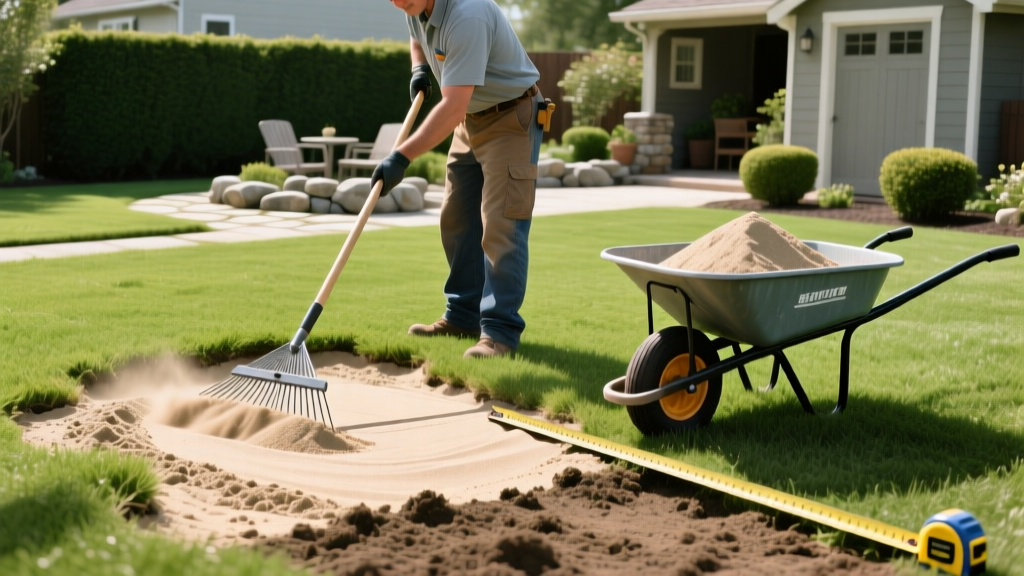
Masonry Sand for Lawn Leveling: Step-by-Step Application Guide
The Science of Sand Selection: Why Masonry Sand Wins
Uneven lawns cause mower scalping, create tripping hazards, and disrupt uniform irrigation. While topdressing is the standard remediation, the choice of material dictates long-term success. Using masonry sand for lawn leveling provides an optimal balance of drainage, particle uniformity, and structural stability that other sand types simply cannot match.
Masonry sand is mechanically washed and screened to a fine, uniform grain size (typically 0.1 to 0.5 millimeters). This washing process removes silt, clay, and dust, ensuring the sand will not compact into a hardpan layer over time. According to Penn State Extension, topdressing materials must integrate with the existing soil profile without creating distinct textural layers that impede water movement. Masonry sand achieves this seamlessly, particularly when mixed with screened compost.
Sand Type Comparison Matrix
| Sand Type | Grain Size | Silt/Clay Content | Drainage Profile | Leveling Verdict |
|---|---|---|---|---|
| Masonry Sand | 0.1 - 0.5mm | Washed (Near 0%) | Excellent | Best Choice: Uniform, won't compact, integrates well. |
| Play Sand | Fine / Variable | High (Unwashed) | Poor | Avoid: Binds into concrete-like clumps when wet. |
| Concrete Sand | 1.0 - 2.0mm | Washed | Very High | Poor: Too coarse; difficult to push into turf canopy. |
| Utility Fill Sand | Variable | Very High | Very Poor | Avoid: Contains weed seeds and heavy clay. |
Calculating Volume and Mix Ratios
Before ordering materials, calculate your exact volume requirements to avoid over-application, which can smother grass crowns. The golden rule of leveling is to apply no more than 1/4-inch to 1/2-inch of material per pass.
The Formula: Square Footage × Depth (in feet) ÷ 27 = Cubic Yards.
Example: A 5,000 sq. ft. lawn requiring a 1/4-inch (0.0208 ft) fill requires: 5,000 × 0.0208 ÷ 27 = 3.85 cubic yards of total mix.
Pro Tip: The 70/30 Mix Ratio
For established lawns, mix 70% washed masonry sand with 30% finely screened compost. The sand provides structural leveling and drainage, while the compost retains moisture and introduces microbial activity. For severe drainage issues or golf-course style bermudagrass, a 100% masonry sand application is acceptable.
For established lawns, mix 70% washed masonry sand with 30% finely screened compost. The sand provides structural leveling and drainage, while the compost retains moisture and introduces microbial activity. For severe drainage issues or golf-course style bermudagrass, a 100% masonry sand application is acceptable.
In 2026, bulk washed masonry sand typically costs $40 to $55 per ton (roughly 0.65 cubic yards per ton), while bagged equivalents at big-box stores run $6 to $8 per 50-pound bag. Always order bulk for areas exceeding 2,000 square feet to save on material and plastic waste.
Seasonal Timing for Your Grass Type
Timing your leveling procedure to coincide with peak turf growth ensures the grass can quickly push through the sand layer. NC State University Turfgrass Extension emphasizes that topdressing dormant or heat-stressed turf leads to crown rot and weed invasion.
- Warm-Season Grasses (Bermuda, Zoysia, Centipede): Level in late spring to early summer when soil temperatures consistently exceed 65°F and the grass is actively spreading via stolons and rhizomes.
- Cool-Season Grasses (Kentucky Bluegrass, Tall Fescue): Level in early fall (late August to September) alongside core aeration and overseeding. Avoid spring leveling, which invites summer crabgrass competition.
Phase 1: Pre-Leveling Preparation
Proper site preparation ensures the sand reaches the soil surface rather than sitting uselessly on top of thatch.
- Scalp the Turf: Lower your mower deck to 1 to 1.5 inches. Bag all clippings. This exposes the soil surface and the true contours of the lawn's bumps and divots.
- Dethatch if Necessary: Use a powered dethatcher or stiff-tine rake to remove thatch if the layer exceeds 0.5 inches. Sand trapped in thatch will not level the soil beneath it.
- Core Aerate: Pull 3-inch to 4-inch soil plugs across the entire lawn. This relieves compaction and creates vertical channels for the masonry sand to infiltrate, improving deep-root drainage.
- Mark Obstacles: Flag sprinkler heads, valve boxes, and shallow utility lines with high-visibility marking paint to prevent damage during the dragging process.
Phase 2: Application Step-by-Step
Execute the application on a dry, windless day. Wet sand clumps and becomes impossible to spread evenly.
Step 1: Dump and Distribute
Deposit wheelbarrow loads of your 70/30 sand-compost mix in small, evenly spaced piles across the work area. Do not dump the entire load in one spot, as moving heavy, wet sand across the lawn will tear the turf.
Step 2: Drag with a Leveling Rake
Using a 36-inch aluminum leveling rake (such as the Rocklin or Yard Butler models), drag the mix across the lawn. The flat bottom edge of the rake acts as a screed, knocking sand into low spots while scraping it off high spots. Work in overlapping, sweeping arcs.
Step 3: Sweep the Canopy
After the low spots are filled, use a stiff push broom to sweep the sand off the grass blades and down into the soil base. Leaving sand on the leaf blades blocks photosynthesis and invites fungal pathogens like brown patch.
Warning: The Smothering Threshold
Never bury the grass crowns. You must be able to see the tips of the grass blades poking through the sand after sweeping. If the turf is completely buried, the grass will suffocate and die within 7 to 10 days. For deep ruts exceeding 1 inch, fill them with native topsoil first, tamp down, and use the masonry sand mix only for the final 1/4-inch grading.
Never bury the grass crowns. You must be able to see the tips of the grass blades poking through the sand after sweeping. If the turf is completely buried, the grass will suffocate and die within 7 to 10 days. For deep ruts exceeding 1 inch, fill them with native topsoil first, tamp down, and use the masonry sand mix only for the final 1/4-inch grading.
Phase 3: Post-Application Care and Recovery
The first 48 hours after applying masonry sand for lawn leveling are critical for settling the material and initiating turf recovery.
- Water Immediately: Apply 0.25 inches of water via irrigation to wash residual dust off the grass blades and help the sand settle into the aeration holes and soil depressions.
- Apply Nitrogen: Apply a fast-release nitrogen fertilizer (such as 24-0-0) at a rate of 0.5 lbs per 1,000 sq. ft. This fuels the rapid vertical growth required for the grass to push through the new sand layer.
- Resume Mowing: Wait 5 to 7 days before mowing. When you do mow, raise the deck to your standard height. The sand may dull your mower blade faster than usual; sharpen or replace the blade after the first post-leveling cut.
Troubleshooting Common Leveling Failures
Problem: Sand washing away on slopes.
Solution: Masonry sand lacks cohesive binding agents. On slopes greater than a 5% grade, increase the compost ratio to 50/50 to add organic binding, or use a biodegradable erosion control tackifier sprayed over the sand immediately after application.
Problem: Weed seeds sprouting in the leveling mix.
Solution: This occurs when using unwashed utility sand or non-sterilized bulk compost. Always specify 'washed' masonry sand from the quarry, and source compost from facilities that use windrow turning to reach 140°F+ pathogen-killing temperatures.
Problem: The lawn feels spongy after leveling.
Solution: You applied sand over a thick layer of thatch without dethatching first. The sand is now trapped in the organic layer, holding excess moisture. You must aggressively core aerate and dethatch to pull the sand-soil interface back into contact with the mineral soil.

