
Lawn Care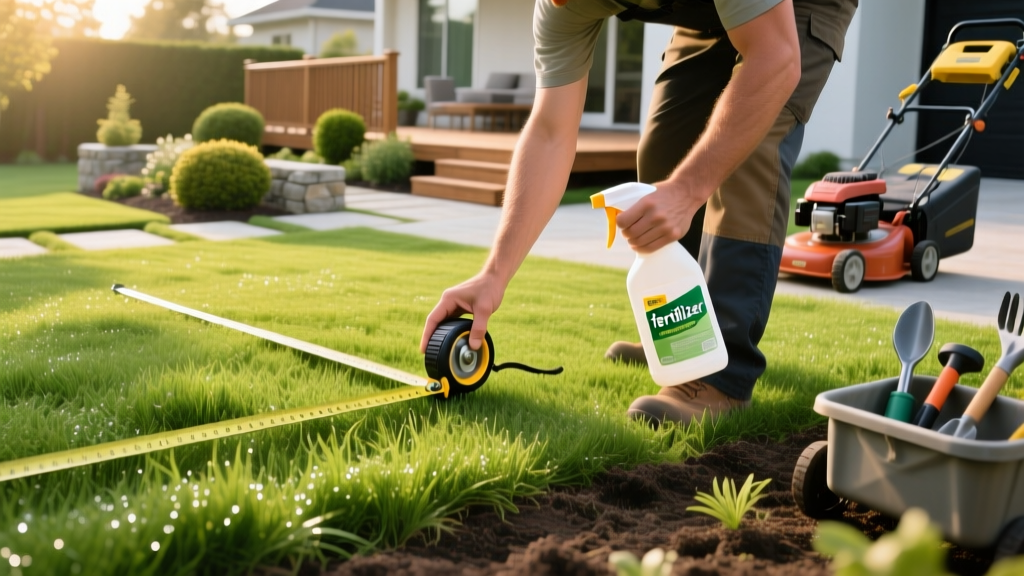
How to Measure Lawn Square Footage for Seed and Fertilizer
Guessing your lawn's size is the most expensive mistake in turf management. Overestimating your yard by just 20% means you will purchase excess grass seed, waste fertilizer, and risk nitrogen burn on your turf. Underestimating leads to thin germination and inadequate pre-emergent herbicide barriers. Before you calibrate your spreader or order pallets of sod, you must know exactly how to measure lawn square footage. This foundational step dictates every subsequent lawn maintenance procedure, from aeration to seasonal feeding programs.
The 4 Methods to Measure Lawn Area
Not all measuring techniques are created equal. The method you choose should depend on your property size, budget, and the required precision for the products you are applying. Pre-emergent herbicides require high precision, while bulk topsoil allows for wider margins of error.
| Method | Best For | Accuracy | Cost |
|---|---|---|---|
| Pacing (Heel-to-Toe) | Small, flat urban lawns | Low (+/- 15%) | Free |
| Long Tape Measure | Rectangular suburban yards | High (+/- 2%) | $15 - $30 |
| Measuring Wheel | Large properties, curves | Very High (+/- 1%) | $35 - $80 |
| GPS / Mapping Apps | Multi-acre estates, complex shapes | High (+/- 3%) | $0 - $50/yr |
Step-by-Step: Measuring Rectangular and Square Lawns
For standard suburban lots, the math is straightforward, but the execution requires discipline. Do not measure from the property line; measure only the actual turf area.
- Identify the Boundaries: Walk the perimeter of your grass. Note where the grass meets the driveway, the foundation of your house, and the street curb.
- Measure Length and Width: Using a 100-foot fiberglass tape measure (fiberglass won't stretch or rust like steel), record the longest vertical and horizontal dimensions of the turf.
- Calculate Gross Area: Multiply the length by the width. A 50-foot wide by 100-foot deep backyard yields 5,000 gross square feet.
- Subtract Non-Turf Areas: This is where most homeowners fail. You must subtract the square footage of your house footprint, concrete patios, garden beds, and driveways.
Warning: The 10% Buffer Rule
When buying grass seed, always add a 10% buffer to your final calculated square footage. Seed loss occurs due to bird foraging, wind displacement, and poor soil contact. If your calculated turf area is 4,000 sq ft, purchase enough seed for 4,400 sq ft.
When buying grass seed, always add a 10% buffer to your final calculated square footage. Seed loss occurs due to bird foraging, wind displacement, and poor soil contact. If your calculated turf area is 4,000 sq ft, purchase enough seed for 4,400 sq ft.
Tackling Irregular Shapes and Curves
Very few lawns are perfect rectangles. Curved garden beds, circular driveways, and triangular side-yards require breaking the property down into geometric primitives. According to turfgrass management guidelines from the University of Minnesota Extension, calculating these distinct zones separately and summing them is the most reliable way to determine total area.
Essential Geometric Formulas for Lawns
- Triangles (Corner yards): Area = 0.5 × Base × Height. If a side yard is 20 feet long (base) and tapers from 10 feet wide to 0 feet (height), the area is 100 sq ft.
- Circles (Round patios or tree rings): Area = π × Radius². A circular flower bed with a 6-foot radius removes roughly 113 sq ft of treatable turf.
- Trapezoids (Angled property lines): Area = 0.5 × (Base 1 + Base 2) × Height.
The Grid Method for Complex Curves
If your lawn features free-form, winding garden beds that defy basic geometry, use the Grid Method. Print a satellite image of your property from Google Earth. Overlay a transparent grid where each square represents 100 square feet (e.g., a 10x10 foot box). Count the full squares that contain grass, and estimate the partial squares. This technique is heavily utilized by professional landscapers when bidding on high-end estate renovations.
Translating Square Footage to Product Application Rates
Once you know your exact square footage, you must translate this into product purchasing and spreader calibration. Agricultural labels mandate specific application rates per 1,000 square feet. Applying products based on a guessed lawn size violates environmental best practices and can result in chemical runoff, a concern heavily monitored by the Environmental Protection Agency (EPA).
| Product Category | Standard Rate per 1,000 sq ft | Requirement for 5,000 sq ft Lawn |
|---|---|---|
| Tall Fescue Seed (New Lawn) | 6.0 - 8.0 lbs | 30 - 40 lbs |
| Kentucky Bluegrass Seed (Overseed) | 1.5 - 2.0 lbs | 7.5 - 10 lbs |
| Granular Fertilizer (Standard N-P-K) | Varies (Aim for 1 lb actual Nitrogen) | Check bag coverage chart |
| Pre-Emergent Herbicide (e.g., Prodiamine) | 0.5 - 1.0 oz (depending on formulation) | 2.5 - 5.0 oz |
Pro Tip for Spreader Calibration: To ensure your spreader applies the exact amount of fertilizer your square footage demands, mark off a 1,000 sq ft test area (e.g., 20 x 50 feet). Weigh your fertilizer bag, spread over the test area at your chosen setting, and weigh the bag again. The difference is your actual application rate per 1,000 sq ft.
Recommended Digital Tools for 2026
For homeowners managing properties larger than a quarter-acre, physical measuring wheels become tedious. Modern digital tools leverage LiDAR and satellite telemetry to calculate turf area in minutes.
- Apple Measure App (LiDAR equipped): For smaller urban yards, the LiDAR sensors on recent iPhone Pro models can map flat ground planes with surprising accuracy. Simply walk the perimeter while pointing the camera at the turf edge.
- Google Earth Pro (Desktop): The 'Measure Distance' polygon tool remains the gold standard for free, remote property mapping. Zoom in on your property, click the perimeter points of your grass, and the software will calculate the exact square footage, automatically adjusting for terrain slope.
- PLSCapes / iScape: Professional-grade landscaping apps allow you to trace turf zones over satellite imagery, automatically subtracting the square footage of mapped structures and hardscapes.
Frequently Asked Questions
Do I include the sidewalk in my lawn square footage?
No. Never include sidewalks, driveways, or street curbs in your calculation. Applying fertilizer or herbicide to concrete not only wastes expensive product but also contributes to chemical runoff into municipal storm drains.
How do I measure a sloped hill for seed calculation?
Measure the horizontal distance (the base) and the vertical rise to find the slope angle, or simply use a GPS mapping app which calculates the true surface area accounting for elevation changes. For steep slopes, add an extra 15% to your seed order to account for gravity-induced seed migration during the first heavy rain.
Why does my fertilizer bag say it covers 5,000 sq ft, but I run out early?
This usually happens due to spreader miscalibration or overlapping passes. If you overlap each pass by 50% instead of the recommended 10-20% edge overlap, you will effectively apply double the product in those zones, exhausting your bag long before you reach the calculated square footage limit. Always calibrate your spreader on a hard surface before hitting the turf.

