
Lawn Care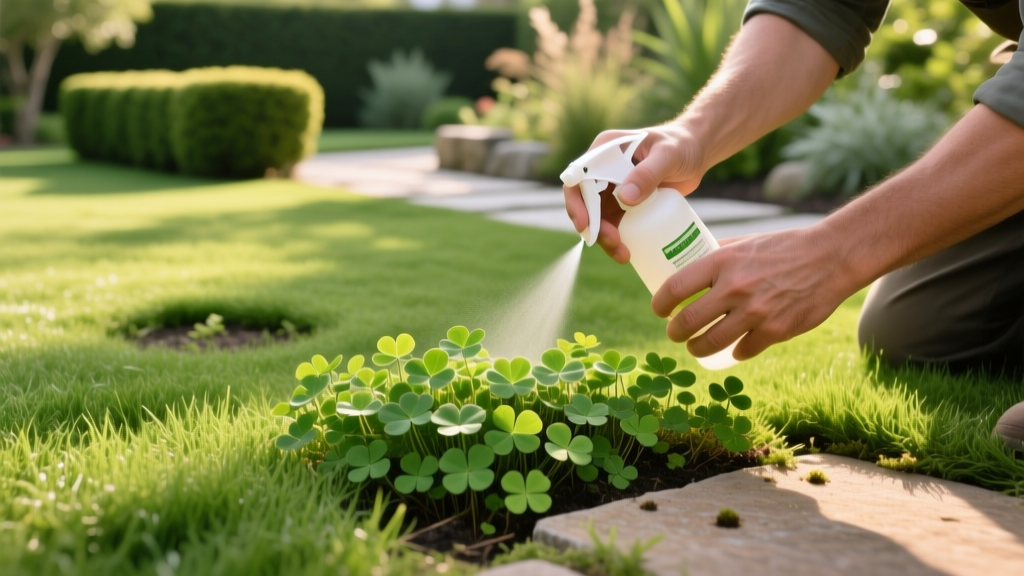
Micro Clover Grass Weed Control: Spot-Treatment Guide for Turf
Micro clover grass (Trifolium repens dwarf cultivars like 'Pirouette' and 'Rivendel') is heavily marketed as an eco-friendly lawn alternative due to its nitrogen-fixing capabilities and drought tolerance. However, when these aggressive, low-growing legumes invade a meticulously maintained Kentucky bluegrass, tall fescue, or bermudagrass lawn, they become a formidable broadleaf weed. Unlike standard white clover, micro clover features tightly spaced internodes and smaller leaves, allowing it to slip beneath mower blades and form dense, smothering mats that outcompete desirable turfgrass.
Eradicating micro clover grass requires a targeted approach. Broadcast spraying often damages surrounding turf or fails to penetrate the dense stolon network. This guide details precise spot-treatment protocols, specific herbicide formulations, and cultural corrections required to permanently remove micro clover from traditional lawns.
Identifying Micro Clover Grass vs. Standard White Clover
Accurate identification dictates your treatment strategy. Micro clover shares the same trifoliate leaf structure as standard white clover (Trifolium repens), but its growth habit is distinctly more compact. According to weed science data from North Carolina State University Turffiles, dwarf clover varieties can survive mowing heights as low as 1.5 inches, whereas standard white clover is typically decimated at that height.
| Characteristic | Micro Clover Grass (Dwarf Cultivars) | Standard White Clover |
|---|---|---|
| Leaflet Size | 0.25 to 0.5 inches across | 0.5 to 1.0 inches across |
| Stolon Internode Length | Very short (creeps tightly to soil) | Longer (arches and roots at nodes) |
| Flower Production | Sparse, smaller white/pink globes | Abundant, large white globes |
| Mowing Tolerance | Survives 1.5-inch cuts easily | Struggles below 2.5 inches |
The Nitrogen Deficiency Indicator
Diagnostic Insight: Micro clover grass possesses Rhizobium bacteria in its root nodules, allowing it to pull nitrogen directly from the atmosphere. If you see aggressive micro clover patching in your lawn, it is a biological indicator that your soil's available nitrogen levels are critically low. The clover is not just invading; it is exploiting a nutrient void that your turfgrass cannot fill.
Chemical Spot-Treatment Protocols
Because micro clover grass forms a dense, waxy cuticle on its small leaves, contact herbicides often fail to translocate down to the stolon nodes. You must use systemic, selective broadleaf herbicides applied via a low-pressure pump sprayer directly to the foliage.
Synthetic Selective Herbicides
For rapid eradication in cool-season and warm-season turf, formulations containing a three- or four-way active ingredient blend are mandatory. Single-ingredient 2,4-D is largely ineffective against mature micro clover.
- Recommended Active Ingredients: Triclopyr, Quinclorac, Dicamba, and Carfentrazone-ethyl.
- Top Product Pick: SpeedZone Broadleaf Herbicide for Turf (contains carfentrazone-ethyl, 2,4-D, MCPP, and dicamba). Expect pricing around $130 per gallon, but it yields hundreds of spot-treatment batches.
- Consumer Alternative: Ortho WeedClear Lawn Weed Killer (Triclopyr, 2,4-D, Dicamba). Available in 32 oz ready-to-spray bottles for approximately $12.
Spot-Spraying Execution: Mix 1.5 fluid ounces of a concentrated Triclopyr/Dicamba blend per 1 gallon of water. Add 0.5 oz of a non-ionic surfactant (like Southern Ag Surfactant) to break the clover's waxy leaf surface. Adjust your pump sprayer nozzle to a pin-stream or coarse droplet setting to prevent drift onto desirable broadleaf ornamentals. Spray the micro clover patches until the leaves are visibly wet, but not dripping.
Organic Iron-Based Herbicides
If you maintain an organic lawn program or are treating near sensitive garden beds, chelated iron (FeHEDTA) is the only viable spot-treatment. Grasses naturally tolerate high iron levels, while broadleaf weeds like micro clover absorb it rapidly, leading to fatal cellular necrosis.
- Active Ingredient: FeHEDTA (Iron HEDTA) at 24% to 27% concentration.
- Product Recommendation: Natria Lawn Weed Control Ready-to-Spray or Fiesta Turf Weed Killer.
- Application Constraint: FeHEDTA requires two applications spaced 14 days apart to achieve >85% control of micro clover. The first application burns the foliage; the second kills the regrowth from the stolons.
Temperature Warning: Never apply FeHEDTA when ambient temperatures exceed 85°F (29°C). High heat causes the iron to become phytotoxic to your surrounding turfgrass, resulting in severe brown spotting on fescue and bluegrass.
Manual and Cultural Eradication Tactics
The Stolon Extraction Technique
Pulling micro clover grass by hand is notoriously difficult. Unlike dandelions with a single taproot, micro clover spreads via above-ground stolons that root at every node. If you pull the main crown and leave the rooted nodes behind, the plant will regenerate within 10 days.
For isolated patches under 2 square feet, use a stand-up weeder with serrated claws (such as the Fiskars Uproot Weeder). Insert the claws at a 45-degree angle directly beneath the stolon network, lifting the entire mat of roots and soil simultaneously. Do not attempt this when the soil is bone dry; water the patch deeply 12 hours prior to extraction to soften the soil matrix.
Correcting the Soil Nitrogen Imbalance
As noted by the University of Minnesota Extension, clover thrives in nitrogen-poor environments. To culturally suppress micro clover grass, you must outcompete it with aggressive turfgrass fertilization.
- Spring Application: Apply a slow-release, methylene-urea based fertilizer at a rate of 1.0 lb of actual nitrogen per 1,000 sq ft.
- Fall Application: Apply a fast-release urea fertilizer at 1.0 lb N per 1,000 sq ft in early autumn to stimulate dense turf canopy closure before winter.
By maintaining high nitrogen levels, the turfgrass will grow thicker and cast deeper shade, depriving the micro clover stolons of the direct sunlight they require to root at the nodes.
Post-Treatment Recovery and Prevention
Once the micro clover grass is eradicated via herbicide or manual extraction, it will leave behind bare, circular patches in your lawn. If left untreated, these bare spots will immediately be recolonized by new clover seeds or creeping stolons from the perimeter.
- Rake the Bare Spot: Use a metal bow rake to scratch the top 1/4 inch of soil, removing dead clover thatch and creating a seedbed.
- Overseed Immediately: Apply a matching turfgrass seed (e.g., fine fescue or Kentucky bluegrass) at a rate of 3 to 4 lbs per 1,000 sq ft.
- Topdress and Water: Cover the seed with a 1/8 inch layer of peat moss or compost. Water lightly twice daily for 14 days until germination occurs.
- Adjust Mowing Height: Raise your mower deck to 3.5 inches. Taller grass blades shade the soil surface, preventing any surviving micro clover seeds from receiving the light required for germination.
Treating micro clover grass is not a one-time event; it is a symptom management process. By combining targeted systemic herbicides with aggressive nitrogen fertilization and optimal mowing heights, you can permanently shift the ecological advantage back to your desirable turfgrass.

