
Lawn Care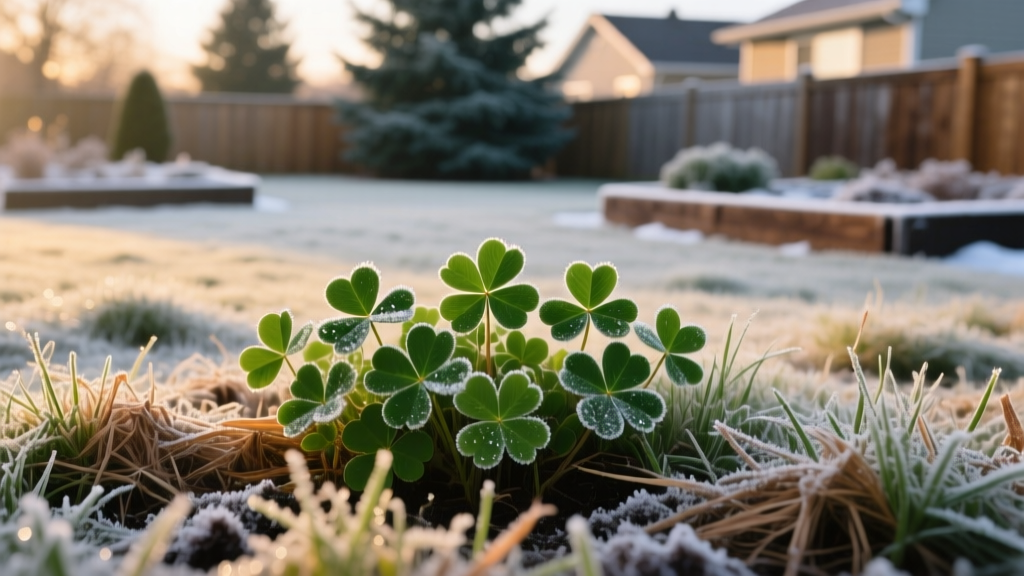
Micro Clover in Winter: Regional Survival & Care Guide
The Biology of Micro Clover Cold Tolerance
Micro clover (Trifolium repens var. 'Pirouette', 'Nano', or 'MicroWhite') has fundamentally shifted the turfgrass paradigm by offering a low-input, nitrogen-fixing lawn alternative. However, homeowners frequently ask what happens to this shallow-rooted legume when temperatures plummet. Unlike traditional cool-season grasses that rely on deep crown carbohydrate reserves, micro clover survives winter primarily through its stolon network and central taproot.
According to the USDA Plants Database, white clover species are hardy in Zones 3 through 9. But hardiness is highly conditional. The plant's above-ground stolons will die back when exposed to prolonged temperatures below 20°F. The critical survival mechanism lies in the sub-surface crown. If insulated by a consistent snowpack, micro clover crowns can withstand ambient air temperatures down to -30°F. Without snow cover, however, the combination of freezing temperatures and harsh, dry winter winds causes severe cellular desiccation, often leading to widespread winter kill.
Hardiness Reality Check: Pure micro clover lawns are rare and highly susceptible to winter erosion. For optimal winter survival and soil stabilization, agronomists recommend a mixed sward of 5-10% micro clover blended with fine fescues or perennial ryegrass. The grass blades act as a physical windbreak, trapping snow and insulating the clover crowns.
Regional Winter Behavior Matrix
Because the United States spans vastly different microclimates, managing micro clover in winter requires a localized approach. The table below outlines what to expect from your lawn based on your USDA Hardiness Zone.
| USDA Zone | Winter Foliage State | Crown Survival Expectancy | Primary Winter Threat |
|---|---|---|---|
| Zone 3-4 | Complete top-growth dieback; dormant brown stolons. | 85-95% (if snow-covered) | Ice encasement (anoxia) and frost heaving. |
| Zone 5-6 | Partial dieback; surviving leaves turn bronze/purple (anthocyanin production). | 70-90% | Desiccation from dry winter winds without snow insulation. |
| Zone 7-8 | Semi-evergreen; slow growth during warm spells. | 95%+ | Snow mold (Microdochium nivale) and winter annual weeds. |
| Zone 9+ | Fully evergreen; continuous, albeit slow, growth. | 100% | Overgrowth, thatch accumulation, and fungal pathogens. |
For a deeper understanding of integrating legumes into cold-climate landscapes, the University of Minnesota Extension provides excellent regional data on lawn alternatives and their overwintering capabilities in northern tiers.
Seasonal Timing Calendar for Winter Prep
Proper seasonal timing is the difference between a lush spring recovery and a patchy, weed-infested yard. Follow this chronological framework to prepare your micro clover lawn for dormancy.
Late Fall (October - November)
- The Final Mow: Drop your mower deck to 1.5 or 2.0 inches. While micro clover prefers a 2.5 to 3.0-inch height during the growing season, leaving it too long going into winter traps excess moisture at the soil line, creating a prime breeding ground for Typhula snow mold.
- Debris Management: Micro clover stolons are easily smothered. Mulch fallen leaves finely or rake them completely. A thick mat of wet leaves will block the minimal winter sunlight the semi-evergreen crowns need to maintain baseline carbohydrate levels.
- Potassium Boost: Avoid high-nitrogen fertilizers after October 1st. Instead, apply a winterizer with a 0-0-25 (N-P-K) profile. Potassium acts as a natural antifreeze within the plant's cellular structure, lowering the freezing point of the cell sap and increasing cold hardiness.
Deep Winter (December - February)
- Traffic Restriction: When micro clover is frozen solid, the water inside its stolon cells expands. Walking on a frozen clover lawn causes physical cellular rupture (crown shattering). Keep foot traffic off the lawn entirely when frost is visible.
- Snow Management: Do not shovel heavy, compacted snowbanks onto the clover lawn. Dense ice layers cut off oxygen exchange, leading to anoxic death within 45 to 60 days. Distribute shoveled snow evenly or pile it on hardscapes.
Early Spring (March - April)
- Dormancy Assessment: Wait until soil temperatures consistently reach 45°F before assessing winter kill. Micro clover is notoriously slow to break dormancy compared to fescues. What looks like dead brown thatch in early April may simply be a delayed green-up.
Troubleshooting Winter Kill & Spring Recovery
Even with meticulous prep, extreme weather events like polar vortexes or ice storms can damage your sward. Here is how to execute a targeted recovery.
Warning: The "Scratch Test" Fallacy
Many homeowners scratch the stolon to check for green tissue in early spring. Because micro clover relies on sub-surface crown buds rather than stolon nodes for spring regeneration, a brown stolon does not mean the plant is dead. Wait for the soil to warm to 50°F before declaring areas dead.
Many homeowners scratch the stolon to check for green tissue in early spring. Because micro clover relies on sub-surface crown buds rather than stolon nodes for spring regeneration, a brown stolon does not mean the plant is dead. Wait for the soil to warm to 50°F before declaring areas dead.
Overseeding Economics and Execution
If you confirm winter kill, overseeding is required. Specialty micro clover seeds (like 'Pirouette' or 'MicroWhite') are significantly more expensive than standard white Dutch clover. As of 2026, expect to pay between $45 and $60 per pound for coated, high-germination micro clover seed.
Application Rates: For a mixed lawn, overseed at a rate of 1 lb per 1,000 square feet. For renovating a pure clover patch, increase the rate to 2 to 2.5 lbs per 1,000 square feet. Always mix the seed with a starter fertilizer containing Pantoea agglomerans or similar PGPR (Plant Growth-Promoting Rhizobacteria) to accelerate root establishment before the heat of summer.
Frequently Asked Questions
Does micro clover stay green all winter?
Only in USDA Zones 8b and higher. In Zones 5 through 7, the leaves will produce anthocyanins, turning a deep bronze or purplish-red to protect against UV radiation and cold stress before eventually browning after hard freezes. In Zones 3 and 4, the top growth dies back completely, leaving a dormant brown mat until mid-spring.
Can I use pre-emergent herbicides on micro clover in late winter?
No. Standard pre-emergents like prodiamine or dithiopyr are non-selective regarding seed germination. If you apply these in late winter or early spring to stop crabgrass, you will simultaneously prevent your micro clover from self-seeding and naturally repairing winter-damaged patches. Rely on post-emergent spot treatments for broadleaf weeds instead.
Why is my micro clover lawn turning yellow in late February?
Yellowing in late winter is typically a sign of iron chlorosis induced by cold, wet soils, or a secondary fungal infection like snow mold. If the yellowing is accompanied by a fuzzy white or pink webbing at the soil line, you are dealing with snow mold. Improve air circulation by gently raking the affected areas as soon as the ground thaws to dry the crowns.

