
Lawn Care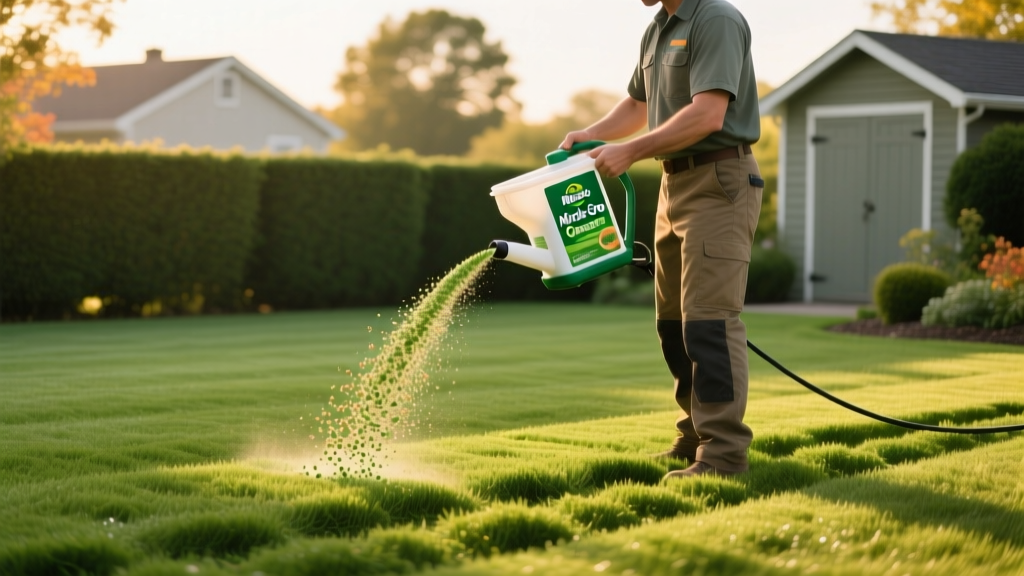
Step-by-Step Guide to Applying Miracle-Gro Grass Food for Thick Lawns
Achieving a dense, dark-green lawn requires precise nutrient delivery, and Miracle-Gro Grass Food remains one of the most accessible options for homeowners in 2026. However, the high nitrogen concentration in these formulations demands strict adherence to application procedures. Over-application or improper mixing will result in severe turf burn, while under-application leads to patchy, yellowing growth. This guide details the exact step-by-step maintenance procedures for applying both water-soluble and granular Miracle-Gro variants.
Understanding Miracle-Gro Grass Food Formulations
Before opening a box, you must identify which formulation you are using, as the application mechanics differ entirely. Miracle-Gro primarily offers two lawn-specific formulations:
- Water Soluble Lawn Food (36-0-6 NPK): A high-nitrogen, zero-phosphorus blend designed for rapid foliar absorption and deep root feeding. The absence of phosphorus complies with municipal runoff regulations, as noted by the Environmental Protection Agency (EPA), preventing algae blooms in local waterways.
- Granular Lawn Food (Various NPK ratios, typically 24-0-11 or similar slow-release blends): Coated prills that require soil moisture to break down, providing a steady nutrient release over 4 to 6 weeks.
Critical Soil Temperature Threshold: Never apply any Miracle-Gro formulation when soil temperatures exceed 85°F or when cool-season grasses (Fescue, Kentucky Bluegrass) enter summer dormancy. Pushing nitrogen into dormant turf forces weak, spindly growth that is highly susceptible to brown patch fungus and drought stress.
Pre-Application Lawn Maintenance Checklist
Fertilizer cannot penetrate a thatch layer thicker than 0.5 inches, nor can it be absorbed efficiently by overgrown turf. Complete these maintenance steps 24 to 48 hours before application:
- Mow to Optimal Height: Cut cool-season grasses to 2.5–3.0 inches and warm-season grasses (Bermuda, Zoysia) to 1.5–2.0 inches. Bag the clippings for this specific mow to prevent the fertilizer from getting trapped in the thatch layer.
- Core Aeration (If Compacted): If water pools on your lawn after heavy rain, perform core aeration. According to the University of Minnesota Extension, aerating immediately before fertilization allows nutrients to bypass the thatch layer and reach the root zone directly.
- Clear Debris: Rake away fallen leaves, twigs, and organic matter that will block granular prills from reaching the soil.
Step-by-Step Application Procedure
Step 1: Calibration and Area Measurement
Guessing your lawn's square footage is the leading cause of fertilizer burn. Measure your lawn's length and width using a measuring wheel or a GPS-enabled smartphone app.
Calculation: Multiply length by width to get total square footage. Subtract the square footage of your home's footprint, driveway, and garden beds. A standard 5 lb box of Miracle-Gro Water Soluble Lawn Food covers exactly 4,000 square feet. If your usable turf area is 6,000 square feet, you will need 1.5 boxes (7.5 lbs) for a full application.
Step 2: Mixing and Applying Water-Soluble Variants
The water-soluble variant is applied using a hose-end sprayer, typically the Miracle-Gro Garden Feeder or an Ortho Dial N Spray.
- Fill the Feeder: Pour the water-soluble crystals into the feeder jar up to the fill line. Do not add water to the jar; the hose-end siphon will mix it automatically.
- Attach and Prime: Screw the feeder onto your garden hose. Turn the water spigot on fully to ensure maximum water pressure (minimum 40 PSI is required for proper siphoning).
- The Application Pass: Turn the dial to the "ON" position. Walk backward at a steady pace of 3 feet per second, using a sweeping motion to ensure even coverage.
Pro Tip: Always start at the farthest edge of your lawn and work your way back toward the water spigot to avoid dragging the hose over freshly treated, wet grass, which can cause streaking.
- Shut Off Sequence: Turn the dial to "OFF" before turning off the water spigot. This prevents a pressure surge that could blow the siphon tube out of the jar.
Step 3: Applying Granular Variants with a Spreader
If you are using a granular Miracle-Gro product, a rotary (broadcast) spreader is required for even distribution. Drop spreaders are not recommended for granular lawn foods due to the high risk of striping.
- Set the Spreader Dial: For a standard Scotts EdgeGuard Mini or Turf Builder spreader, set the dial to 4.5. (Always check the back of the specific Miracle-Gro bag, as prill size varies by manufacturing batch).
- Perimeter Pass: Walk the entire perimeter of your lawn with the spreader's edge guard engaged to prevent fertilizer from landing on concrete driveways or landscape beds, where it will stain and burn ornamental plants.
- Interior Passes: Disengage the edge guard. Walk in straight lines, overlapping each previous pass by exactly 20% (roughly one foot). The rotary action throws prills in a 10-foot swath, and the overlap ensures uniform coverage without dark green streaks.
Post-Application Watering and Maintenance Matrix
Watering requirements immediately following application depend entirely on the formulation used and your specific grass type. Failure to water granular fertilizer in will result in nitrogen volatilization (loss to the atmosphere), while over-watering water-soluble fertilizer will wash it past the root zone.
| Grass Type | Water-Soluble Post-Watering | Granular Post-Watering | Next Mowing Window |
|---|---|---|---|
| Kentucky Bluegrass / Fescue | None (absorbed via foliage) | 0.25 inches immediately | 48 hours |
| Bermuda / Zoysia | None (absorbed via foliage) | 0.25 inches immediately | 72 hours |
| St. Augustine / Centipede | Light rinse if applied in high heat | 0.5 inches immediately | 72 hours |
Expert Insight: If applying water-soluble Miracle-Gro when ambient air temperatures are between 80°F and 85°F, wait until early evening. Applying high-nitrogen liquid to warm-season grasses in direct midday sun can cause microscopic leaf scorch, appearing as brown tips 24 hours later.
Troubleshooting Common Application Errors
Even with careful measurement, environmental variables can cause application anomalies. Use this diagnostic framework to correct issues:
- Symptom: Dark Green Streaks Alternating with Yellow Streaks.
Cause: Inconsistent walking speed or failure to overlap rotary spreader passes by 20%.
Fix: Do not apply more fertilizer to the yellow stripes. Wait 14 days for the dark stripes to metabolize the excess nitrogen, then apply a half-rate (0.5x) application strictly to the pale areas. - Symptom: Brown, Crispy Grass Tips 24-48 Hours After Liquid Application.
Cause: Fertilizer burn from applying water-soluble nitrogen to dry, drought-stressed turf or during peak UV hours.
Fix: Flush the affected area with 1 inch of plain water immediately to dilute the salt concentration in the soil. Suspend all mowing for one week. - Symptom: Granular Prills Visible on Soil Surface After 3 Weeks.
Cause: Insufficient post-application watering or a thatch layer exceeding 0.75 inches blocking soil contact.
Fix: Rent a power dethatcher to physically break up the thatch and pull the remaining prills into the soil profile, followed by a deep 1-inch watering cycle.
Frequently Asked Questions
Can I mix Miracle-Gro Grass Food with liquid weed killers?
No. Mixing high-nitrogen water-soluble fertilizers with broadleaf herbicides (like 2,4-D or Dicamba) in the same tank alters the pH and chemical stability of the herbicide, severely reducing its efficacy and increasing the risk of turf phytotoxicity. Apply herbicides first, wait 7 days, then apply the Miracle-Gro Grass Food.
How often should I reapply the water-soluble variant?
The 36-0-6 water-soluble formulation provides a rapid, short-lived nitrogen flush. For sustained color, it must be reapplied every 2 to 3 weeks during the active growing season. However, to prevent soil acidification and salt buildup, alternate every third application with a granular, slow-release organic nitrogen source.
Is it safe for pets after application?
Keep dogs and cats off the lawn until the water-soluble application has completely dried into the foliage (usually 2 to 4 hours). For granular applications, pets must remain off the turf until the post-application watering is complete and the grass blades are dry to prevent ingestion of concentrated prills.

