
Lawn Care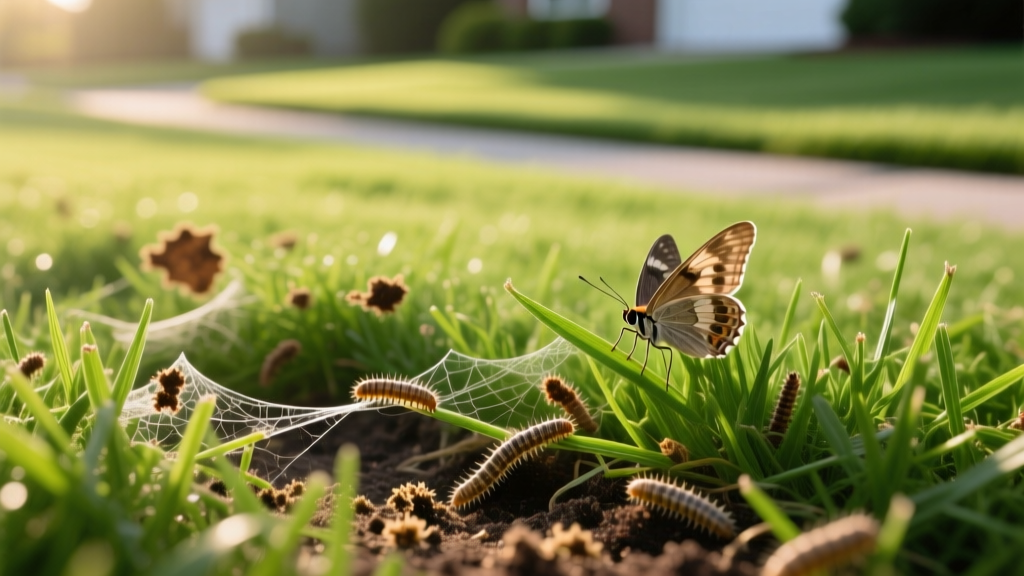
Moths in Lawn: How to Stop Sod Webworms From Destroying Turf
The Moth-Caterpillar Connection: What You Are Actually Seeing
Spotting small, tan or grayish moths zigzagging across your grass at dusk is a common late-summer occurrence. While seeing these moths in your lawn can trigger alarm, the adult insects themselves pose zero threat to your turf. Adult lawn moths (primarily from the Crambidae family) do not possess the mouthparts required to chew grass blades. Instead, they are actively mating and depositing hundreds of eggs on the tips of your grass blades.
The true threat to your landscape is the larval stage: sod webworms, armyworms, and cutworms. These caterpillars hatch within 5 to 7 days, drop to the thatch layer, and begin voraciously chewing on grass blades at night. By the time you notice the adult moths, the first generation of eggs has likely already hatched. Effective yard defense requires ignoring the flying adults and targeting the subterranean larvae before they sever the grass at the crown.
⚠️ Defense Warning: Do not waste time or money spraying insecticides at the flying adult moths. Adult moths are highly mobile and will simply fly back into your yard from neighboring properties. Furthermore, broad-spectrum sprays applied in the evening will decimate local pollinator populations without solving the root infestation. Target the thatch layer where the larvae feed.
Diagnostic Matrix: Is Your Lawn Actually Infested?
Before purchasing treatments, confirm that sod webworms or armyworms are the culprits behind your thinning turf. Drought stress, fungal pathogens, and dog urine can all mimic caterpillar damage. Use the diagnostic matrix below to differentiate webworm damage from environmental stress.
| Symptom | Sod Webworm Indicator | Drought / Environmental Stress |
|---|---|---|
| Blade Appearance | Notched, ragged edges; clipped at the base | Folded, rolled, or uniformly wilted blades |
| Patch Shape | Irregular, coalescing brown spots (1-3 inches wide) | Large, uniform brown areas matching sun exposure |
| Thatch Inspection | Presence of green frass (pellets) and silk webbing | Dry thatch, no frass, no webbing |
| Wildlife Activity | Flocks of starlings, robins, or grackles pecking turf | Minimal bird foraging in affected areas |
The Soap Drench Test: Confirming the Infestation
Visual inspection is often insufficient because larvae hide deep in the thatch during daylight hours. The gold standard for confirming a webworm or armyworm presence is the soap drench test. According to the University of Minnesota Extension, this method forces larvae to the surface without killing them, allowing for an accurate population count.
- Mix the Solution: Combine 2 tablespoons of lemon-scented liquid dish soap (such as Dawn) into 2 gallons of clean water.
- Apply: Slowly pour the mixture over a 1-square-yard area at the edge of a damaged brown patch, ensuring it penetrates the thatch layer.
- Wait and Count: Wait 10 minutes. The soap irritates the caterpillars' skin, forcing them to the surface. Count the number of larvae that emerge.
- Evaluate: If you count more than 10 to 15 larvae per square yard, the population has crossed the economic injury threshold, and targeted treatment is required immediately.
Targeted Treatment Protocols: Biological vs. Chemical
Once you have confirmed an active larval infestation, you must choose an intervention strategy. The optimal choice depends on your tolerance for chemical use, the size of the infestation, and the presence of non-target organisms like earthworms and pollinators.
Biological Controls: Precision and Safety
Biological controls are highly effective against early-instar (young) caterpillars and pose zero risk to humans, pets, or beneficial insects.
- Bacillus thuringiensis var. kurstaki (Btk): Btk is a naturally occurring soil bacterium that produces proteins toxic to caterpillars when ingested. Products like Monterey B.t. or Thuricide cost approximately $15 to $20 for a 16 oz bottle, covering up to 4,000 square feet. Application rule: Apply in the late afternoon. Btk degrades rapidly in UV light, and since webworms feed at night, evening application ensures they ingest the treated grass before the sun breaks down the active ingredient.
- Spinosad: Derived from the soil actinomycete Saccharopolyspora spinosa, Spinosad (found in products like Fertilecide or Conserve SC) offers slightly faster knockdown than Btk. Apply at a rate of 0.25 to 1.25 fl oz per 1,000 sq ft. It is highly effective but can be toxic to bees if applied while they are actively foraging; always spray after sunset.
Chemical Interventions: Fast Knockdown for Severe Outbreaks
If the soap drench test reveals massive populations (30+ larvae per square yard) or the caterpillars are in their later, larger instars, biologicals may not act fast enough to save the turf. Synthetic pyrethroids provide rapid contact and residual control.
- Bifenthrin: Available in consumer products like Talstar P or Ortho BugClear. The standard application rate is 1 fl oz per 1,000 square feet. A 32 oz bottle costs around $40 and treats nearly half an acre. Bifenthrin provides a residual barrier in the thatch for up to 30 days. University of Kentucky Entomology notes that pyrethroids are highly effective but must be watered in lightly (1/8 inch of irrigation) immediately after application to push the chemical into the thatch where the larvae hide.
- Chlorantraniliprole: Found in premium products like Acelepryn, this anthranilic diamide is exceptionally safe for non-target organisms and provides long-lasting residual control (up to 60 days). While commercial sizes are expensive ($150+), it is the industry standard for high-value turf defense.
Decision Framework: Which Treatment to Choose?
Choose Btk (Biological) if: The infestation is caught early, larvae are small (under 1/2 inch), you maintain an organic garden, or you have active beehives nearby.
Choose Bifenthrin (Chemical) if: The damage is spreading rapidly, larvae are large and mature, you need immediate cessation of feeding, or you are treating a large commercial property.
Cultural Defense: Making Your Turf Uninviting
Pesticides only treat the current generation. To prevent future moths in your lawn from successfully establishing a colony, you must alter the microenvironment to make it hostile to egg-laying females and larval survival.
Thatch Management
Sod webworms rely on a thick thatch layer to hide from predators and retain moisture during the day. If your thatch layer exceeds 0.5 inches, it acts as an impenetrable bunker. Perform core aeration in the fall and use a power rake or dethatching blade in the spring to physically remove the excess organic matter. This exposes the soil surface, making it less attractive for egg deposition and allowing insecticides to penetrate effectively.
Strategic Mowing Heights
Mowing your grass too short stresses the plant and exposes the soil to the sun, which accelerates drought stress and makes the turf more susceptible to defoliation. Maintain taller mowing heights to shade the soil and promote deep root growth. For cool-season grasses like Tall Fescue, maintain a height of 3 to 4 inches. For warm-season grasses like Bermudagrass, keep it between 1.5 and 2 inches. Taller grass also harbors ground beetles and spiders, which are natural predators of webworm larvae.
Frequently Asked Questions
Will watering my lawn drown the sod webworms?
No. While sod webworms prefer the humid microclimate of a damp thatch layer, heavy irrigation will not drown them. In fact, overwatering can promote fungal diseases like Pythium blight, which will compound the damage to your already stressed turf. Stick to the standard 1 to 1.5 inches of water per week, applied deeply and infrequently.
Why do I see moths in my lawn every evening but no brown patches?
Adult moths are strong fliers and often emerge from neighboring fields, golf courses, or unmanaged ditches to swarm over your well-lit or irrigated lawn. If your thatch is minimal and your turf is healthy, the eggs they lay may not survive, or the resulting larvae may be consumed by local bird and beetle populations before causing visible damage. Continue to monitor with the soap drench test before applying any treatments.
Do sod webworms kill the grass roots?
Generally, no. Sod webworms are defoliators; they chew the blades off at the crown but leave the root system intact. If the infestation is halted and the crown is undamaged, the grass will recover fully within 2 to 3 weeks with proper watering and a light application of nitrogen fertilizer. However, armyworms and cutworms can occasionally sever the plant entirely, requiring overseeding in bare patches.

