
Lawn Care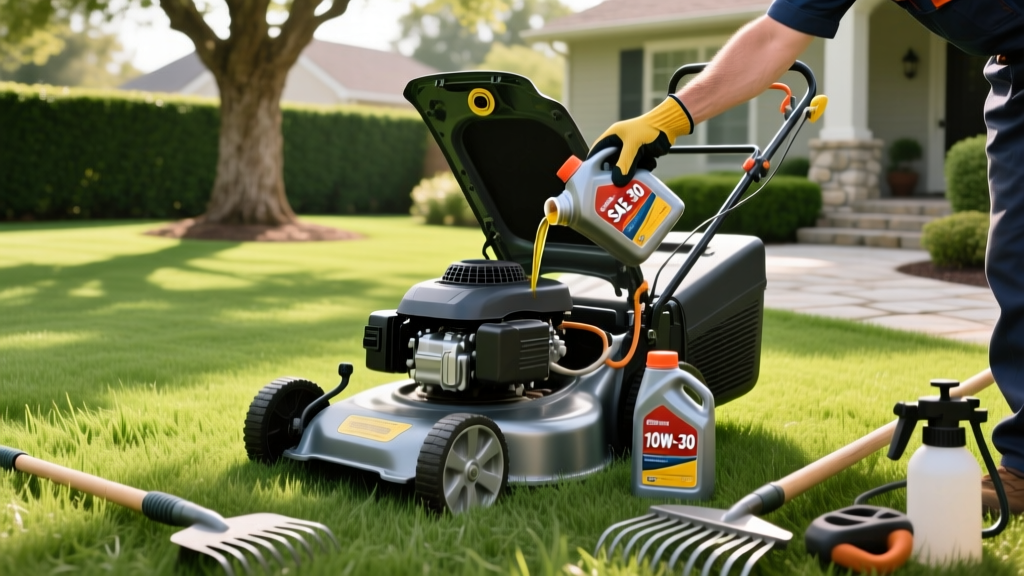
Choosing the Right Motor Oil for Lawn Mowers: SAE 30 vs 10W-30
The Hidden Cost of Using Leftover Automotive Oil
Every spring, thousands of homeowners inadvertently destroy their small engines by topping off their mower crankcases with leftover 5W-20 or 5W-30 automotive oil from their car's last oil change. While it might seem like a harmless substitution, the internal environment of a lawn mower engine is radically different from a modern liquid-cooled automobile engine. Choosing the correct motor oil for lawn mowers is not about brand loyalty; it is about matching the fluid's shear stability, zinc additive content, and thermal breakdown threshold to the extreme operating conditions of air-cooled small engines.
Automotive engines operate at highly regulated temperatures, typically keeping oil between 190°F and 220°F. In contrast, the air-cooled single-cylinder engines found in most walk-behind mowers and riding tractors routinely see oil sump temperatures exceed 300°F at the cylinder head. This extreme heat rapidly degrades multi-grade automotive oils, causing them to thin out and lose their protective film strength precisely when the engine needs it most under heavy load.
⚠️ Critical Warning: Friction Modifiers
Modern automotive oils (API SP category) contain high levels of friction modifiers designed to improve fuel economy in cars. In lawn mowers equipped with wet clutches or certain gear-driven transmissions, these modifiers can cause clutch slippage, leading to premature transmission failure and a complete loss of drive power.
Decoding Viscosity: SAE 30 vs. 10W-30 vs. Synthetic
Viscosity is the single most important property of motor oil for lawn mowers. It dictates how well the oil resists thinning under high heat and how effectively it coats internal components during startup. Most small engine manufacturers, including Briggs & Stratton and Honda Power Equipment, recommend either SAE 30 or 10W-30, but the right choice depends on your specific climate and equipment type.
| Oil Type | Best Application | Temperature Range | Shear Stability |
|---|---|---|---|
| SAE 30 (Conventional) | Standard walk-behind mowers, warm climates | 40°F to 100°F+ | Excellent (Single-grade does not shear) |
| 10W-30 (Conventional) | Riding mowers, variable seasonal temps | 0°F to 100°F | Moderate (VIIs can break down in gear sumps) |
| 5W-30 Full Synthetic | Cold climate starts, commercial zero-turns | -20°F to 110°F+ | High (Synthetic base resists thermal breakdown) |
| 15W-50 Synthetic | Heavy-duty commercial, extreme heat | 50°F to 120°F | Superior (Thick film strength at high RPM) |
Single-grade oils like SAE 30 are often the superior choice for basic push mowers operating in summer heat. Because they lack Viscosity Index Improvers (VIIs)—the polymer additives that allow multi-grade oils to flow at different temperatures—they are immune to mechanical shearing. In mowers where the engine oil also lubricates the transmission gears, the mechanical grinding of the gears will physically chop the VII polymers in 10W-30 oil, causing it to permanently thin out to a 10W-20 or 10W grade within just 15 hours of operation.
The ZDDP Factor: Why API Classifications Matter
One of the most overlooked aspects of small engine maintenance is the ZDDP (Zinc Dialkyldithiophosphate) content in the oil. ZDDP is an anti-wear additive that creates a sacrificial boundary layer on high-friction metal surfaces, such as the flat-tappet camshafts and lifters found in overhead valve (OHV) small engines.
Over the last two decades, the API engine oil standards have progressively reduced the allowable limits of zinc and phosphorus in automotive oils to protect the catalytic converters in modern cars. Current API SP automotive oils typically contain around 700 to 800 parts per million (ppm) of ZDDP. Small engines, which do not use catalytic converters, require significantly more protection. Dedicated small engine oils, such as those manufactured by Briggs & Stratton or Honda OEM, routinely push ZDDP levels to 1,200 ppm or higher. Running low-zinc automotive oil in an air-cooled mower will accelerate camshaft lobe wear, eventually leading to a loss of compression and engine failure.
Pro-Tip: The Diesel Oil Hack
Many commercial landscapers use heavy-duty diesel oils (like Rotella T4 15W-40) in their riding mowers. Diesel oils are formulated with high ZDDP content (often 1,200+ ppm) and robust detergent packages to handle soot. While excellent for engine longevity, ensure your mower's ambient operating temperatures support a 15W-40 viscosity, as it will be too thick for cold spring startups.
Precision Oil Change Protocol
Changing the oil in a lawn mower requires more precision than a standard automotive oil change. Small engine crankcases hold very little fluid—typically between 15 and 24 ounces (0.44 to 0.71 Liters) for walk-behinds, and 48 to 64 ounces for riding mowers. An overfill of just 4 ounces can cause the crankshaft to whip the oil into a foam, leading to aeration, overheating, and blown crankcase seals.
- Thermal Preparation: Run the mower for exactly 5 to 7 minutes. This warms the oil to approximately 140°F, reducing its viscosity and keeping abrasive carbon particles suspended in the fluid so they drain out completely.
- Safety Lockout: Disconnect the spark plug wire and secure it away from the plug. On riding mowers, remove the ignition key and disconnect the negative battery terminal to prevent accidental cranking.
- Extraction vs. Draining: While draining via the bottom plug (usually requiring a 3/8" or 1/2" ratchet) works, it often results in spilled oil on the mower deck. Using a manual fluid extractor pump (like a 6.5L Mityvac) inserted down the dipstick tube is cleaner and extracts up to 95% of the old oil without tilting the machine.
- Filter Maintenance: If your riding mower has a spin-on oil filter, apply a thin film of fresh oil to the rubber gasket before installing. Hand-tighten only; do not use a filter wrench, as overtightening will crush the gasket and cause a massive leak.
- Measured Refill: Never pour directly from a large jug. Pour the fresh motor oil for your lawn mower into a calibrated measuring cup. Add 80% of the stated capacity, wait 60 seconds for the oil to settle in the sump, and then check the dipstick. Add the remaining fluid in 1-ounce increments until the level sits precisely at the top crosshatch mark.
Troubleshooting & Edge Cases
Even with the correct oil, small engines present unique maintenance edge cases that can trap inexperienced operators. Understanding these scenarios will save you from costly dealership repair bills.
- The Hydrostatic Transmission Trap: Some older Cub Cadet and John Deere riding mowers share a common oil sump between the engine and the hydrostatic transmission. These specific models require a specialized anti-wear hydraulic fluid, not standard motor oil. Putting standard 10W-30 in a shared sump will destroy the hydraulic charge pump. Always verify your specific operator's manual before adding fluid.
- Oil Dilution from Ethanol: Small engines left sitting with E10 or E15 fuel often experience fuel seeping past the carburetor needle and into the crankcase. If you pull your dipstick and the oil level is above the full mark and smells strongly of gasoline, the oil is compromised. Gasoline thins the oil and destroys its lubricity. You must drain the sump, fix the carburetor, and refill with fresh oil immediately.
- Proper Disposal: Small engines generate a high volume of acidic, carbon-heavy waste oil over their lifespan. Never dump this in the trash or soil. According to the EPA used oil recycling guidelines, used oil should be stored in a sealed, leak-proof container and taken to a local auto parts store or municipal hazardous waste facility, which are legally required to accept it for re-refining.
Final Equipment Selection Matrix
To summarize your purchasing decision at the hardware store, use this quick-reference framework based on your specific equipment profile:
1. Standard Push Mower (Warm Climate, >50°F): Buy conventional SAE 30 small engine oil. High ZDDP, no shear risk, maximum protection for splash-lubricated sumps.
2. Riding Tractor / Zero-Turn (Variable Climate): Buy 10W-30 or 10W-40 small engine specific oil (or heavy-duty diesel 15W-40 if ambient temps stay above 40°F). Ensures cold-start flow and high-temp film strength for pressurized lubrication systems.
3. Commercial Fleet / Extreme Heat (Southern US Summers): Buy 15W-50 Full Synthetic small engine oil. The synthetic base stock resists thermal breakdown at 300°F+ cylinder head temperatures, allowing for extended 100-hour drain intervals.
By respecting the unique thermodynamic and mechanical demands of small engines, and selecting a motor oil formulated specifically for those parameters, you can easily double the operational lifespan of your mower's engine block and maintain peak cutting performance season after season.

