
Lawn Care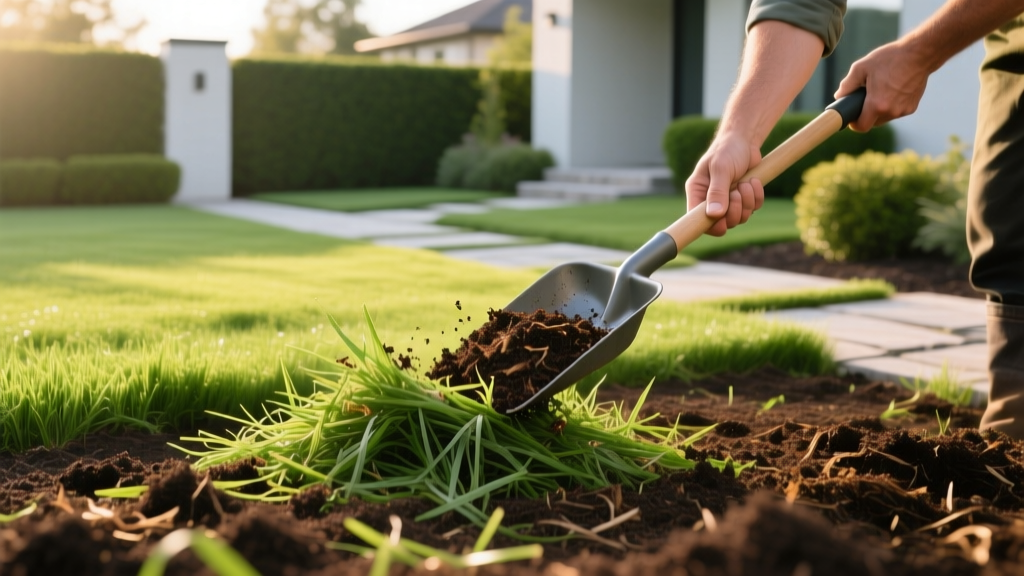
Building a Thriving Mulched Lawn: Clippings and Compost
The Biology of a Mulched Lawn
A mulched lawn operates on a closed-loop nutrient cycle, fundamentally shifting how turfgrass derives its fertility. Rather than bagging and removing biomass, maintaining a mulched lawn involves two distinct practices: grasscycling (leaving finely chopped clippings on the turf) and supplementing with fine organic soil amendments like compost or leaf mold. According to University of Minnesota Turfgrass Science, grass clippings are approximately 75% water and 25% dry matter. When chopped to a length of 1 inch or less, these clippings bypass the thatch layer and fall directly to the soil surface, where soil microbes decompose them in 7 to 14 days.
Nutrient Return Data: A consistently mulched lawn returns roughly 1 to 2 pounds of nitrogen per 1,000 square feet annually. This satisfies up to 25% of your turf's total nitrogen requirement, allowing you to reduce synthetic fertilizer applications by one full cycle per year.
The primary biological advantage of a mulched lawn is the continuous feeding of the soil food web. As clippings break down, they feed bacteria and fungi, which in turn are consumed by nematodes and protozoa. This microbial grazing releases plant-available nitrogen directly into the root zone, a process far more efficient than surface-applied granular fertilizers that are prone to volatilization and runoff.
Equipment: Mulching Blades vs. Standard Blades
You cannot achieve a true mulched lawn with a standard high-lift mower blade. Standard blades are designed to create an updraft that stands grass up for a clean cut and expels it out the side discharge. Mulching blades, conversely, feature a curved profile and extended cutting edges that keep the clipping suspended in the mower deck's vortex, chopping it multiple times before it falls.
| Blade Type | Design Profile | Best Use Case | Drawbacks |
|---|---|---|---|
| Standard High-Lift | Straight edge with large upward-curving fins | Bagging, side-discharging, tall wet grass | Leaves clippings too large to decompose quickly |
| Basic Mulching | Slightly curved with extra cutting teeth | Routine weekly mowing of dry grass | Struggles with heavy leaf fall or overgrown turf |
| Gator Blades (e.g., Oregon G5) | Aggressive teeth angled toward the center | Heavy mulching, leaf shredding, dense turf | Requires higher engine RPM to maintain vortex |
For battery-powered mowers, ensure your mulching plug is fully seated. Electric motors deliver instant torque but can bog down if the deck is choked with damp clippings. If you are using a gas mower, maintain engine speeds above 3,000 RPM to ensure the aerodynamic vortex inside the deck remains strong enough to recut the clippings.
Beyond Clippings: Top-Dressing with Fine Mulch and Compost
While grasscycling handles immediate nitrogen needs, a premium mulched lawn requires periodic soil amendments to build long-term soil structure and water retention. The EPA's composting guidelines highlight that adding organic matter increases the soil's cation exchange capacity (CEC), allowing it to hold onto nutrients longer.
Step-by-Step Compost Top-Dressing Protocol
- Calculate Volume: To apply a 1/4-inch layer of fine compost over 1,000 square feet, you need exactly 0.75 cubic yards of material. Screened compost typically costs between $40 and $60 per cubic yard in 2026.
- Core Aerate First: Always pull 3-inch deep soil cores before top-dressing. This ensures the organic amendment falls directly into the aeration holes, bypassing the thatch layer and integrating with the native soil.
- Screen the Material: If using homemade compost or leaf mold, pass it through a 1/4-inch hardware cloth screen. Large particles will smother the grass crowns and block sunlight.
- Distribute and Drag: Shovel the compost into small piles across the lawn. Use a flexible landscape rake or a specialized compost spreader (like the Lesco Spreader) to drag the material evenly. Finish by dragging a piece of chain-link fence or a heavy mat to work the compost down to the soil line.
- Water Immediately: Apply 0.5 inches of irrigation to wash the compost off the grass blades and into the soil profile, preventing fungal foliar diseases.
Troubleshooting Common Mulched Lawn Issues
Maintaining a mulched lawn requires adapting to environmental conditions. When the system fails, it is almost always due to moisture mismanagement or mowing frequency errors.
- Problem: Clumping and Smothering.
Cause: Mowing wet grass or removing more than 1/3 of the grass blade height at once.
Fix: Never mulch when the turf is wet. If the grass has grown too tall, mow once at a higher deck setting to cut the tops, then lower the deck and mow again in a perpendicular direction to properly mulch the remaining clippings. - Problem: Excessive Thatch Buildup.
Cause: Misattributing thatch to clippings. Thatch is composed of lignin-rich stems, stolons, and roots, not soft leaf tissue. Over-applying synthetic nitrogen accelerates thatch by outpacing microbial decomposition.
Fix: Reduce synthetic nitrogen by 25% to account for clipping return, and perform core aeration annually to introduce oxygen to thatch-degrading microbes. - Problem: Nitrogen Tie-Up (Yellowing Turf).
Cause: Top-dressing with high-carbon, unfinished compost or raw wood mulch. Microbes consume available soil nitrogen to break down the excess carbon.
Fix: Only use fully finished, dark, earthy-smelling compost with a C:N ratio below 20:1. If tie-up occurs, apply a quick-release liquid nitrogen (like 28% UAN) at a rate of 0.25 lbs per 1,000 sq ft to bridge the gap.
Seasonal Management Calendar
The approach to managing a mulched lawn shifts depending on whether you are growing cool-season grasses (Kentucky Bluegrass, Tall Fescue) or warm-season grasses (Bermuda, Zoysia). Refer to Penn State's Turfgrass Extension for regional climate adjustments.
| Season | Cool-Season Grass Strategy | Warm-Season Grass Strategy |
|---|---|---|
| Spring | Begin mulching as soon as growth starts. Keep blades sharp to prevent tearing disease-prone spring tissue. | Bag the first 2-3 mows to remove winter dormancy debris and allow soil to warm up faster. |
| Summer | Raise mower deck to 3.5 - 4 inches. Mulched clippings act as a micro-mulch layer, reducing soil evaporation. | Peak growth phase. Mow frequently (every 4-5 days) to ensure clippings remain small enough to decompose in high heat. |
| Fall | Mulch fallen leaves directly into the turf. Use Gator blades and mow twice a week until leaf drop ceases. | Apply 1/4 inch compost top-dressing after core aeration before the grass enters winter dormancy. |
| Winter | Dormant. Avoid walking on frozen turf to prevent crown damage and soil compaction. | Dormant. Do not apply amendments; wait for spring green-up to resume the nutrient cycle. |
By treating your turf as a living ecosystem rather than a sterile carpet, a mulched lawn drastically reduces yard waste, lowers fertilizer costs, and builds a resilient soil profile capable of withstanding drought and heavy foot traffic.

