
Lawn Care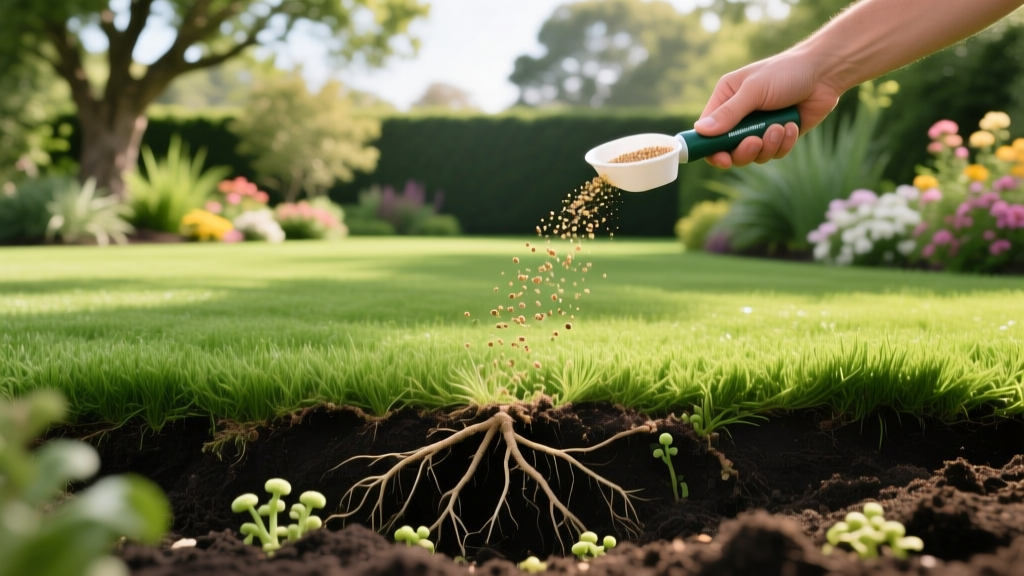
Building Soil Health With a Targeted Natural Lawn Fertiliser Program
Most homeowners treat their turf like a hydroponic system, spoon-feeding synthetic salts that bypass soil biology entirely. While this forces rapid green-up, it degrades soil structure, suppresses microbial life, and creates a dependency on frequent chemical inputs. Transitioning to a natural lawn fertiliser program fundamentally shifts this paradigm. Instead of feeding the plant directly, you feed the soil food web, which in turn mineralizes nutrients and delivers them to the grass roots in a slow, steady stream.
However, organic lawn care is not as simple as swapping a synthetic bag for an organic one. Natural fertilizers require specific soil temperatures, proper pH levels, and precise application math to be effective. This guide provides the exact frameworks, ingredient breakdowns, and troubleshooting protocols needed to build a resilient, chemical-free lawn.
The Soil Food Web: Mineralization vs. Osmosis
Synthetic fertilizers dissolve instantly in soil moisture and are drawn into grass roots via osmosis. A natural lawn fertiliser, such as feather meal or alfalfa meal, consists of complex proteins and organic matter that grass roots cannot absorb directly.
The Mineralization Process: When you apply organic nitrogen, soil bacteria (primarily Bacillus and Pseudomonas species) and fungi secrete enzymes to break down these complex proteins. This biological digestion process converts organic nitrogen into ammonium, and subsequently into nitrate—the form grass roots can actually uptake. This biological bottleneck is exactly why organic nutrients release slowly over 4 to 12 weeks, virtually eliminating the risk of fertilizer burn and nutrient leaching.
According to research published by the University of Minnesota Extension, lawns managed with organic inputs develop significantly higher microbial biomass and deeper root systems compared to those managed with synthetic salts, primarily due to the continuous carbon food source provided by organic amendments.
Decoding Organic N-P-K: Primary Ingredients
Not all organic nitrogen sources are created equal. The release rate and secondary benefits vary drastically based on the source material. When selecting a natural lawn fertiliser, look for these core ingredients on the label:
| Ingredient | Typical N-P-K | Release Time | Best Use Case |
|---|---|---|---|
| Feather Meal | 12-0-0 | 4-6 months | Long-term baseline nitrogen; excellent for fall root-building. |
| Alfalfa Meal | 3-1-2 | 1-2 months | Spring green-up. Contains triacontanol, a natural growth hormone that stimulates lateral turf spread. |
| Kelp Meal | 1-0-2 | 1-2 months | Summer stress mitigation. Packed with cytokinins and trace minerals to help grass survive drought and heat. |
| Poultry Manure | 4-3-3 | 2-3 months | Balanced macro-nutrient boost; fast-acting organic nitrogen source. |
The Application Math: Calculating Exact Rates
The most common mistake homeowners make with organic lawn care is under-applying product. Because natural fertilizers have lower N-P-K ratios than synthetics (e.g., 8-0-0 vs. 32-0-4), you must apply a higher physical volume of granules to deliver the same amount of actual nitrogen.
Step 1: Calculate Product Weight
The target application rate for established turf is 0.5 to 0.8 lbs of actual Nitrogen per 1,000 sq ft per application. Use this formula to determine how much physical product to load into your spreader:
(Target N Rate ÷ % Nitrogen on Bag) × 100 = Lbs of product per 1,000 sq ft
Example: If you are using an 8-0-0 natural lawn fertiliser and want to apply 0.6 lbs of N:
(0.6 ÷ 8) × 100 = 7.5 lbs of product per 1,000 sq ft.
Step 2: Calibrate Your Spreader
Organic granules are often irregular in size and denser than synthetic prills. Do not rely blindly on the spreader settings printed on the bag.
- Set your rotary spreader (e.g., Scotts EdgeGuard Mini) to a medium setting (typically 5 or 6).
- Weigh out exactly 7.5 lbs of the fertiliser.
- Measure a 10x10 ft test area on your driveway (100 sq ft). You should dispense exactly 0.75 lbs of product over this space.
- Adjust the dial up or down until the output matches the math. Organic products usually require a spreader setting 1 to 2 notches higher than their synthetic equivalents.
Seasonal Application Framework
Timing organic applications requires watching soil temperatures, not just the calendar. The Soil Health Institute emphasizes that microbial activity is strictly temperature-dependent.
Spring Activation (Soil Temp 55°F+)
Wait until soil temperatures at a 2-inch depth consistently hit 55°F before applying your first round. Applying feather meal in early March in Zone 5 is a waste of product; the microbes are dormant and the granules will simply sit on the soil surface. Use an alfalfa-heavy blend (like Espoma Organic Lawn Food) for the spring application to leverage fast-release nitrogen and natural growth hormones.
Summer Stress Mitigation (June - August)
Reduce nitrogen applications during peak summer heat to avoid forcing tender, water-hungry top growth. Instead, apply a kelp-based natural lawn fertiliser. The potassium and trace minerals in kelp thicken grass cell walls and improve moisture retention, helping the turf survive July and August droughts without supplemental irrigation.
Fall Root Storage (Late September - October)
This is the most critical application of the year. Apply a heavy dose of feather meal or poultry manure (0.8 to 1.0 lbs of N per 1,000 sq ft). Because soil temps are still warm but air temps are cooling, the grass will push the mineralized nitrogen down into the root zone, storing it as carbohydrates for an explosive, early-spring green-up the following year.
Troubleshooting: Why Organic Programs Fail
If you have applied natural fertilizers but your lawn remains pale or thin, you are likely dealing with one of three biological bottlenecks.
Warning: pH Lockout
Natural phosphorus (from bone meal or poultry manure) and iron are highly sensitive to soil pH. If your soil pH is above 7.5, these nutrients bind with calcium and become completely insoluble. Before applying organic P or Iron, you must lower your soil pH by applying elemental sulfur at a rate of 1 lb per 1,000 sq ft to drop the pH by approximately 0.2 units.
Natural phosphorus (from bone meal or poultry manure) and iron are highly sensitive to soil pH. If your soil pH is above 7.5, these nutrients bind with calcium and become completely insoluble. Before applying organic P or Iron, you must lower your soil pH by applying elemental sulfur at a rate of 1 lb per 1,000 sq ft to drop the pH by approximately 0.2 units.
- Compacted Soils and Anaerobic Conditions: The microbes required to mineralize organic fertilizers are aerobic. If your soil is heavily compacted, oxygen cannot reach the root zone, microbial populations crash, and the natural fertiliser sits undigested. You must core aerate compacted lawns before starting an organic program.
- Low Cation Exchange Capacity (CEC): Sandy soils have a naturally low CEC, meaning they cannot hold onto nutrients. Even slow-release organic nutrients can leach through pure sand. To fix this, incorporate 10 lbs of charged biochar per 1,000 sq ft annually. Biochar acts as a permanent, microscopic sponge, increasing the soil's CEC and holding organic nutrients in the root zone.
- Thatch Buildup: A thatch layer thicker than 0.5 inches will intercept organic granules, preventing them from reaching the soil where the microbes live. Always dethatch or perform aggressive core aeration before applying natural lawn fertilisers.
Long-Term ROI: Organics vs. Synthetics
On a per-bag basis, a natural lawn fertiliser costs roughly 30% to 50% more than synthetic alternatives. A 30 lb bag of premium organic blend (covering 5,000 sq ft) typically retails for $35-$45, compared to $18-$25 for a synthetic equivalent.
However, evaluating the ROI purely on fertilizer cost is flawed. Lawns managed organically for 3+ years develop robust fungal networks and higher organic matter content, which drastically increases the soil's water-holding capacity. Homeowners who transition to organic programs consistently report a 20% to 30% reduction in summer irrigation costs and a near-total elimination of annual core aeration requirements due to natural soil decompaction by earthworms and fungi. When factoring in reduced water bills and eliminated chemical weed-control services, the 5-year cost of an organic program frequently breaks even with, or undercuts, a synthetic chemical regimen.

