
Lawn Care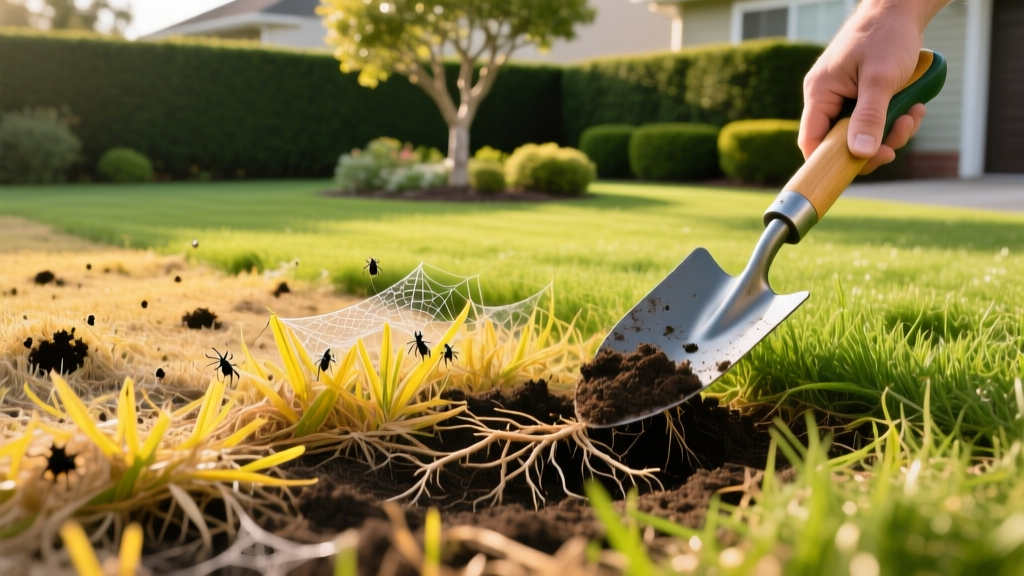
New Lawn Dying? Diagnose Symptoms and Apply Rescue Fixes
Watching a new lawn dying after investing thousands of dollars in premium sod or carefully graded seed is a homeowner's worst nightmare. Unlike established turf, newly planted grass lacks the deep root reserves to survive environmental stress, making the window for intervention incredibly narrow. When fresh turf begins to fail, generic advice like 'water more' or 'apply fertilizer' often accelerates the decline. Effective rescue requires precise symptom diagnosis and targeted chemical or cultural interventions.
The 60-Second Diagnostic Matrix
Before purchasing any curative products, walk your lawn and match your primary visual symptoms to this diagnostic matrix. Misdiagnosing a fungal issue as underwatering and subsequently increasing irrigation will destroy your turf in under 48 hours.
| Primary Symptom | Probable Cause | Immediate Rescue Fix |
|---|---|---|
| Sod lifts easily, edges curling inward | Hydrophobic soil or poor subgrade contact | Core aeration, wetting agents, heavy rolling |
| Rapid brown patches with dark 'smoke rings' | Pythium Blight or Brown Patch fungus | Curative fungicide (Propiconazole/Azoxystrobin) |
| Uniform yellowing, white crust, burnt tips | Fertilizer burn or extreme pH shock | Soil flushing protocol (1.5 inches of water) |
| Turf feels spongy, peels back like carpet | Subsurface grubs or billbugs severing roots | Curative Trichlorfon (Dylox) application |
Symptom 1: The 'Tug Test' Failure (Rooting & Hydration)
Perform the 'tug test' by grabbing a handful of grass near the edge of a failing zone and pulling gently upward. If the sod lifts cleanly with minimal resistance and the underside of the roots is dry, you are dealing with a soil-to-root contact failure. This is frequently caused by hydrophobic soil—often the result of dry clay subgrades or excessive sand topdressing that repels water rather than absorbing it.
The Wetting Agent and Rolling Protocol
Simply turning on the sprinklers longer will cause runoff, not absorption. You must break the soil's surface tension.
- Step 1: Apply a professional-grade wetting agent like Aqua-Aid or Penterra at a rate of 3 oz per 1,000 square feet. These surfactants reduce water's surface tension, forcing it into the soil profile.
- Step 2: Water immediately with a light 15-minute cycle to activate the surfactant.
- Step 3: Rent a water-filled lawn roller (approx. 300 lbs). Roll the entire affected area to physically press the sod roots back into the moist subgrade, eliminating air pockets that desiccate new root tips.
Expert Tip: For the first 14 days, new sod requires the top 1 inch of soil to remain consistently moist. According to the University of Minnesota Extension, this usually requires 3 to 4 short watering cycles (10-15 minutes each) spread throughout the day, rather than one long deep soak which promotes shallow rooting and rot.
Symptom 2: Rapid Brown Patches with Dark Borders
If your new lawn dying presents as expanding circular brown patches, inspect the border of the living and dead grass early in the morning when dew is present. If you see a dark, purplish-black 'smoke ring' or fine white cobweb-like mycelium, you are dealing with a high-temperature fungal pathogen. Fresh sod is highly susceptible to Pythium Blight and Rhizoctonia solani (Brown Patch) because it is kept constantly moist to encourage rooting.
Curative Fungicide Application
Do not wait for cultural practices to solve an active fungal outbreak; the pathogen will outpace your turf's recovery.
- Select a Systemic Fungicide: Use a FRAC Group 11 or 3 fungicide. Propiconazole 14.3 (liquid) or Azoxystrobin (granular, such as Scotts DiseaseEx) are industry standards.
- Apply at Curative Rates: Preventative rates will not stop an active infection. Apply Propiconazole 14.3 at the maximum curative label rate of 2 to 4 oz per 1,000 square feet.
- Alter Watering: Immediately switch to watering only between 4:00 AM and 6:00 AM. This allows the grass blades to dry completely before nightfall, starving the fungus of the leaf-wetness period it requires to sporulate.
'Pythium blight can destroy a newly seeded or sodded lawn in 24 to 48 hours under hot, humid conditions. Curative fungicide applications must be initiated the moment symptoms are observed to save the plant crown.' — NC State University TurfFiles
Symptom 3: Uniform Yellowing and Burnt Tips
When the entire lawn turns a pale, sickly yellow and the very tips of the grass blades look scorched or white, the root system is suffering from chemical burn. This typically occurs when a homeowner applies a high-nitrogen starter fertilizer to wet grass, or when the soil pH is locked out due to excessive lime application prior to sodding.
The Flush and Test Protocol
If you suspect fertilizer burn, cease all chemical applications immediately.
- Flush the Soil: Apply 1.5 inches of water over a 4-hour period to leach excess soluble salts below the root zone. Use a rain gauge or a straight-sided tuna can to measure exact water volume.
- Test the Soil: Once the turf dries, use a reliable test kit like the Luster Leaf 1601 Rapitest ($15-$20) or mail a core sample to your local university extension. If the pH is below 5.5 or above 8.0, nutrient lockout is preventing the grass from absorbing iron and nitrogen, causing the chlorosis (yellowing).
- Apply Chelated Iron: If pH correction will take too long, apply a liquid chelated iron supplement (like Ironite 1-0-1) at 4 oz per 1,000 sq ft to force rapid greening without adding more nitrogen salts to the burned soil.
Symptom 4: Spongy Turf and Carpet-Like Peeling
If the grass feels unusually spongy underfoot and you can peel it back with your hands like a newly laid carpet, the roots have been entirely severed. While this can sometimes be a severe rooting failure, it is frequently the work of subsurface pests—specifically white grubs or billbugs that have migrated into the fresh, nutrient-rich topsoil to feed on the tender new roots.
Curative Grub Knockdown
Preventative grub controls (like Chlorantraniliprole/Acelepryn) take 60 to 90 days to reach peak efficacy and will not save a lawn currently being eaten. You need an immediate-contact curative insecticide.
- Active Ingredient: Trichlorfon (commonly sold as Dylox 6.2).
- Application Rate: 3 lbs per 1,000 square feet.
- Activation: Trichlorfon degrades rapidly in alkaline water and high pH soils. It must be watered in immediately with at least 0.5 inches of water to push the chemical into the top 2 inches of soil where the grubs are feeding.
Rescue Intervention Cost Matrix (2026 Estimates)
Budgeting for lawn rescue requires understanding the cost per 1,000 square feet. Below are current market averages for professional-grade rescue materials.
| Intervention | Recommended Product | Cost per 1,000 sq ft | Time to Visible Result |
|---|---|---|---|
| Hydrophobic Soil Fix | Aqua-Aid Surfactant | $4.50 - $6.00 | 3 - 5 Days |
| Fungal Pathogen Kill | Propiconazole 14.3 | $8.00 - $12.00 | 7 - 10 Days |
| Fertilizer Burn Flush | Water + Chelated Iron | $2.00 - $4.00 | 48 - 72 Hours |
| Curative Grub Control | Dylox 6.2 (Trichlorfon) | $10.00 - $14.00 | 3 - 5 Days (Pest Death) |
Critical Post-Rescue Maintenance Rules
Once you have applied the correct rescue fix, the turf will be in a fragile state of recovery. Adhere strictly to these rules to prevent a secondary collapse:
WARNING: The Mowing Ban. Do not mow a dying or recently rescued lawn. Mowing removes the leaf surface area the plant desperately needs for photosynthesis to rebuild its root system. Wait until the grass has visibly recovered, rooted firmly, and exceeds 4.5 inches in height before executing the first cut. When you do mow, never remove more than 1/3 of the total blade height.
- Suspend Nitrogen: Do not apply any high-nitrogen fertilizers for at least 21 days post-rescue. Forcing top-growth when the root system is compromised will exhaust the plant's carbohydrate reserves.
- Limit Foot Traffic: Keep pets and children off the recovering turf. Compaction on wet, stressed soil crushes the fragile new root hairs attempting to anchor the plant.
- Monitor Soil Temperature: Use a digital soil probe thermometer. If soil temperatures exceed 80°F at a 2-inch depth, cool-season grasses (like Kentucky Bluegrass or Tall Fescue) will naturally slow root production. Increase irrigation frequency slightly to provide evaporative cooling to the root zone.
By accurately diagnosing the specific failure mode and applying targeted, chemically precise interventions, you can halt the decline and salvage your investment. For ongoing regional turfgrass data and localized disease alerts, consistently monitor resources from Purdue University Turfgrass Science and your local cooperative extension office.

