
Lawn Care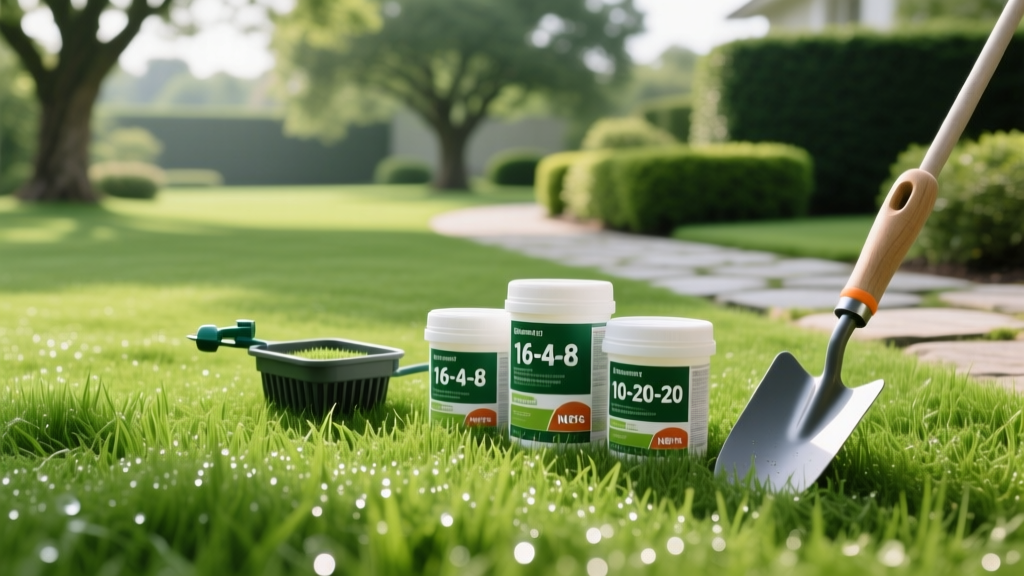
Best New Lawn Fertilizer Guide: Starter NPK Ratios and Timing
The Science of Starter NPK Ratios
Applying standard maintenance fertilizer to a newly seeded or sodded lawn is one of the most common and costly mistakes in turf establishment. Established lawns require high nitrogen (N) to fuel blade growth and maintain color. However, a new lawn fertilizer must prioritize root development, which requires a completely different macronutrient profile.
Fertilizer bags display three numbers representing the NPK ratio: Nitrogen (N), Phosphorus (P), and Potassium (K). For new grass, Phosphorus is the critical limiting factor. Phosphorus drives ATP (adenosine triphosphate) production, which is the primary energy transfer mechanism for root cell division and expansion. Without adequate phosphorus in the top 2 inches of soil, grass seedlings will germinate but fail to develop the deep root mass required to survive summer heat stress.
Pro Tip: The Mesotrione Advantage
Standard pre-emergent herbicides (like pendimethalin) will kill grass seed. If you need weed control while establishing a new lawn, look for a starter fertilizer containing mesotrione (often branded as Tenacity). Mesotrione inhibits photosynthesis in broadleaf weeds and crabgrass without harming germinating cool-season grass seeds like Kentucky bluegrass or tall fescue.
Standard pre-emergent herbicides (like pendimethalin) will kill grass seed. If you need weed control while establishing a new lawn, look for a starter fertilizer containing mesotrione (often branded as Tenacity). Mesotrione inhibits photosynthesis in broadleaf weeds and crabgrass without harming germinating cool-season grass seeds like Kentucky bluegrass or tall fescue.
2026 Starter Fertilizer Comparison Matrix
Not all starter fertilizers are created equal. The ideal NPK ratio for a new lawn generally falls between 1:2:1 and 1:3:1 (Nitrogen to Phosphorus). Below is a breakdown of the most effective commercial starter formulations available for residential use, including current pricing and coverage metrics.
| Product | NPK Ratio | Bag Coverage | Avg. Price | Cost / 1k sq ft |
|---|---|---|---|---|
| Scotts Turf Builder Starter Food | 24-25-4 | 15,000 sq ft | $42.99 | $2.86 |
| Lesco Professional Starter | 18-24-12 | 15,000 sq ft | $38.50 | $2.56 |
| Jonathan Green Seeding & Sodding | 12-18-8 | 15,000 sq ft | $44.00 | $2.93 |
| Scotts Starter with Weed Preventer | 21-22-4 | 15,000 sq ft | $54.99 | $3.66 |
Seed vs. Sod: Adjusting Your Application Strategy
While the nutrient requirements are similar, the physical application of a new lawn fertilizer differs drastically depending on whether you are planting seed or laying sod.
Establishing from Seed
Grass seed contains enough internal energy to germinate, but the moment the radicle (first root) emerges, it must immediately access soil phosphorus.
- Preparation: Apply starter fertilizer to bare, graded soil before spreading seed.
- Spreader Setting: For Scotts Turf Builder Starter (24-25-4), use a rotary spreader setting of 6.5 to achieve the target rate of 1.0 lb of Nitrogen per 1,000 sq ft.
- Incorporation: Lightly rake the fertilizer into the top 1/4 inch of soil so it is in the exact root zone of the germinating seed.
Establishing from Sod
Sod is essentially mature grass that has had its root system severed during harvesting. It experiences immediate transplant shock and requires rapid root regeneration to 'knit' into the subsoil below.
- Preparation: Do not apply fertilizer to the bare soil before laying sod; the severed roots cannot access it until they grow downward.
- Application: Lay the sod first, then apply the starter fertilizer directly on top of the grass blades.
- Watering: Water immediately and heavily. The water will wash the granular fertilizer off the blades and down into the soil seam where the new roots are forming.
Warning: The pH Lockout Effect
Phosphorus is highly reactive and easily binds to calcium in alkaline soils (pH above 7.2) or iron/aluminum in acidic soils (pH below 5.5), rendering it completely unavailable to the plant. If your soil test shows a pH outside the 6.0 to 7.0 range, applying expensive starter fertilizer is a waste of money. Amend with elemental sulfur (for high pH) or lime (for low pH) prior to establishment.
Phosphorus is highly reactive and easily binds to calcium in alkaline soils (pH above 7.2) or iron/aluminum in acidic soils (pH below 5.5), rendering it completely unavailable to the plant. If your soil test shows a pH outside the 6.0 to 7.0 range, applying expensive starter fertilizer is a waste of money. Amend with elemental sulfur (for high pH) or lime (for low pH) prior to establishment.
The 90-Day New Lawn Fertilizer Timeline
A common failure mode is over-fertilizing young grass, which leads to fertilizer burn and shallow root systems. Follow this strict 90-day timeline to transition your new lawn safely.
- Day 0 (Establishment): Apply starter fertilizer at a rate of 1.0 lb of Nitrogen per 1,000 sq ft. Water deeply to activate the prills.
- Days 14-28 (Germination & Sprouting): Do not apply any additional fertilizer. Focus entirely on keeping the top 1 inch of soil consistently moist. The initial starter application is actively feeding the developing roots.
- Day 30-45 (First Mow): Once the grass reaches 3.5 inches, mow it down to 2.5 inches. Remove no more than 1/3 of the blade. Do not fertilize yet; the grass is still utilizing the initial phosphorus load.
- Day 60-90 (The Transition Feed): The root system is now established enough to handle standard maintenance fertilizers. Apply a slow-release, nitrogen-heavy fertilizer (e.g., a 32-0-4 or 30-0-0 formulation) at a rate of 0.75 to 1.0 lb of Nitrogen per 1,000 sq ft. This shifts the plant's energy from root building to lateral growth and blade thickening.
Navigating Phosphorus Bans and Soil Test Exceptions
Because excess phosphorus runoff contributes to severe aquatic eutrophication (algal blooms in lakes and streams), many states and municipalities have enacted strict bans on the sale and application of phosphorus-containing fertilizers. According to the University of Minnesota Extension, states like Minnesota, New York, Wisconsin, and Michigan prohibit the use of phosphorus on established lawns.
However, nearly all of these jurisdictions include a legal exemption for new lawn establishment or when a verified soil test proves a phosphorus deficiency. If you live in a restricted zone, you must keep your receipt for the starter fertilizer and, ideally, a copy of your soil test results, to prove compliance if questioned by local environmental authorities. For comprehensive regional guidelines on soil preparation and nutrient management, refer to the UMass Amherst Extension Lawn Establishment fact sheet.
What if you cannot find starter fertilizer?
If local regulations or supply chain issues prevent you from sourcing a high-phosphorus starter fertilizer, you can use a standard 10-10-10 balanced fertilizer. However, you must increase the application rate to ensure adequate phosphorus delivery, while being extremely careful not to exceed 1.0 lb of Nitrogen per 1,000 sq ft to avoid burning the tender seedlings. This requires precise mathematical calculation based on the bag's guaranteed analysis.
Frequently Asked Questions
Can I use weed and feed on a new lawn?
Standard 'weed and feed' products contain pre-emergents like dithiopyr or post-emergents like 2,4-D that will severely damage or kill germinating grass seed and freshly laid sod. Wait until the new lawn has been mowed at least three times before applying any traditional broadleaf weed killers.
How long does starter fertilizer last in the soil?
Most granular starter fertilizers use water-soluble phosphorus sources like monoammonium phosphate (MAP) or diammonium phosphate (DAP). These break down rapidly, providing a nutrient pulse that lasts 4 to 6 weeks. This aligns perfectly with the critical root-establishment window before the 60-day transition feed is required.

