
Lawn Care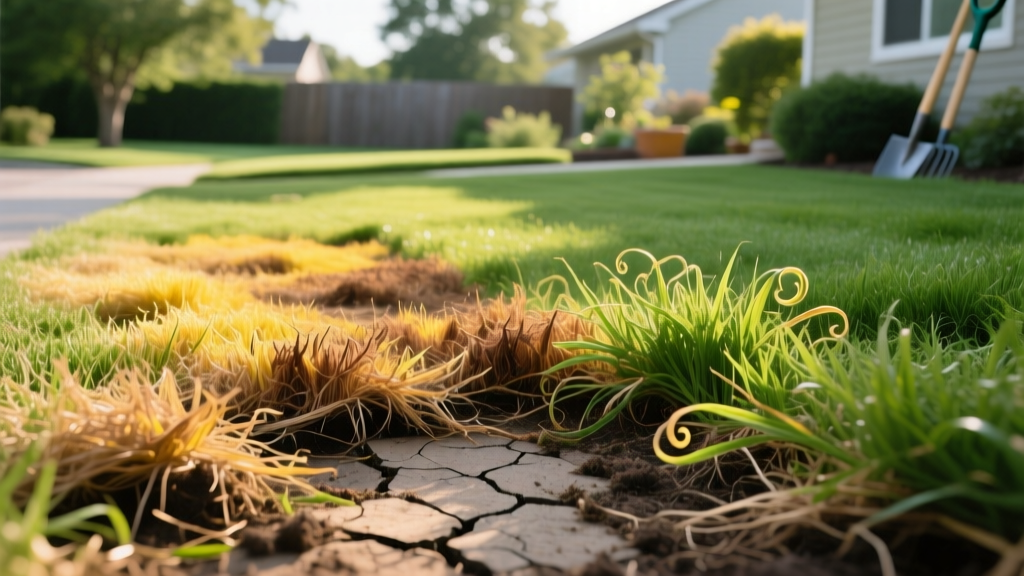
Nitrogen Burn Grass Recovery: Identification & Treatment
The Science of Osmotic Stress: Why Fertilizer Burns Grass
When homeowners search for solutions to nitrogen burn grass damage, they often mistakenly believe the fertilizer literally "heated up" and scorched the turf. In reality, fertilizer burn is a physiological condition driven by osmotic stress. Synthetic nitrogen sources are essentially mineral salts. When you apply a high-nitrogen fertilizer like Urea (46-0-0) to dry soil, the salt concentration in the soil solution rapidly exceeds the solute concentration inside the grass root cells.
Through the process of osmosis, water moves from an area of low salt concentration (inside the root) to an area of high salt concentration (the surrounding soil). This effectively pulls moisture out of the turfgrass roots, inducing a state of severe physiological drought even if the soil feels slightly damp. According to the Penn State Extension, this rapid dehydration causes cell collapse, manifesting as the crispy, yellow-brown leaf tips and streaks characteristic of fertilizer burn.
⚠️ Critical Edge Case: Applying synthetic nitrogen to warm-season grasses (like Bermuda or Zoysia) during their fall dormancy transition is a primary failure mode. Because the grass has stopped active transpiration, it cannot draw water to dilute the soil salts. The salts accumulate in the thatch layer, leading to severe winterkill and delayed spring green-up.
Symptom Matrix: Nitrogen Burn vs. Fungal Disease vs. Drought
Accurate diagnosis is the first step in turf recovery. Misidentifying nitrogen burn as a fungal pathogen like Brown Patch (Rhizoctonia solani) will lead to unnecessary fungicide applications while the salt damage worsens. Use this diagnostic matrix to confirm your lawn's condition.
| Diagnostic Factor | Nitrogen Burn | Brown Patch Fungus | Drought Stress |
|---|---|---|---|
| Onset Time | 24 to 48 hours post-application | 5 to 10 days of high humidity | Gradual over 7-14 days |
| Visual Pattern | Linear streaks matching spreader tracks | Circular patches with smoke rings | Uniform thinning or footprinting |
| Leaf Blade Inspection | Crispy, bleached tips; no distinct lesions | Tan lesions with dark brown borders | Folded or rolled leaf blades |
| Crown Health | White/firm (if caught early) or mushy (severe) | Often intact unless rot sets in | Firm, dormant, and white |
The 4-Step Nitrogen Burn Recovery Protocol
If you have confirmed osmotic stress from over-fertilization, immediate intervention is required to save the turfgrass crowns. Follow this exact sequence to leach the salts and stimulate recovery.
Step 1: Aggressive Soil Leaching (Hours 1-24)
You must physically flush the excess salts out of the root zone. Apply 1.5 to 2.0 inches of water to the affected areas within the first 24 hours of noticing the burn. This equates to roughly 1,000 to 1,300 gallons of water per 1,000 square feet. Use a sprinkler with a catch-can to measure the exact output. Do not rely on a quick 10-minute hose spray; the water must penetrate at least 6 inches deep to push the nitrates below the active root zone.
Step 2: The Crown Viability Test (Day 3)
After leaching, wait 48 hours and perform the "Tug and Slice" test. Gently pull on a handful of the burned grass. If it resists, the roots are holding. Take a pocket knife and slice a small plug of the turf. Inspect the crown (the base where the shoots meet the roots). If the crown is firm and white or pale yellow, the plant is alive and will push new growth in 14 to 21 days. If the crown is black, mushy, or pulls up with zero resistance, the tissue is dead and requires renovation.
Step 3: Apply Liquid Soil Conditioners (Day 4-7)
To accelerate the buffering of residual soil salts and stimulate root regeneration, apply a high-quality liquid humic acid. Products like Simple Lawn Solutions Liquid Humic/Fulvic (typically $35 for a 32 oz bottle treating up to 3,200 sq ft) or N-EXT Humic12 contain carbon-rich compounds that bind to excess soil cations, improving nutrient uptake and reducing osmotic shock. Apply at a rate of 3 oz per 1,000 sq ft using a hose-end sprayer.
Step 4: Targeted Overseeding for Dead Zones (Day 14+)
For areas where the crown viability test failed, you must reseed. Rake out the dead thatch, loosen the top 2 inches of soil, and apply a low-salt starter fertilizer. Scotts Turf Builder Starter Food for New Grass (24-25-4) is formulated with a lower salt index than standard winterizers. Seed with a matching cultivar (e.g., Jonathan Green Black Beauty Ultra for cool-season lawns) at a rate of 4 to 6 lbs per 1,000 sq ft, and keep the top inch of soil continuously moist for 21 days.
Fertilizer Salt Index: Choosing Burn-Safe Products
Prevention is vastly superior to recovery. Understanding the Salt Index of your nitrogen source allows you to match the fertilizer to your lawn's current environmental conditions. The UMass Amherst Turf Program and other agronomic institutions use the Salt Index to measure the osmotic pressure a fertilizer creates relative to sodium nitrate (which is set at a baseline of 100).
- Synthetic Urea (46-0-0): Salt Index of 75. Extremely high burn potential. Requires immediate watering-in and precise spreader calibration. Best used in liquid form or heavily coated slow-release prills.
- Ammonium Sulfate (21-0-0): Salt Index of 69. High burn potential, but excellent for lowering soil pH in alkaline environments. Never apply to dry, dormant turf.
- Methylene Urea / MUtech (39-0-0): Salt Index of 30-40. Moderate burn potential. A staple for professional summer applications on cool-season grasses when temperatures exceed 80°F.
- Milorganite (5-2-0): Salt Index of ~1. Virtually zero burn potential. This biosolid organic fertilizer will not burn grass even if spilled or double-applied, making it the premier choice for stressed lawns, summer heat, and slopes where runoff is a concern. (Cost: ~$22-$26 per 36 lb bag).
Spreader Calibration and the 50/50 Rule
The most common cause of nitrogen burn grass damage is overlapping spreader passes. When using a rotary spreader like the Scotts Elite Spreader (Model 76602), the throw pattern is rarely uniform; it drops heavily in the center and feathers at the edges. If you overlap the center of pass B with the center of pass A, you have effectively doubled the application rate in that stripe.
The Fix: Always employ the 50/50 criss-cross method. Calculate the total nitrogen required for your lawn, but set your spreader dial to deliver exactly half that amount. Walk your primary grid lines (North-South) applying the first 50%. Then, adjust your spreader to the exact same setting and walk the perpendicular grid lines (East-West) to apply the remaining 50%. This guarantees mathematical uniformity and eliminates the heavy overlap streaks that cause localized osmotic burn.
Frequently Asked Questions
Can I apply Epsom salts or Gypsum to fix fertilizer burn?
No. Epsom salts (magnesium sulfate) and Gypsum (calcium sulfate) are inherently salts. Adding them to a lawn suffering from osmotic stress will only increase the total dissolved solids (TDS) in the soil solution, exacerbating the physiological drought and worsening the burn. Stick to pure water leaching and carbon-based humic acids.
How long does it take for nitrogen-burned grass to turn green again?
If the crowns survived the initial osmotic shock and you leached the soil within 24 hours, you will see new green tillers emerging from the base of the plant in 14 to 21 days. Full canopy recovery to match the surrounding undamaged turf typically takes 4 to 6 weeks of active growing season weather.
Is liquid fertilizer less likely to burn grass than granular?
It depends entirely on the formulation and application rate. Liquid fertilizers like Urea Ammonium Nitrate (UAN 28-0-0 or 32-0-0) are highly soluble and immediately available to the plant. If applied at high rates in direct, hot sunlight without watering in, liquid nitrogen will cause severe foliar burn within hours. Granular slow-release fertilizers (like those coated with sulfur or polymer) are generally safer for novice applicators because they require soil microbial activity and moisture to break down the coating over 6 to 10 weeks.

