
Lawn Care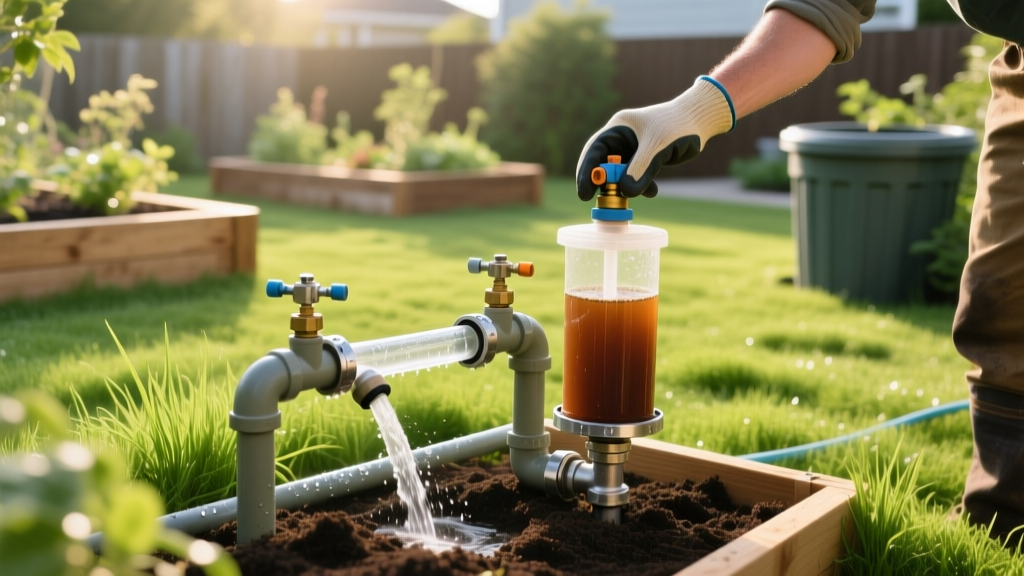
Building an Organic DIY Sprinkler System with Compost Tea Injection
Transitioning to an organic lawn care regimen requires more than just swapping synthetic granules for compost tea and kelp extract. Water management is the hidden variable that dictates the success of a chemical-free lawn. Standard irrigation setups are engineered for highly soluble synthetic salts. When you push particulate-heavy organic liquids like fish hydrolysate, humic acids, or aerated compost tea through standard PVC lines and tiny spray nozzles, two things happen: severe nozzle clogging and anaerobic biofilm buildup inside your pipes.
Building an organic-focused diy sprinkler system means rethinking how water and amendments are delivered to the soil profile. By integrating a dedicated fertigation manifold, large-orifice rotary nozzles, and smart cycle-and-soak programming, you can automate deep-root hydration and organic feeding while actively preventing the fungal diseases that plague poorly irrigated organic lawns.
The Core Components of an Organic-Focused Irrigation Manifold
A chemical-free lawn relies on soil biology to break down organic matter and feed the grass roots. Your irrigation system must support this biology without introducing anaerobic conditions or clogging. Here are the non-negotiable components for your organic manifold:
- Backflow Preventer: A pressure vacuum breaker (PVB) or reduced pressure zone (RPZ) assembly is legally required in most municipalities to prevent organic amendments from siphoning back into your municipal drinking water. Expect to spend $120 to $180 on a brass Watts or Febco model.
- Smart Controller with Flow Sensing: The Rachio 3 Smart Sprinkler Controller (approximately $229) integrates with local weather stations to skip watering after rain events. Overwatering is the primary cause of brown patch and dollar spot in organic lawns, making weather-based skipping critical.
- Venturi or Bypass Injector: To deliver compost tea or liquid kelp, you need an injector. The EZ-FLO 10010 Main Line Fertilizer Injector ($135) uses water pressure to siphon organic liquids from a reservoir tank directly into the mainline. Unlike cheap siphon mixers, it allows you to dial in the exact injection ratio (e.g., 1 ounce per gallon of water flow).
- Flush Valve Assembly: Organic liquids leave behind proteins and sugars that feed bacteria inside your PVC pipes. You must install a manual ball-valve flush line at the lowest point of your manifold to blow out organic residue after every feeding cycle.
Sizing and Layout for Deep Root Hydration
Organic lawns require deeper, less frequent watering to encourage roots to chase moisture down into the biologically active soil layers. According to the University of Minnesota Extension, lawns generally need 1 to 1.5 inches of water per week, but the delivery method drastically impacts soil absorption and runoff.
Standard fixed-spray nozzles dump water at 1.5 to 2.0 inches per hour. This exceeds the infiltration rate of most clay-heavy soils, leading to pooling, runoff, and the waste of your expensive organic liquid amendments. For an organic diy sprinkler system, you must switch to multi-stream rotary nozzles.
| Nozzle Type | Orifice Size | Precipitation Rate | Organic Suitability |
|---|---|---|---|
| Standard Fixed Spray | 0.05 - 0.10 inches | 1.5 - 2.0 in/hr | Poor: Tiny orifices clog instantly with fish emulsion and compost particulates. |
| Hunter MP Rotator | 0.15 - 0.25 inches | 0.4 - 0.6 in/hr | Excellent: Large orifices pass organics easily; slow rate prevents amendment runoff. |
| Toro Precision Rotary | 0.12 - 0.20 inches | 0.5 - 0.8 in/hr | Good: Reliable alternative to MP Rotators with similar slow-application benefits. |
By utilizing Hunter MP Rotators, you apply water and organic amendments slower than the soil's absorption rate. This ensures that your liquid humic acids and microbial inoculants penetrate deeply into the root zone rather than washing down the street, which the EPA WaterSense program identifies as a major source of residential water waste and nutrient pollution.
Step-by-Step: Integrating a Compost Tea Injector
Installing the injection system requires basic PVC plumbing skills. Here is how to integrate the EZ-FLO injector into your diy sprinkler system manifold without compromising water pressure.
- Locate the Injection Point: The injector must be installed after the backflow preventer and master valve, but before the zone valves. This ensures amendments are only pulled into the lines when a zone is actively running.
- Build the Bypass Loop: Cut a 24-inch section of 1-inch Schedule 40 PVC. Install two 90-degree elbows and a T-fitting to create a U-shaped bypass loop. The injector tank will connect to the two open ends of this loop using the included polyethylene tubing.
- Install the Flow Restrictor: Inside the bypass loop, install a ball valve. This valve restricts water flow through the loop, creating the pressure differential required to pull the heavy organic tea up from the tank and into the mainline.
- Connect the Tank and Calibrate: Fill the EZ-FLO tank with your brewed compost tea or liquid kelp. Turn on a single zone and slowly open the bypass ball valve. Watch the fluid level in the tank's clear sight tube. Adjust the valve until the tank empties at your desired rate (typically 1 quart of organic liquid per 10 minutes of watering).
Organic Pro Tip: Never put dry granular organic fertilizers (like feather meal or milorganite) into a liquid injection tank. They will not fully dissolve and will permanently clog the injector's internal siphon screen. Stick strictly to liquids like fish hydrolysate, liquid aeration solutions, and properly filtered compost tea.
Programming for Organic Disease Prevention
Chemical-free lawns lack the systemic fungicides used in conventional turf management to suppress diseases like Pythium blight and Rhizoctonia (brown patch). Therefore, your smart controller programming is your primary disease control mechanism.
The Cycle and Soak Method
Instead of running your zones for 45 minutes straight, which leads to saturation and anaerobic soil conditions, program your Rachio controller to use 'Cycle and Soak'. Divide your total watering time into three shorter cycles, spaced 45 minutes apart. This allows water and organic amendments to percolate deeply, keeping the soil surface relatively dry and hostile to fungal spores.
Timing the Injection
Always schedule your organic fertigation zones to run between 4:00 AM and 6:00 AM. This allows the grass blades to dry completely once the sun rises. Watering in the evening with organic liquids coats the grass blades in sugars and proteins from the compost tea, creating an all-you-can-eat buffet for fungal pathogens overnight.
Maintenance: Flushing Organic Biofilm
The most common failure point in an organic diy sprinkler system is the accumulation of biofilm. The natural bacteria present in compost tea and fish emulsion will colonize the interior walls of your PVC pipes and the filters inside your rotary nozzles. If left unchecked, this slime will restrict water flow and cause uneven coverage.
At the end of every organic feeding cycle, you must flush the lines. Turn off the injector tank valve, open the manual flush valve at the end of your manifold, and run the furthest zone for 3 minutes with clean water only. This pushes the remaining organic residue out of the lateral lines.
Once a month, perform a biological flush. Add food-grade 35% hydrogen peroxide to the injector tank (diluted down to a 3% solution in the tank water). Run this through the system. The hydrogen peroxide will oxidize and destroy the organic biofilm inside the pipes without harming the established soil biology once it breaks down into water and oxygen in the soil profile. Remove the nozzle filters from your MP Rotators twice a season and soak them in white vinegar to dissolve any mineral or organic scaling.
Frequently Asked Questions
Can I use aerated compost tea (ACT) in an automated sprinkler system?
Yes, but ACT must be heavily filtered through a 400-mesh screen before entering the injection tank. The brewing process creates large fungal hyphae and undecomposed organic particles that will easily block the internal screens of rotary nozzles. Non-aerated compost extracts (NCE) are generally safer for automated injection systems because they are less particulate-heavy.
Will the compost tea smell when sprayed through the sprinklers?
Properly brewed aerobic compost tea should smell like rich, damp forest soil. If your tea smells like sulfur or rotten eggs, it has gone anaerobic. Spraying anaerobic tea will not only smell terrible but will introduce harmful pathogens to your lawn. Always use an air pump to brew your tea for 24-36 hours and use it immediately after brewing.

