
Lawn Care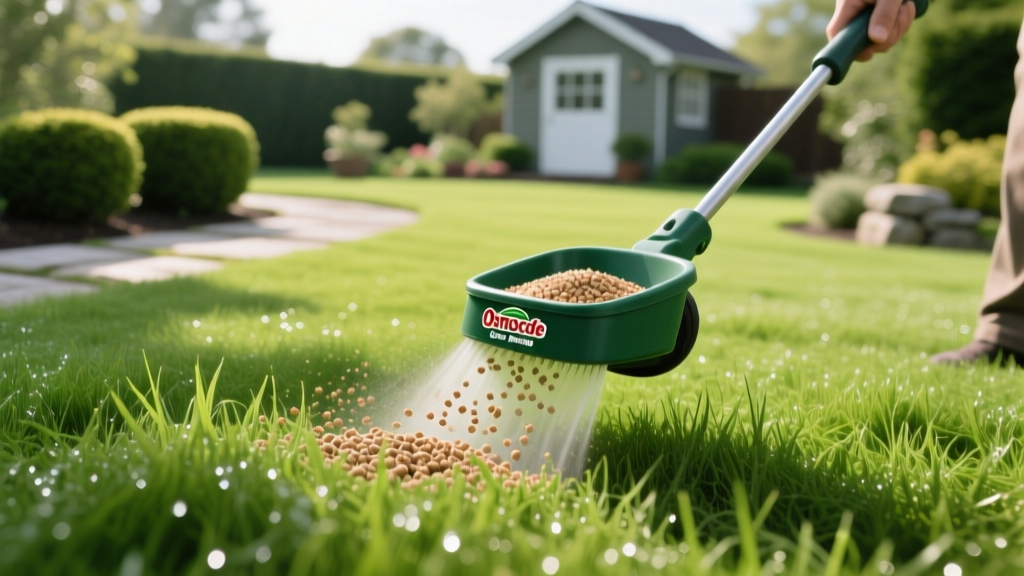
Osmocote Slow Release Fertilizer for Lawns: Application Guide
The Science Behind Polymer-Coated Turf Nutrition
When homeowners hear the name Osmocote, they typically picture potted petunias and indoor ficus trees. However, the underlying technology of Osmocote slow release fertilizer—specifically its patented alkyd resin coating—is highly effective for turfgrass when applied correctly. Unlike traditional quick-release synthetic fertilizers (like standard urea) that dump nutrients into the soil all at once, Osmocote utilizes a semi-permeable polymer membrane.
Water vapor penetrates the coating, dissolving the nutrient core inside the prill. As soil temperatures rise, osmotic pressure increases, pushing the dissolved nutrients out through microscopic pores in the resin. This temperature-dependent release curve perfectly mirrors the natural growth patterns of both cool-season and warm-season grasses. When the soil is cold and the grass is dormant, nutrient release slows to a trickle. When soil temperatures hit the optimal 65°F to 80°F range, the release rate accelerates to match the turf's peak metabolic demand.
The NPK Trap: Garden Formulas vs. Lawn Formulas
The most critical mistake homeowners make is applying standard Osmocote Plus (15-9-12) to their lawns. This formulation is engineered for ornamentals and container plants, which require high phosphorus (the '9' in the NPK ratio) for root establishment and blooming.
Established turfgrass requires very little phosphorus. Applying a high-phosphorus fertilizer to a lawn is not only a waste of money, but as of 2026, it is strictly regulated or outright illegal in many municipalities due to the risk of phosphorus runoff causing severe algae blooms in local waterways. According to the University of Minnesota Extension, established lawns should only receive phosphorus if a recent soil test explicitly indicates a deficiency.
| Product Line | NPK Ratio | Target Use | Phosphorus Risk | Cost per 5,000 sq ft |
|---|---|---|---|---|
| Osmocote Plus (Standard) | 15-9-12 | Ornamentals, Pots, Shrubs | High (Illegal in some zones) | ~$45.00 |
| Osmocote Smart Release Lawn | 20-0-5 | Established Turfgrass | Zero (Phosphorus-free) | ~$18.00 |
| Osmocote Outdoor & Indoor | 19-6-12 | Flowerbeds, Trees | Moderate | ~$32.00 |
Warning: Never use standard Osmocote Plus on your lawn. The high phosphorus content can trigger environmental violations, and the high potassium/sulfur ratios are unbalanced for turfgrass, potentially leading to nutrient lockout of essential micronutrients like iron and manganese.
Step-by-Step Application Rates for Turfgrass
To achieve a dense, dark green lawn without triggering excessive top growth (which leads to thatch buildup and frequent mowing), you must calibrate your application rate precisely. Osmocote Smart Release Lawn Food (20-0-5) is typically applied at a rate of 2.8 pounds per 1,000 square feet, delivering roughly 0.56 pounds of actual nitrogen per 1,000 square feet.
1. Calculate and Calibrate
Measure your lawn's exact square footage. Do not guess. For a standard Scotts EdgeGuard Mini rotary spreader, set the dial to 3.5. If you are using a drop spreader (which is highly recommended for small, geometric lawns to prevent prills from bouncing into flowerbeds), set the dial to 5.0. Always verify your spreader's specific calibration chart on the product packaging, as prill size can vary slightly between manufacturing batches.
2. The Crisscross Application Pattern
Polymer-coated prills are perfectly spherical and uniform, which is excellent for even distribution but makes it difficult to see where you have already walked. Apply half of your calculated fertilizer walking in vertical lines (North to South), and the second half walking in horizontal lines (East to West). This grid pattern eliminates striping and missed spots.
3. The Crucial Watering Step
While Osmocote does not wash away or leach into groundwater like raw urea, the osmotic release process requires initial moisture. Apply 0.25 inches of water immediately after spreading. This wets the resin coating, initiating the vapor exchange without flooding the soil or causing the prills to float into storm drains.
Osmocote vs. Competing Slow-Release Technologies
Understanding how Osmocote stacks up against other slow-release lawn fertilizers helps you decide if it is the right tool for your specific soil and climate. The UMass Amherst Turf Program categorizes slow-release fertilizers into two main camps: coated synthetics and organic/biosolids.
- Osmocote (Resin-Coated): Release is dictated strictly by soil temperature. It is highly predictable and will not burn grass even in high heat. Best for homeowners who want a 'set it and forget it' feeding that lasts 3 to 4 months.
- Milorganite (Biosolid): Release is dictated by microbial activity. Soil microbes must break down the organic matrix to release nitrogen. If the soil is cold, dry, or biologically dead, Milorganite will sit dormant. It requires moist, warm soil to function.
- Polyon / Sulfur-Coated Urea (SCU): SCU relies on microbial degradation of the sulfur shell and physical cracking. It is less predictable than Osmocote's resin coating and can sometimes 'dump' nutrients if the coating cracks under foot traffic or mower wheels.
Troubleshooting Common Application Mistakes
Even with a premium product like Osmocote, improper lawn care practices can negate the benefits or create localized issues.
Mowing Too Soon After Application
Osmocote prills are hard and roughly 2mm to 3mm in diameter. If you apply the fertilizer and mow the lawn the next day, the mower blades will physically shatter the resin coating. This instantly converts a 3-month slow-release fertilizer into a quick-release fertilizer, risking localized nitrogen burn and defeating the purpose of the product. Rule of thumb: Mow your lawn immediately before applying Osmocote, and wait at least 5 to 7 days before your next mow to allow the prills to settle into the thatch layer and soil surface.
Hardscape Staining
The resin coating itself is inert, but the nutrients inside (particularly iron and manganese micronutrients) can oxidize and leave rust-colored stains on concrete driveways and patios if swept into puddles. Always use a leaf blower or stiff broom to immediately blow stray prills off hardscapes and back onto the turf before watering.
Applying to Dormant Grass
Because Osmocote's release mechanism is tied to temperature, applying it to a fully dormant, frozen, or snow-covered lawn is a waste of product. The prills will sit on the surface, vulnerable to being eaten by birds or washed away by spring meltwater before the soil warms enough to trigger the osmotic release. Wait until soil temperatures consistently reach 55°F at a 2-inch depth (typically mid-April for cool-season grasses, and late May for warm-season grasses) before your first spring application.
Frequently Asked Questions
Can I use Osmocote on newly seeded lawns?
It is not recommended for the first 4 weeks. New grass seedlings require immediate, easily accessible phosphorus for root development (which Osmocote Lawn Food lacks) and quick nitrogen for initial blade growth. Use a specialized starter fertilizer (like a 24-25-4) for seeding, and transition to Osmocote Smart Release Lawn Food for the second feeding once the grass has been mowed three times.
Do the empty resin shells degrade in the soil?
The alkyd resin shells do not biodegrade quickly. They remain in the soil as microscopic, inert husks long after the nutrients are depleted. While they are non-toxic and do not harm soil biology, they do not contribute to soil organic matter. If you are strictly focused on building soil carbon and organic matter, you should alternate Osmocote applications with compost top-dressing or organic fertilizers.
How long does an application actually last?
The label claims up to 4 months, but this is heavily dependent on your local climate. In the deep South, where soil temperatures frequently exceed 85°F, the osmotic pressure increases, and the prills may deplete in 8 to 10 weeks. In cooler northern climates with mild summers, a single spring application can easily sustain the turf for 12 to 14 weeks.

