
Lawn Care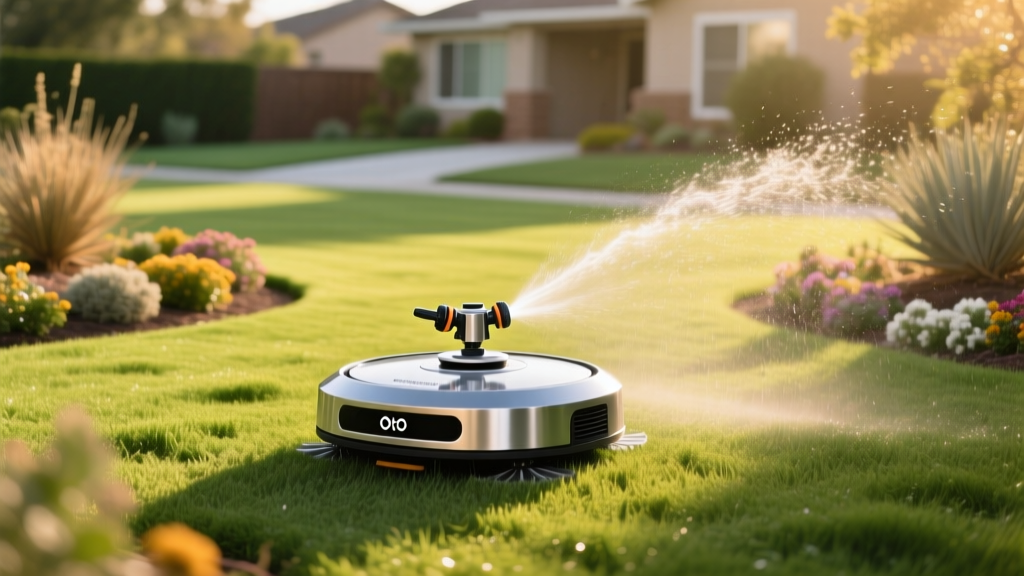
OtO Smart Sprinkler Review 2026: Above-Ground Robotic Irrigation
The Shift to Above-Ground Robotic Irrigation
For decades, achieving precise, automated lawn irrigation meant one thing: trenching your yard, laying PVC pipes, and spending upwards of $3,500 to $5,000 on an in-ground sprinkler system. For renters, homeowners with complex hardscaping, or those dealing with rocky soil, traditional in-ground systems are either impossible or financially unviable. Enter the OtO smart sprinkler, an above-ground robotic irrigator that has fundamentally disrupted the residential watering market. By combining GPS-assisted boundary mapping, weather-adaptive algorithms, and precision nozzle targeting, the OtO system eliminates the need for underground plumbing while delivering the efficiency of a high-end smart controller.
According to the EPA WaterSense program, weather-based smart irrigation controllers can reduce outdoor water use by up to 20% compared to traditional clock-based timers. The OtO system takes this a step further by physically aiming water only at the grass, virtually eliminating the sidewalk and driveway runoff that plagues traditional oscillating and impact sprinklers. But how does it perform under real-world fluid dynamics and varying yard topographies?
OtO Smart Sprinkler Hardware & Technical Specifications
Before mapping your yard, it is critical to understand the physical limitations and requirements of the OtO hardware. The unit is essentially a motorized, weather-sealed turret that connects directly to a standard outdoor hose bib.
| Specification | Technical Detail |
|---|---|
| Max Coverage Area | Up to 3,000 sq. ft. per unit (highly dependent on PSI/GPM) |
| Required Water Pressure | 40 PSI to 80 PSI (Optimal performance at 60+ PSI) |
| Minimum Flow Rate | 6 Gallons Per Minute (GPM) |
| Power Source | Integrated Solar Panel + 15ft AC Power Adapter (backup) |
| Connectivity | Wi-Fi (2.4GHz) + Bluetooth Low Energy (BLE) |
| Hose Connection | Standard 3/4-inch Garden Hose Thread (GHT) |
| Mapping Precision | Within 6 to 12 inches of physical boundaries |
| Retail Price (2026) | $349 per single unit / $599 for dual-zone bundle |
Installation and Zone Mapping: A Step-by-Step Breakdown
Unlike in-ground systems that require professional surveying, the OtO setup is entirely user-driven via the companion smartphone app. The mapping process relies on a combination of your phone's GPS and visual SLAM (Simultaneous Localization and Mapping) to create a digital twin of your lawn.
- Faucet Prep and Backflow Prevention: Before attaching the OtO, ensure your outdoor faucet has a proper vacuum breaker or backflow preventer installed. This is a code requirement in most municipalities to prevent contaminated lawn water from siphoning back into your home's drinking supply.
- Hose Selection: Connect the OtO using a high-quality, kink-resistant rubber hose. Avoid expandable fabric hoses, as they restrict flow rates and cause severe pressure drops at the nozzle.
- Perimeter Walking: Open the OtO app and select 'Map New Zone'. Walk the exact perimeter of your lawn while holding your phone at waist height. The app records the boundary, allowing you to create 'keep-out' zones for garden beds, patios, and tree trunks.
- Solar Alignment: Position the unit so its integrated solar panel faces true South (in the Northern Hemisphere) to ensure the internal lithium-ion battery remains charged through the peak watering hours of early morning.
Fluid Dynamics: Pressure, Coverage, and Edge Cases
The most common point of failure for above-ground smart sprinklers is not the software, but the homeowner's water supply. The OtO relies on your home's dynamic water pressure to throw water accurately. If your home operates on a well system with a weak pressure tank, or if you are using a 100-foot length of narrow 5/8-inch hose, you will experience severe pressure degradation.
Expert Tip: The Hose Diameter Bottleneck
Water flowing through a 50-foot 5/8-inch hose at 6 GPM will lose approximately 12 PSI due to friction. If your faucet outputs 50 PSI, the OtO only receives 38 PSI, resulting in a shortened throw distance and uneven distribution. Always use a 3/4-inch heavy-duty rubber hose to minimize friction loss, or keep the OtO unit within 25 feet of the faucet.
Water flowing through a 50-foot 5/8-inch hose at 6 GPM will lose approximately 12 PSI due to friction. If your faucet outputs 50 PSI, the OtO only receives 38 PSI, resulting in a shortened throw distance and uneven distribution. Always use a 3/4-inch heavy-duty rubber hose to minimize friction loss, or keep the OtO unit within 25 feet of the faucet.
Furthermore, turfgrass health relies on deep, infrequent watering. As noted by Penn State Extension, lawns generally require 1 to 1.5 inches of water per week to encourage deep root growth and drought resistance. The OtO app includes a 'Catch Cup Test' feature, allowing you to place standard tuna cans across your zone to measure exactly how many minutes the robot needs to run to deliver that precise 1-inch threshold, adjusting automatically for local evapotranspiration (ET) rates.
OtO vs. Traditional In-Ground Systems vs. Oscillating Sprinklers
How does the OtO stack up against the alternatives when factoring in installation effort, long-term maintenance, and water efficiency? Below is a comparative matrix for a standard 5,000 sq. ft. suburban lawn.
| Feature | OtO Smart Sprinkler (2 Units) | Traditional In-Ground (PVC) | Standard Oscillating Sprinkler |
|---|---|---|---|
| Upfront Cost | ~$700 | $3,500 - $5,500 | $30 - $60 |
| Installation Time | 30 Minutes | 2 - 4 Days (Trenching) | 2 Minutes |
| Water Efficiency | High (Targeted, Weather-based) | High (If properly zoned) | Low (High wind drift & runoff) |
| Winterization | Detach and store indoors | Professional blow-out ($100+/yr) | Detach and store indoors |
| Trip Hazard | Moderate (Hose on lawn) | None (Underground) | High (Hose on lawn) |
Winterization and Long-Term Maintenance
Because the OtO sits above ground and retains a small amount of water inside its internal solenoid valve and nozzle manifold, it is highly susceptible to freeze damage. Leaving the unit outdoors during freezing temperatures will crack the internal ABS plastic housing, voiding the warranty.
Winterization Protocol:
- In late autumn, run the 'Winterize' cycle in the app, which opens all valves to drain residual water.
- Disconnect the unit from the hose and store it in a climate-controlled garage or basement.
- Clean the internal mesh filter located at the hose thread connection. Municipal water lines often flush sediment in the fall, which can clog the OtO's micro-nozzles and cause erratic spray patterns.
- Wipe down the solar panel with a damp microfiber cloth to remove pollen and dust buildup, ensuring maximum charge efficiency for the following spring.
Final Verdict: Who Should Buy the OtO System?
The OtO smart sprinkler is not a replacement for a fully engineered, multi-zone in-ground system on a massive 1-acre estate. However, for urban and suburban homeowners with lawns under 6,000 square feet, it represents a massive leap in irrigation technology. It is the definitive choice for renters who cannot alter the property's landscaping, homeowners dealing with mature tree roots that make trenching impossible, and eco-conscious users looking to eliminate hardscape water waste. At $349 per unit, the ROI is realized within two to three seasons through reduced water bills and the elimination of professional winterization fees.

